Xanthosoma violaceum
Xanthosoma violaceum Care Guide
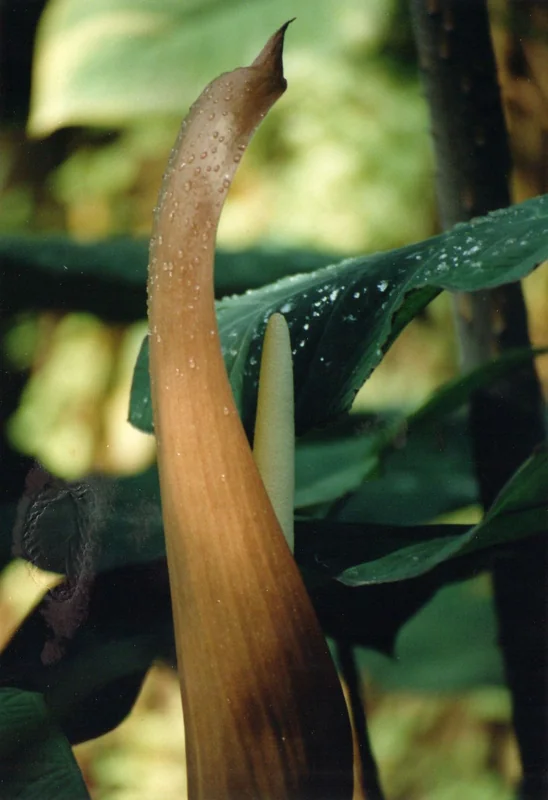 Featured photoxanthosoma-violaceum.jpg
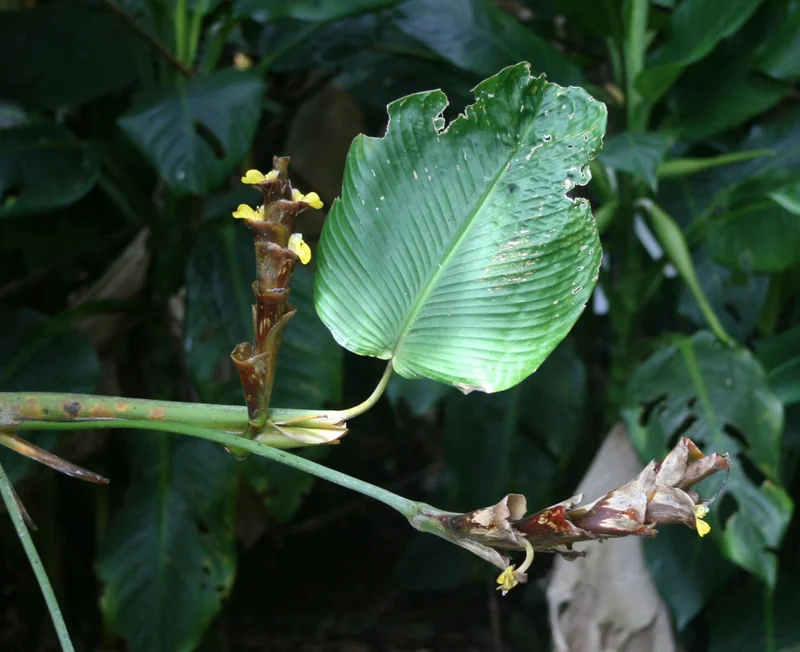
Xanthosoma violaceum is a striking Caribbean aroid that combines broad, blue-green arrowhead leaves with dramatically dark, purple-to-nearly-black petioles for a two-toned contrast rarely seen in other large houseplants. Native to the Caribbean, it has been cultivated across tropical America for its ornamental appeal. Indoors it thrives in bright, humid conditions and grows vigorously in summer, producing impressive leaves up to 60 cm across.
Care facts at a glance
- Light
- Bright indirect
- Water
- Keep consistently moist during the growing season; water every 3–5 days. Reduce somewhat in winter.
- Humidity
- 60–85 %
- Temperature
- 18–35 °C
- Soil
- Rich, well-draining potting mix with added perlite; avoid heavy clay-based soils.
- Origin
- Caribbean region; cultivated and naturalised throughout tropical America.
- Mature size
- 0.9 to 1.3 m tall; leaves 40–60 cm across.
Overview
Xanthosoma violaceum Schott was described in 1832. The violet-to-black anthocyanin pigmentation in the petioles is the result of high concentrations of anthocyanin compounds, the same pigments responsible for purple colouration in red cabbage and blueberries. These pigments intensify under higher light levels and in cooler temperatures, which is why the purple colouration is often most dramatic on plants grown in bright, slightly cool conditions. The blue-green hue of the leaf blade results from a wax coating that scatters short-wavelength light.
Care Priorities
- Bright, indirect light maximises both the blue-green leaf colour and the intensity of the purple petioles.
- Provide a large container (30–40 cm wide) with excellent drainage to support the vigorous root system.
- Feed generously through the growing season — use a balanced fertiliser with micronutrients to maintain colour intensity.
- The plant will slow in winter; reduce watering and feeding, but avoid complete dormancy if growing indoors year-round.
Common Problems
Fading of the purple petiole colour usually indicates insufficient light or nitrogen deficiency. Move to a brighter position and increase feeding frequency. Yellowing leaves in summer that are not the oldest leaves on the plant point to root issues — check for root rot or nutrient lockout from pH imbalance. Aphids commonly colonise new growth in spring; remove with a strong water jet or treat with insecticidal soap. Leaf edge browning is usually a humidity or salt build-up issue.
Sources & further reading (2)
- botanical-garden — accessed 2026-05-27
- encyclopedia — accessed 2026-05-27
Frequently asked questions
Does the purple colour fade over time?
The purple petiole colour can fade if light levels drop. Anthocyanin production is light-dependent — move the plant closer to a bright window to restore the purple intensity. New leaves will have the most vivid colouration.
Can I grow it outdoors in summer?
Yes — a partly shaded position outdoors in summer produces extremely rapid growth and the most vivid colouration. Bring it inside before temperatures drop below 15 °C in autumn.
Is it the same as 'Black Magic' elephant ear?
No. 'Black Magic' is a cultivar of Colocasia esculenta with nearly black leaves throughout. X. violaceum has blue-green leaves with purple petioles. The two genera are related but distinct, and the colour distribution is the clearest visual differentiator.