Calathea lutea
Calathea lutea Care Guide
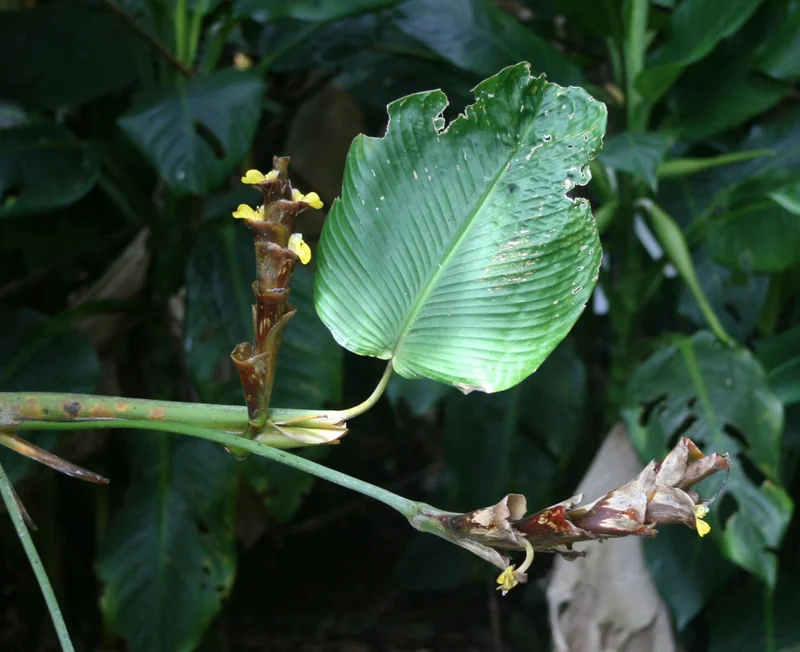 Featured photocalathea-lutea.jpg
Calathea lutea is one of the largest members of the Marantaceae family, producing enormous waxy, paddle-shaped leaves that can reach 120 cm or more in length in ideal conditions, held on long upright petioles. Native to tropical forests from Mexico to Brazil, it is widely cultivated across the tropics as an ornamental and is grown indoors in large, bright spaces as a dramatic specimen plant. Unlike smaller calathea relatives, it tolerates a wider range of light and humidity conditions, making it more adaptable and easier to maintain than most of its family.
Care facts at a glance
- Light
- Bright indirect
- Water
- Water when the top 3 to 4 cm of the substrate has dried; every 7 to 14 days depending on pot size and conditions.
- Humidity
- 55–80 %
- Temperature
- 18–32 °C
- Soil
- Rich, free-draining mix: loam, compost, and perlite in equal parts; large pots are needed at maturity.
- Origin
- Tropical forests from southern Mexico to Brazil and the Caribbean.
- Mature size
- 1.5 to 3 m tall outdoors; 1 to 1.8 m indoors; leaves 60 to 120 cm long.
Overview
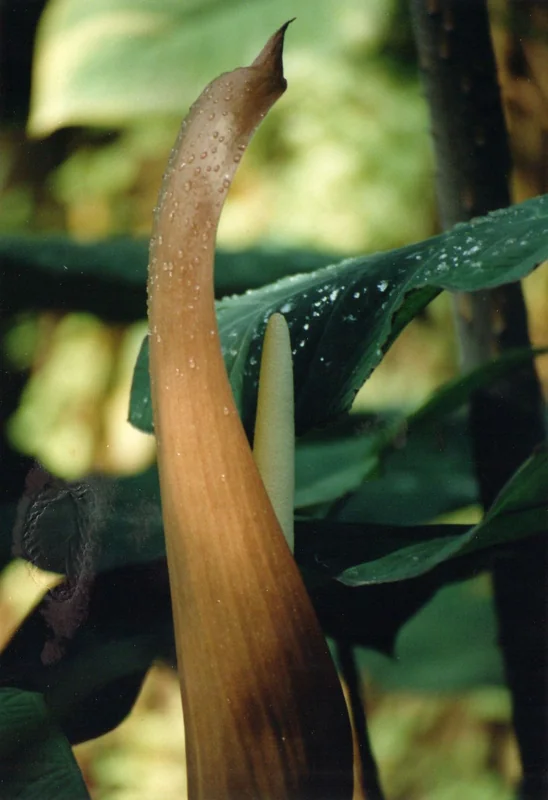
Calathea lutea has not been reclassified to Goeppertia and retains its original Calathea placement in current taxonomy. The species name refers to the yellow colouration of parts of the plant rather than the leaf, which is uniformly green above and waxy-white below. The waxy underside surface is caused by a thick layer of epicuticular wax that reduces water loss from the large leaf area. In its native range the leaves are harvested and used to wrap tamales and other foods due to the food-safe, water-resistant wax coating. The plant produces small yellow flowers subtended by large bracts — the 'cigar' that gives it one of its common names.
Care Priorities
- Bright indirect light is necessary to support the high growth rate and enormous leaf size; it tolerates more light than smaller calatheas.
- Regular, deep watering is essential — large leaves and pots dry faster than small plants; check frequently.
- Its tropical origin means it dislikes temperatures below 18 °C; protect from cold draughts in winter.
- The large leaf area needs regular wiping to remove dust and maintain optimal light capture; use a soft damp cloth.
Common Problems
Leaf margins turning brown and dry indicate low humidity or inconsistent watering; increase humidity above 55 percent and water more regularly. The large leaves are vulnerable to spider mites in dry conditions — inspect undersides regularly and treat with neem oil at the first sign of webbing. Root rot from waterlogging is possible if the pot is too small or drainage is inadequate; use a large, well-draining pot and never allow the plant to sit in standing water. Scale insects on petioles may be mistaken for part of the plant texture; remove with isopropyl alcohol.
Sources & further reading (2)
- botanical-garden — accessed 2026-05-08
- encyclopedia — accessed 2026-05-08
Frequently asked questions
How large can it grow indoors?
With sufficient space, light, and humidity, it can reach 1 to 1.8 m indoors. In a large, bright conservatory or atrium it can approach its outdoor size of 2 to 3 m.
Is the leaf waxy coating harmful?
Not at all — the wax is non-toxic and is the same substance used to wrap traditional foods in its native range. It simply serves as a protective water barrier for the large leaf surface.
Does it move its leaves like other calatheas?
Yes — it has the same pulvini mechanism and folds its leaves upward at night, though the movement is less dramatic to observe given the enormous leaf mass.