Oncidium flexuosum
Oncidium flexuosum Care Guide
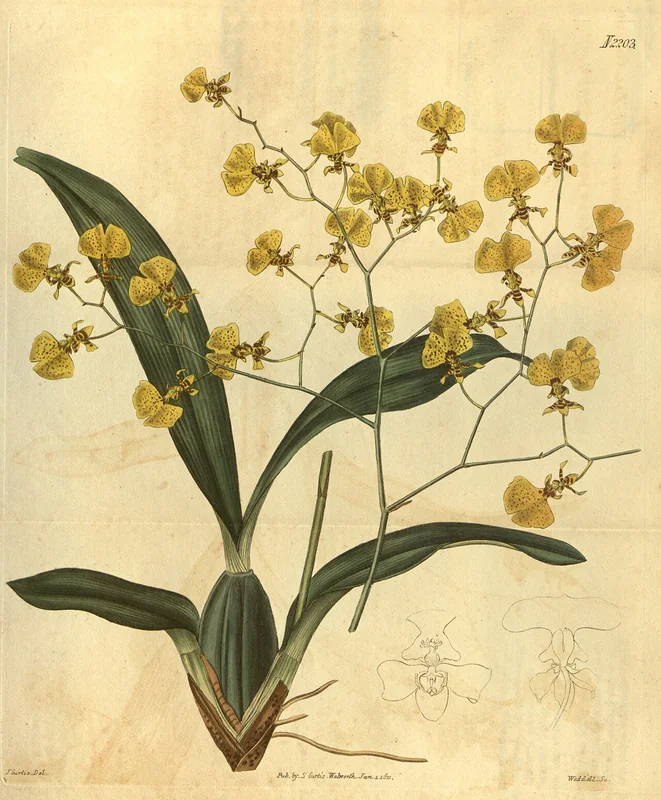 Featured photooncidium-flexuosum.jpg
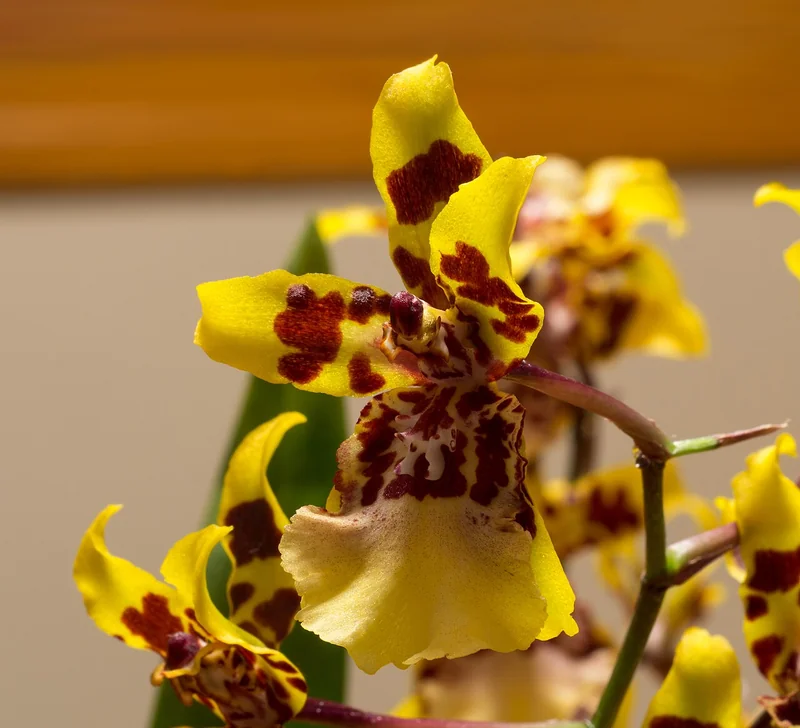
Oncidium flexuosum is a vigorous, free-flowering South American oncidium producing long, arching, highly branched panicles of numerous small, bright yellow flowers with brown markings — each resembling a tiny dancer in a skirt, giving rise to the common name 'dancing dolls'. Native to Brazil, Uruguay, and Argentina, it grows as an epiphyte and lithophyte and tolerates a wide range of temperatures and light conditions. Its prolific bloom output and resilient constitution make it one of the most rewarding oncidiums for home growers.
Care facts at a glance
- Light
- Bright indirect
- Water
- Water thoroughly when the bark substrate dries; every 7 to 10 days in summer, every 14 to 21 days in winter.
- Humidity
- 45–70 %
- Temperature
- 12–32 °C
- Soil
- Coarse bark chips in a free-draining pot; terracotta promotes evaporation and air circulation around roots.
- Origin
- Brazil, Uruguay, and Argentina; epiphytic in seasonal subtropical forests.
- Mature size
- Pseudobulbs 8 to 15 cm; flower panicles 60 to 120 cm long with hundreds of flowers.
Overview
Oncidium flexuosum was described by Sims in 1813 and the species name refers to the flexible, zigzagging nature of the flower branches. It is one of a group of compact-pseudobulbed oncidiums from southern South America that tolerate cooler and drier conditions than their Amazon basin relatives. In cultivation it is fast-growing relative to many orchids, producing new pseudobulbs annually that mature by autumn and then initiate flower spikes. Each panicle branches repeatedly, and the dozens to hundreds of small yellow flowers open over several weeks, creating a spectacle quite disproportionate to the modest plant size.
Care Priorities
- Bright, indirect light — with some morning direct sun being beneficial — promotes the vigorous pseudobulb development needed for reliable flowering.
- A temperature drop of 5 to 8 °C at night in late summer helps initiate flower spikes; avoid artificially maintaining warm temperatures year-round.
- After a new pseudobulb has fully matured, reduce watering slightly and stop nitrogen feeding to signal the plant into spike initiation.
- Provide a stake or cane early as the flower panicle elongates; the branched structure is top-heavy and needs support before it becomes unwieldy.
Common Problems
Black spotting on leaves that enlarges and becomes sunken is bacterial brown rot, exacerbated by water sitting on leaf surfaces; improve air circulation, keep leaves dry, and remove affected tissue. Spider mites establish in hot, dry conditions and cause yellowing stippling on pseudobulbs and leaves; increase humidity and treat with neem oil. Root rot from a too-fine, water-retaining substrate is common; use only coarse bark and repot every 2 years. Failure to produce a spike after pseudobulb maturation usually means insufficient light or the absence of a seasonal temperature differential.
Sources & further reading (2)
- botanical-garden — accessed 2026-05-08
- encyclopedia — accessed 2026-05-08
Frequently asked questions
How many flowers does a mature plant produce?
A well-grown mature plant with multiple pseudobulbs can produce several simultaneous panicles, each with 50 to 200 or more flowers. The total flower count can exceed 1000 on a vigorous specimen.
Can I divide it?
Yes — divide in spring just as new growth begins, ensuring each division has at least three pseudobulbs. Smaller divisions may not flower for one to two seasons while they rebuild vegetative mass.
How long does it stay in bloom?
The panicle opens sequentially from base to tip over 2 to 4 weeks, and individual flowers last 2 to 4 weeks after opening. Total bloom time can be 5 to 8 weeks per panicle.