Kohleria eriantha
Kohleria eriantha Care Guide
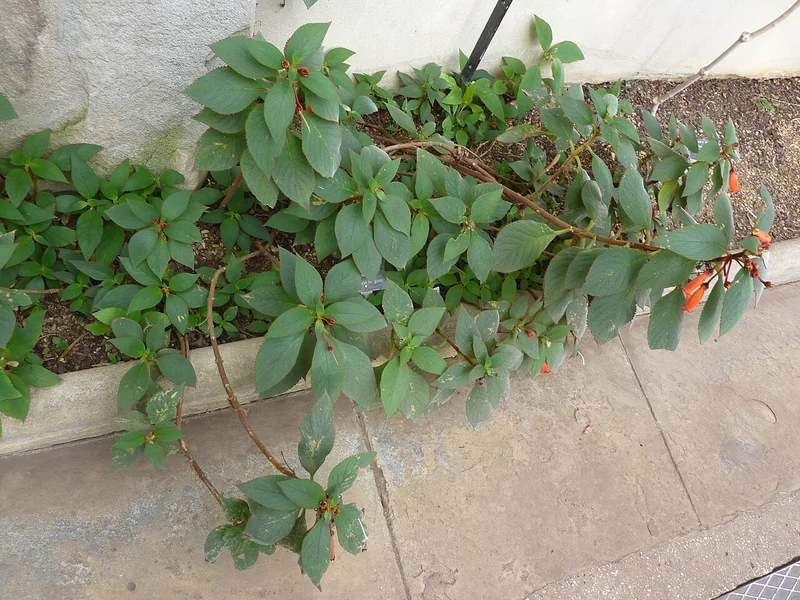 Featured photokohleria-eriantha.jpg
Kohleria eriantha is a rhizomatous gesneriad from Colombia with softly hairy, velvety, dark-green leaves and brilliantly coloured tubular flowers — deep scarlet to orange-red on the outside, yellow with red spots inside. It grows from a creeping rhizome and produces upright, hairy stems bearing successive clusters of flowers over a long season. One of the more striking kohleria species, it is more tolerant of standard indoor conditions than many tropical gesneriads and produces a particularly vivid floral display.
Care facts at a glance
- Light
- Bright indirect
- Water
- Water every 7 to 10 days in the growing season; reduce to every 3 weeks in winter rest.
- Humidity
- 50–75 %
- Temperature
- 15–28 °C
- Soil
- Free-draining, rich mix: peat-free potting compost with 20% perlite.
- Origin
- Humid montane forests of Colombia and adjacent Venezuela.
- Mature size
- Upright stems to 50–70 cm; the rhizome spreads and fills a container over time.
Overview
Kohleria eriantha (Benth.) Hanst. was described in its current combination in 1854. The genus is named for Michael Kohler, a Swiss botanist. K. eriantha is native to the cloud forests of the Colombian Andes, growing in the humid, filtered-light conditions of forest margins and rocky slopes. The tubular flower shape and scarlet-orange colouration are classic hummingbird-pollination adaptations. In cultivation the creeping rhizome spreads vigorously and the plant can fill a container relatively quickly; division every 2 years maintains vigour. It is closely related to the popular Columnea and Aeschynanthus but has distinct hairy, upright stems rather than a trailing habit.
Care Priorities
- Water at soil level only — the hairy leaves hold moisture and develop Botrytis within days if wetted.
- Regular high-phosphorus feeding during the growing season maintains the prolific flowering habit.
- After flowering, cut stems back to the rhizome level to promote fresh, vigorous regrowth with new flower stems.
- A winter rest (reduce temperature to 15–18 °C, reduce watering) from November to February allows the rhizome to consolidate; new stems emerge rapidly in spring warmth.
- Repot or divide every 2 years in spring to maintain vigour in the rhizome.
Common Problems
Botrytis (grey mould) on the hairy leaves or flowers occurs in wet, stagnant conditions; ensure good airflow and never wet the foliage. Aphid infestations on new growth and flower buds in spring are common; treat with insecticidal soap. Thrips damage the velvet leaf surface, leaving pale stippled patches; treat with systemic insecticide. The rhizome overgrowing its container causes the plant to become potbound and reduces flowering; divide and repot in fresh mix. Leggy, sparse stems in winter are normal during the rest period; cut back and allow regrowth in spring.
Sources & further reading (2)
- botanical-garden — accessed 2026-05-27
- encyclopedia — accessed 2026-05-27
Frequently asked questions
What is a rhizome and how do I divide it?
The rhizome is a horizontal, underground (or at-soil-level) stem that stores energy and produces new shoots. To divide, unpot the plant in spring, gently pull apart the rhizome sections (each section should have at least one growing point or bud), and pot each section separately in fresh mix. Water sparingly until new growth appears.
How long is the flowering season?
In good conditions (bright indirect light, regular feeding, warm temperatures), K. eriantha can flower from spring through to late autumn — potentially 5–7 months. Each stem flowers, then can be cut back to encourage another flowering stem from the rhizome. Multiple stems can be maintained simultaneously for continuous colour.
Is it related to African violets?
Distantly — both Kohleria and Saintpaulia (African violets) belong to the family Gesneriaceae, but they are in different subfamilies and tribes. Kohleria belongs to the tribe Gloxinieae (neotropical gesneriads), while Saintpaulia is in the Afro-Asian tribe Epithemateae. The care requirements differ considerably.