Woodwardia radicans
Woodwardia radicans Care Guide
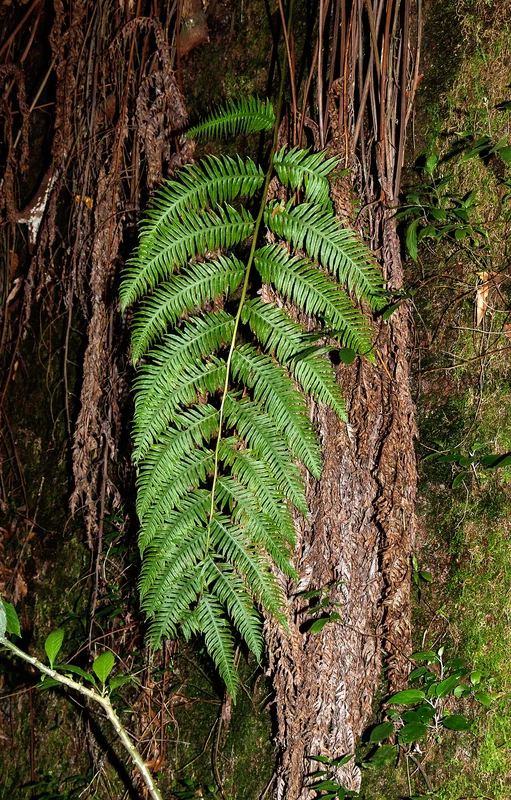 Featured photowoodwardia-radicans.jpg
Woodwardia radicans, the European Chain Fern, is one of the most dramatic ferns available for cultivation, producing enormous, arching, pinnate fronds up to 2 m in length that form a sweeping canopy of dark, glossy green. Native to the Macaronesian islands and the Atlantic coast of southern Europe, it thrives in cool, humid shade and is particularly notable for producing plantlets (bulbils) at the tips of mature fronds that can be rooted to propagate new plants. It makes an exceptional large-space statement fern.
Care facts at a glance
- Light
- Low light
- Water
- Keep the medium consistently moist; water every 3–5 days in warm months. Reduce slightly in winter but never allow to dry completely.
- Humidity
- 70–95 %
- Temperature
- 5–24 °C
- Soil
- Rich, moisture-retentive peat or coco-based mix with good drainage; slightly acidic pH 5.5–6.5.
- Origin
- Shaded ravines, stream margins, and laurel forests of Macaronesia (Azores, Canary Islands, Madeira) and southwestern Europe.
- Mature size
- 1–2 m tall; fronds can reach 2 m in length in ideal conditions.
Overview
Woodwardia radicans (L.) Sm. was described in 1793. The genus is named for Thomas Woodward, an 18th-century British botanist. The species name 'radicans' means 'rooting', referring to the distinctive bulbils (plantlets with tiny fronds and roots) that form on the upper surface near the tip of mature fronds. In nature, when a long frond arches down and the tip touches the ground, the bulbil takes root, creating a new plant — a fascinating and ancient vegetative propagation strategy.
Care Priorities
- This fern requires consistent high humidity (above 70%) — it is best in bathrooms, conservatories, or rooms with a humidifier.
- Cool temperatures (below 20 °C) are preferred; it performs poorly in centrally heated rooms above 22 °C.
- Provide a large, wide container to accommodate the spreading rhizome; a half-barrel or large floor pot is ideal for mature specimens.
- Fronds are fragile and should not be moved once the plant is positioned — disturbing the fronds causes them to yellow and die.
Common Problems
Browning frond tips are the most common problem and indicate low humidity or draughts. Increase humidity immediately and move away from heating vents. Entire fronds yellowing rapidly usually signals overheating above 24 °C or root disturbance. Scale insects are particularly damaging on this fern; inspect the undersides of fronds regularly and treat with horticultural oil spray. Vine weevil larvae attack the rhizome from below — check the roots when repotting and apply biological control nematodes if damage is found.
Sources & further reading (2)
- botanical-garden — accessed 2026-05-27
- encyclopedia — accessed 2026-05-27
Frequently asked questions
How do I root the bulbils?
When a bulbil at the frond tip has 2–3 small frondlets of its own (typically in summer), pin the frond tip against a pot of moist, peaty compost placed beside the parent plant. The bulbil will root within 3–4 weeks, after which you can cut the connecting frond and separate the new plant.
Does it need a very large pot?
Yes for a mature specimen. The spreading rhizome needs space to expand, and the long, arching fronds require surrounding headroom. A pot of 40–50 cm diameter and sufficient height clearance of 2+ m is appropriate for a large plant.
Can it grow outdoors in mild climates?
Yes — in mild maritime climates (e.g., the UK southwest, Brittany, northwest Spain) it can be grown in sheltered, shaded outdoor positions and reaches its maximum size of 2 m frond length in such conditions.