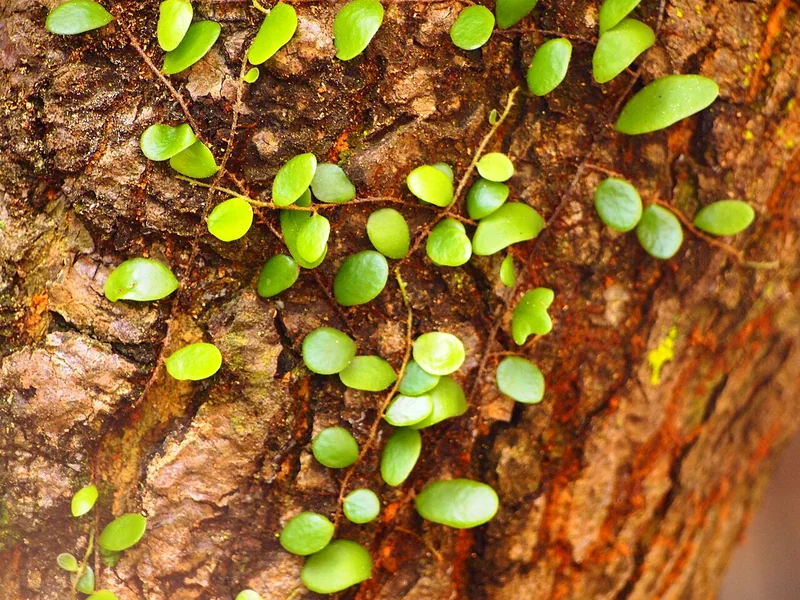
Pyrrosia piloselloides is a diminutive epiphytic fern from the tropical forests of Southeast Asia, producing tiny, round to oval fronds just 1–3 cm across on slender, wiry rhizomes that explore any surface they encounter. Its compact scale makes it perfect for vivarium backgrounds, small mounted cork-bark displays, and miniature plant arrangements. It tolerates variable humidity and light conditions better than most small ferns, making it accessible to growers without specialised humidity equipment.
Care facts at a glance
- Light
- Low light
- Water
- Keep the mounting medium consistently moist; mist daily in dry environments. In terrariums, water every 7–10 days.
- Humidity
- 50–85 %
- Temperature
- 16–30 °C
- Soil
- Epiphytic mount (cork bark, tree fern slab) with sphagnum moss packing; or fine orchid bark mix if potted.
- Origin
- Tropical humid forests of Southeast Asia, including Malaysia, Indonesia, and Thailand.
- Mature size
- Fronds 1–3 cm; rhizome creeps indefinitely over available surface.
Overview
Pyrrosia piloselloides (L.) M.G.Price is named for its resemblance to the mouse-ear hawkweed (Hieracium pilosella), whose common name in turn comes from the Latin for 'mouse ear', describing the tiny, rounded fronds. In nature it carpets tree bark and rocks in the understory of humid tropical forests, colonising surfaces with its thin, wandering rhizomes. The scientific species name was applied by the botanist M.G. Price in 1982 and replaced several earlier synonyms.
Care Priorities
- The wiry rhizome attaches to rough surfaces naturally; a cork bark or tree fern mount allows the plant to display its creeping habit most beautifully.
- Maintain humidity above 50% — lower than this causes frond desiccation and rhizome dieback.
- Low to medium indirect light suits it best; strong direct light bleaches the fronds.
- Mist the mounting medium rather than watering into a substrate — this species grows on surfaces, not in soil.
Common Problems
Fronds turning yellow and falling off the rhizome indicate either overwatering (rhizome soaking in standing water) or severe drought. Feel the rhizome — if firm and pale green, drought is the issue; if soft and brown, reduce moisture and trim. The tiny scale makes pest identification challenging; look for white cottony deposits (mealybugs) or bronze-tan bumps (scale) on rhizome segments. New rhizome growth is the best indicator of plant health — a healthy plant consistently produces new, pale-green growing tips.
Sources & further reading (2)
- botanical-garden — accessed 2026-05-27
- encyclopedia — accessed 2026-05-27
Frequently asked questions
How do I attach it to a mount?
Place a clump of the rhizome with a few fronds against the mounting surface, pack a small amount of damp sphagnum moss around it, and secure with fishing line or natural twine. Mist daily. The rhizome will attach itself over 3–4 weeks.
Can it grow in a terrarium background?
Yes — it is excellent for naturalistic vivarium and terrarium backgrounds made from cork or coconut fibre panels. It carpets vertical surfaces with tiny fronds, creating a living texture effect. It is particularly popular in bioactive terrariums for amphibians.
Is it the same as Pyrrosia lingua?
No — P. lingua is larger (fronds 10–30 cm) and has a more upright habit. P. piloselloides is much smaller (fronds 1–3 cm) with a more strongly horizontal, wandering rhizome. Both are Pyrrosia species with felt-coated fronds, but at completely different scales.