Begonia prismatocarpa
Begonia prismatocarpa Care Guide
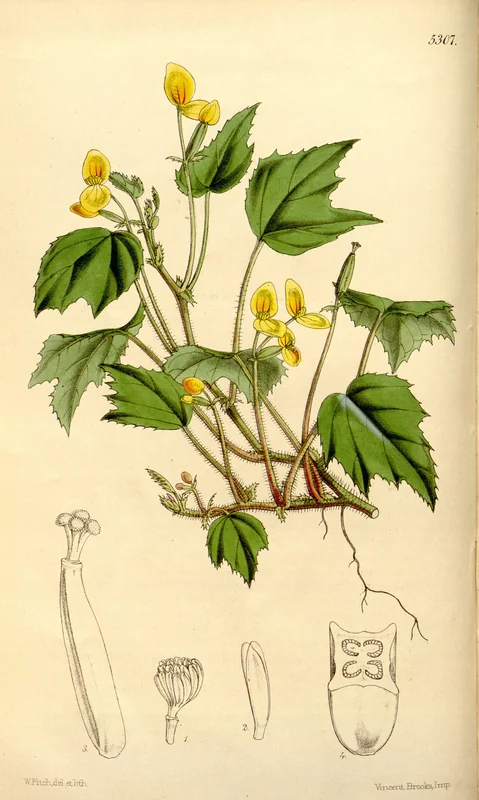 Featured photobegonia-prismatocarpa.jpg
Begonia prismatocarpa is a miniature creeping begonia from the rainforests of West Africa, producing masses of bright, cheerful yellow flowers nearly year-round on a plant barely 5–8 cm tall. It is exceptional in the genus for its yellow flower colour (most begonias flower white, pink, or red) and for its near-continuous blooming. The tiny, round to kidney-shaped, bright-green leaves and compact spreading habit make it ideal for terrariums, vivariums, and enclosed humid displays, where it creates a groundcover carpet of yellow flowers.
Care facts at a glance
- Light
- Low light
- Water
- Keep the medium consistently moist; water every 5 to 7 days or as soon as the surface begins to dry.
- Humidity
- 70–90 %
- Temperature
- 18–30 °C
- Soil
- Fine, moisture-retentive, well-draining mix: peat-free compost with fine perlite and coconut coir. Needs to retain moisture without becoming waterlogged.
- Origin
- Tropical rainforests of West and Central Africa — Cameroon, Nigeria, Gabon.
- Mature size
- Creeping groundcover; 5–8 cm tall, spreading to 20–30 cm in a terrarium.
Overview
Begonia prismatocarpa Hook. was described in 1854. The species name refers to the distinctive prism-shaped (three-angled) seed capsules. It is a creeping rhizomatous begonia native to the forest floor and humid rocky outcrops of tropical West and Central African rainforests. Its yellow flowers are unusual in Begonia — the yellow pigmentation results from carotenoids rather than the anthocyanins responsible for red and pink begonia flowers. It is one of the most floriferous species in the genus, blooming in flushes nearly continuously in warm, humid conditions. Widely used in vivarium and paludarium displays.
Care Priorities
- Terrarium or vivarium culture is strongly recommended; the required 70–90% humidity is very difficult to maintain in open household air.
- Keep consistently moist but ensure there is drainage or a drainage layer to prevent waterlogging.
- Moderate light (500–1,500 lux); too little light reduces flowering, too much causes leaf bleaching and wilting.
- Good airflow even in a terrarium is important; stagnant humid air encourages Botrytis on the delicate foliage.
- Divide or trim when it becomes congested to maintain compact, healthy growth.
Common Problems
Flowering stopping or reducing significantly often indicates a temperature drop below 20 °C or declining light levels; the plant should be year-round warm and bright for continuous bloom. Botrytis on the foliage develops in still, humid conditions; improve airflow with a small fan set to low. Fungus gnats are common in the constantly moist medium; allow the surface to dry slightly (though not the root zone) and apply beneficial nematodes. The plant may become leggy if the light is insufficient; trim and layer the cuttings back into the pot to maintain density.
Sources & further reading (2)
- botanical-garden — accessed 2026-05-27
- encyclopedia — accessed 2026-05-27
Frequently asked questions
Is it really yellow-flowered?
Yes — B. prismatocarpa is one of the very few begonia species with true yellow flowers, which is unusual in a genus dominated by pinks, reds, and whites. The yellow is produced by carotenoid pigments in the petals. The colour is a warm, clear golden-yellow, especially vivid against the bright-green foliage.
Can it be grown outside a terrarium?
Yes, in naturally humid climates (tropical or subtropical environments with 70%+ ambient humidity). In temperate climates with typical indoor humidity of 30–50%, it will languish and may not flower reliably. A covered plant display case or open-topped aquarium makes a reasonable substitute if a full terrarium is not available.
How does it spread in a terrarium?
By horizontal rhizome extension — new shoots emerge from the creeping rhizome and root as they contact the medium surface. Over several months it forms a continuous groundcover carpet. Trim wayward stems with scissors to keep it confined to the desired area; cuttings root readily in moist substrate.