Vriesea hieroglyphica
Vriesea hieroglyphica Care Guide
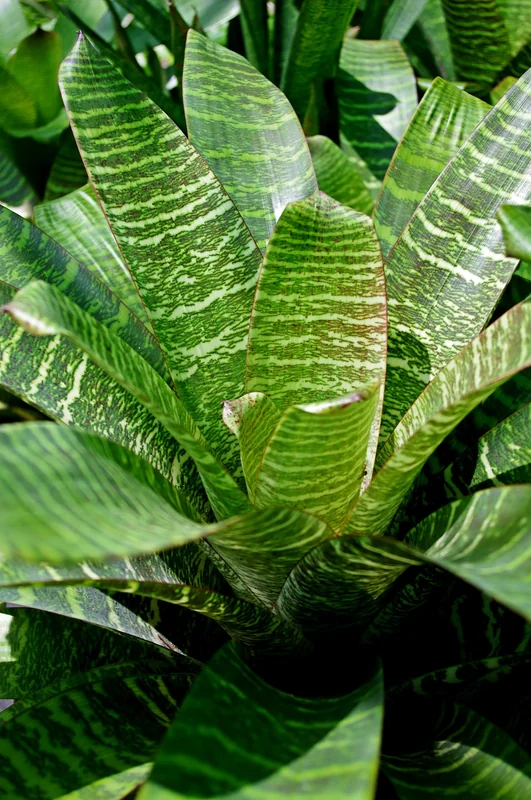 Featured photovriesea-hieroglyphica.jpg
Vriesea hieroglyphica, the king of bromeliads, is a spectacular Brazilian species producing large rosettes of broad, glossy leaves marked with complex, cross-banded, dark-green patterns on a lighter yellow-green background — the patterns are said to resemble hieroglyphic writing, giving the species its name. It can grow very large, with rosettes up to 80 cm across, and is grown primarily as a foliage plant, though it does eventually produce an inconspicuous inflorescence. Its impressive size and ornate markings make it one of the most prized indoor bromeliads.
Care facts at a glance
- Light
- Medium light
- Water
- Keep the central tank filled with fresh water; refresh every 10 to 14 days. Water the soil when the top 3 cm dries.
- Humidity
- 60–85 %
- Temperature
- 15–30 °C
- Soil
- Chunky epiphytic mix with bark, perlite, and minimal compost; this is an epiphyte by nature.
- Origin
- Humid Atlantic coastal forests of southeastern Brazil.
- Mature size
- 60 to 80 cm tall; rosette 60 to 80 cm across.
Overview
Vriesea hieroglyphica was described by E.Morren. Unlike the bright flower-bracted species such as V. splendens, hieroglyphica is grown primarily for its foliage — the complex marking pattern is unique among commonly cultivated bromeliads. In the Atlantic rainforest it grows as an epiphyte at low to mid elevations and is adapted to filtered light under the forest canopy. It is larger and slower-growing than most cultivated vrieseas.
Care Priorities
- Indirect light only; direct sun bleaches the complex markings and causes leaf burn.
- High humidity is important for preserving the glossy leaf surface.
- Keep the tank filled with soft, room-temperature water.
- This is a large plant — allow adequate space for the eventual 80 cm spread of the rosette.
Common Problems
Loss of the marking contrast — markings fading to a uniform green — usually means too much shade; increase indirect light. Mineral deposits on the leaves from hard water can be gently wiped with a damp cloth using distilled water. Heart rot from stagnant tank water is prevented by refreshing the tank every 10 to 14 days.
Sources & further reading (2)
- botanical-garden — accessed 2026-05-08
- encyclopedia — accessed 2026-05-08
Frequently asked questions
Is it only grown for its leaves?
Primarily, yes — the inflorescence is relatively inconspicuous compared to colourful vrieseas like V. splendens. The extraordinary foliage is the main ornamental feature.
How long does it take to reach full size?
This is a slow-growing species — it may take 5 or more years to reach its full rosette size of 70 to 80 cm. It is a long-term investment plant.
Why is it called king of bromeliads?
A combination of its large size, magnificent foliage markings, and regal bearing in the growing collection of bromeliad enthusiasts earned it this honorary common name.