Tylecodon reticulatus
Tylecodon reticulatus Care Guide
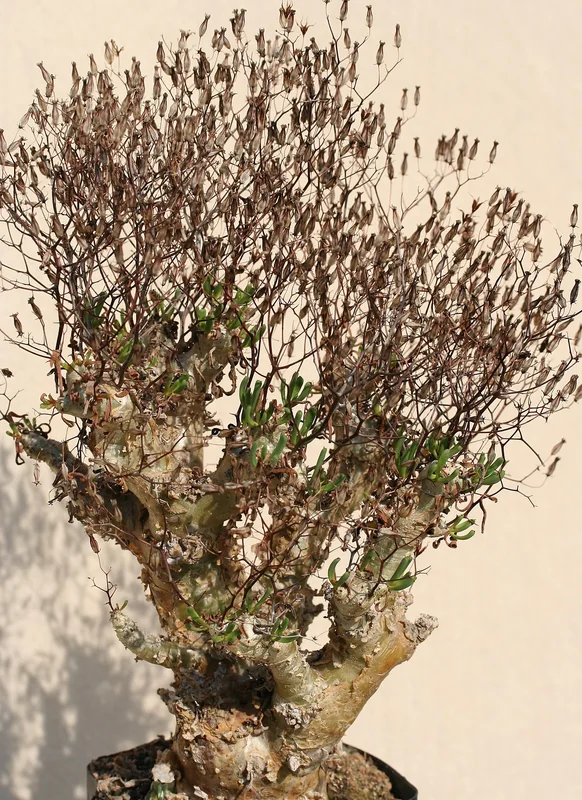 Featured phototylecodon-reticulatus.jpg
Tylecodon reticulatus is a bizarre and fascinating caudiciform succulent from the Namaqualand desert of South Africa, growing a distinctive knobbly caudex covered in papery, flaking bark and armed with persistent, woody petiole spines left from previous seasons' leaves. It grows small, succulent leaves only in the cool winter season, losing them in summer dormancy. Its unusual sculptural form and extraordinary drought adaptation make it a prized specimen for caudex and succulent collectors.
Care facts at a glance
- Light
- Bright indirect
- Water
- Water sparingly only in the growing season (autumn and winter): once every 3–4 weeks. Keep completely dry in summer.
- Humidity
- 10–40 %
- Temperature
- 5–40 °C
- Soil
- Very gritty, mineral-rich mix: 60–70% pumice or coarse grit with lean potting mix.
- Origin
- Stony, semi-arid desert hills of Namaqualand, South Africa.
- Mature size
- 15–40 cm tall; caudex widening slowly over decades.
Overview
Tylecodon reticulatus (L.f.) Toelken was separated from Cotyledon in 1978 when the genus Tylecodon was established for the African species with a winter growth cycle (the name Tylecodon is an anagram of Cotyledon). The woody, persistent petiole remnants that remain on the caudex after summer leaf drop create a network of interlocking spines — the 'reticulatus' (reticulate, net-like) epithet refers to this pattern. Specimens grown for decades develop an increasingly gnarled and sculptural form that makes them among the most valued caudiciforms in cultivation.
Care Priorities
- Observe the winter growth/summer dormancy cycle rigorously — this is a counter-seasonal grower that leafs out in cool months.
- In summer, withhold all water and move to a very bright, warm position.
- Resume very cautious watering in autumn when small new leaves begin to appear.
- Plant in a very small pot relative to the caudex size — tight conditions enhance the sculptural appearance and prevent overwatering.
Common Problems
Summer watering is the most common error and causes rapid caudex rot. The leafless, spiny caudex during summer looks dead but is simply dormant — resist the urge to water. If rot occurs at the caudex base, it is very difficult to save the plant; immediate amputation of affected tissue, fungicide treatment, and complete drying may halt it in early-stage rot. Growth is so slow that any setback requires years to recover.
Sources & further reading (2)
- botanical-garden — accessed 2026-05-27
- encyclopedia — accessed 2026-05-27
Frequently asked questions
Why does it have woody spines?
The 'spines' are actually the persistent petiole remnants (remains of old leaf stalks) that harden and remain on the caudex after summer leaf drop. Each one represents a leaf from a previous growing season. A plant with many persistent petioles is an older, more established specimen.
How do I know it is growing when I can't see any change?
During the winter growing season, watch for small, fleshy new leaves appearing at the stem tips. The caudex may also slightly increase in diameter. Growth in old specimens is often measurable only over years, not weeks.
Can I propagate it from cuttings?
Cuttings are very difficult with Tylecodon — stem cuttings rarely root successfully. Seed is the reliable propagation method, though seedlings take 10+ years to develop a notable caudex. For this reason, old wild-collected or legally nursery-propagated specimens command high prices.