Tillandsia ionantha
Tillandsia ionantha Care Guide
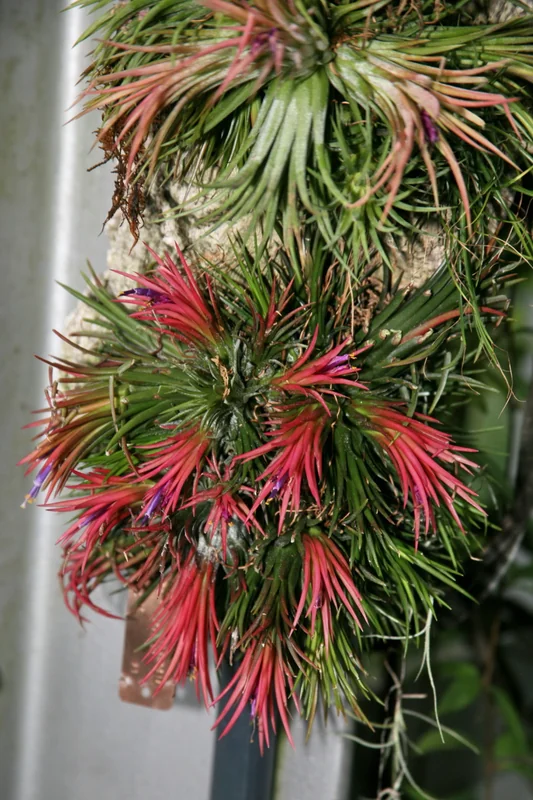 Featured phototillandsia-ionantha.jpg
Tillandsia ionantha is one of the most popular and widely available air plants, native to Central America from Mexico to Nicaragua. It forms a compact rosette of stiff, grey-green leaves covered in silver trichomes, and puts on a spectacular display when approaching flowering: the inner leaves turn bright red or orange, contrasting vividly with the tubular violet flowers. It is an ideal starter air plant due to its small size, vigorous pup production, and tolerance of a wide range of indoor conditions.
Care facts at a glance
- Light
- Bright indirect
- Water
- Mist daily in dry conditions, or soak in water for 20 to 30 minutes twice a week in summer; once per week in winter.
- Humidity
- 40–75 %
- Temperature
- 10–35 °C
- Soil
- No soil required — glue or wire to cork, driftwood, or display in a glass vessel.
- Origin
- Dry and humid forests of Mexico, Guatemala, Honduras, El Salvador, and Nicaragua.
- Mature size
- 5 to 8 cm tall and wide; spreads to 15 to 20 cm wide through pups.
Overview
Tillandsia ionantha was described by Planchon in 1873. There are numerous naturally occurring varieties from different countries, each with slightly different leaf characteristics and flower colour intensity. The 'blushing' display before flowering — inner leaves turning vivid red — lasts for 2 to 4 weeks before the violet tubular flowers open. After flowering, multiple pups form around the base, allowing the colony to expand. Clusters of multiple pups grown together are called 'balls' and are a popular display form.
Care Priorities
- Bright light is essential for the most vivid blushing display; low light produces all-green plants with no colour change.
- Soak rather than mist in very dry climates; misting alone may not provide enough moisture.
- Dry within 4 hours of soaking — the centre of the rosette is the most rot-prone point.
- Fertilise monthly during the growing season to encourage pup production.
Common Problems
Brown leaf tips are the most common issue, caused by low humidity or dry indoor air; increase misting frequency. A completely brown, mushy centre with an unpleasant odour is crown rot; there is no recovery from this — prevent it by ensuring rapid drying after watering. Leaves pale and stretched in low light; increase light intensity.
Sources & further reading (2)
- botanical-garden — accessed 2026-05-08
- encyclopedia — accessed 2026-05-08
Frequently asked questions
Why are the inner leaves turning red?
This is a pre-flowering response. The red colouration attracts pollinators and signals that the plant is about to bloom. Enjoy it — flowers typically appear within 2 to 4 weeks of the blushing starting.
Will the mother plant die after flowering?
Yes — T. ionantha is monocarpic and the flowering rosette dies after setting seed or producing pups. However, the numerous pups that form ensure the colony continues.
Can I grow a cluster (ball) of ionanthas?
Yes — allow pups to remain attached to the mother rosette instead of separating them. Over time a large, multi-rosette cluster develops that is more drought-tolerant and visually impressive.