Faucaria tigrina
Faucaria tigrina Care Guide
 Featured photofaucaria-tigrina.jpg
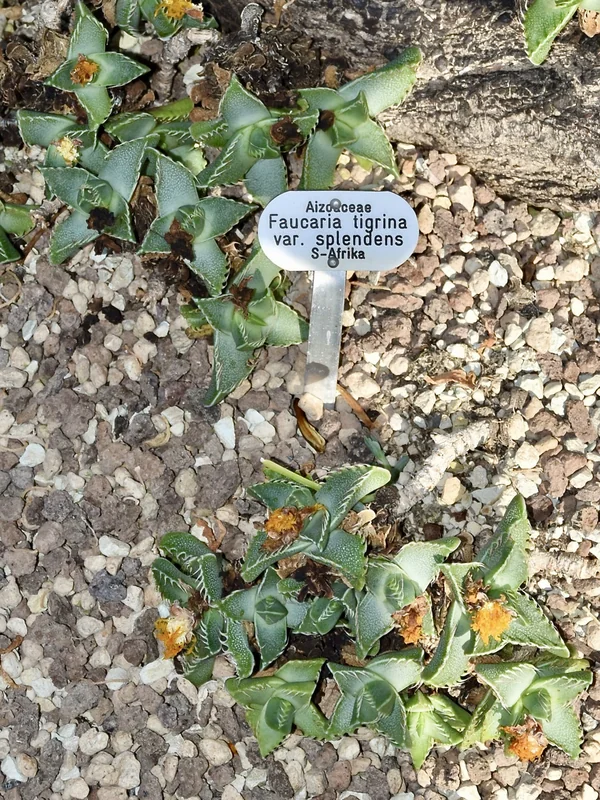
Faucaria tigrina, commonly known as tiger's jaw or shark's jaw, is a compact succulent from the Eastern Cape of South Africa. Its triangular, grey-green leaves are edged with prominent, curved white teeth that interlock when two leaves face each other, closely resembling a predator's jaw. Despite the fierce appearance, Faucaria is a gentle plant that rewards growers with cheerful, vivid yellow flowers in autumn. It is a reliable, easy-growing succulent suited to bright windowsills.
Care facts at a glance
- Light
- Bright indirect
- Water
- Water when the soil is fully dry — every 2 to 3 weeks in summer; monthly or less in winter.
- Humidity
- 30–55 %
- Temperature
- 5–38 °C
- Soil
- Gritty succulent mix with added coarse sand or perlite.
- Origin
- Rocky slopes and valleys of the Eastern Cape, South Africa.
- Mature size
- 8 to 15 cm tall; spreading 15 to 25 cm through offsets.
Overview
Faucaria tigrina was described by Schwantes and belongs to the Aizoaceae family alongside Lithops and Titanopsis. The genus name derives from the Latin faux (throat or jaw), describing the gape-like appearance of the paired leaves with their interlocking teeth. In its native habitat it grows on sunny, rocky slopes where the soil dries completely between infrequent rains. The autumn-blooming yellow flowers can be up to 5 cm across and are produced reliably on mature plants.
Care Priorities
- Bright light, including some direct morning or afternoon sun, brings out the best tooth development and encourages flowering.
- The growth cycle is reversed from most succulents — it grows in autumn and winter, rests in summer. Water accordingly.
- Use a gritty, mineral-rich substrate.
- Do not repot more than every 3 to 4 years; it performs best slightly root-bound.
Common Problems
Leaves becoming soft and collapsing in summer are a sign of natural dormancy combined with overwatering; withhold water until autumn. Pale, stretched growth in any season means insufficient light. Root rot can be triggered by watering in the wrong phase of the growth cycle; check soil thoroughly before watering.
Sources & further reading (2)
- botanical-garden — accessed 2026-05-08
- encyclopedia — accessed 2026-05-08
Frequently asked questions
Do the teeth hurt if I touch them?
The teeth are soft and slightly recurved — they are not sharp enough to cause injury. The appearance is fiercer than the reality.
When do the flowers appear?
Faucaria tigrina flowers in autumn (September to November in the northern hemisphere), producing shiny, golden-yellow, daisy-like blooms that open in the afternoon.
My plant is not flowering after 2 years. What is wrong?
Insufficient light is the most common cause. Move to a full-sun or very bright position. Also ensure the summer watering is reduced to allow a proper rest period, which triggers autumn flowering.