Tillandsia bulbosa
Tillandsia bulbosa Care Guide
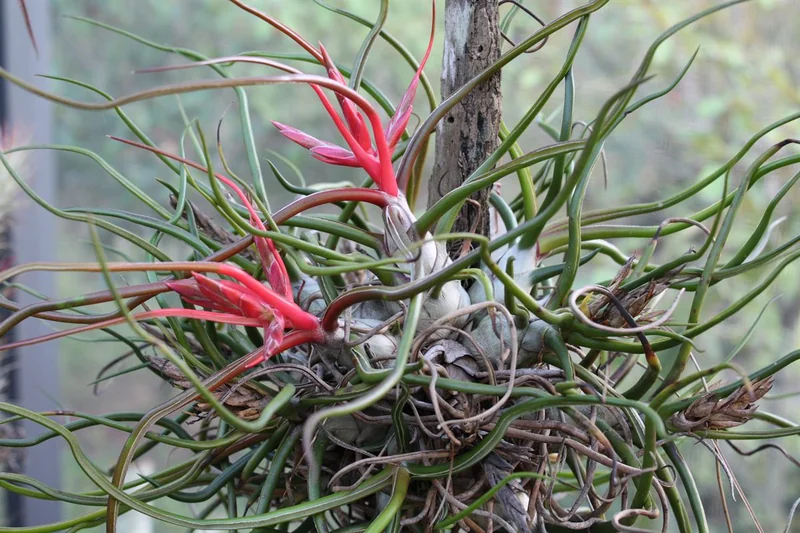 Featured phototillandsia-bulbosa.jpg
Tillandsia bulbosa is a distinctive Central American air plant with a swollen, bulb-like base from which long, curling, tentacle-like green leaves emerge. In its native habitat ants live inside the hollow bulb base, providing protection and nutrients — an unusual mutualistic relationship. It is a shade-adapted tillandsia from humid tropical forests and requires higher humidity and less direct sun than desert species. At flowering, the bracts turn bright red and the tubular purple flowers create a vivid display.
Care facts at a glance
- Light
- Medium light
- Water
- Mist thoroughly 3 to 4 times per week or soak for 20 to 30 minutes twice a week; this species needs more moisture than desert tillandsias.
- Humidity
- 55–85 %
- Temperature
- 12–32 °C
- Soil
- No soil required — mount on bark or display in a humid location with good airflow.
- Origin
- Humid lowland forests of Mexico, Guatemala, Belize, and the Caribbean.
- Mature size
- 15 to 25 cm tall; tentacle leaves to 20 cm long.
Overview
Tillandsia bulbosa was described by Hook. It belongs to a group of myrmecophilous (ant-associated) tillandsias whose swollen, hollow leaf bases provide nesting space for ant colonies in nature. The ants bring in organic matter and their waste fertilises the plant — a form of symbiosis. In cultivation, ants are not present, so regular fertilisation is more important than for other tillandsias. Unlike desert tillandsias, it evolved in humid, shaded environments and requires more water and less sun.
Care Priorities
- Higher humidity than desert tillandsias; position near other plants or in a humid room.
- Indirect light only; the green-leaved varieties are less adapted to intense sunlight than silver-leaved species.
- Ensure the hollow bulb base drains fully after soaking — turn upside-down for a few minutes.
- Fertilise more consistently than with silver-leaved species, as this plant cannot access ant-contributed nutrients indoors.
Common Problems
Rot inside the bulb base caused by trapped water is the most common serious problem; always shake the plant to drain the bulb after soaking. Leaf tip browning in dry conditions responds to increased humidity and misting frequency. In very dry indoor air the twisting leaves may desiccate; place on a pebble tray with water beneath to raise local humidity.
Sources & further reading (2)
- botanical-garden — accessed 2026-05-08
- encyclopedia — accessed 2026-05-08
Frequently asked questions
Do I need ants to grow T. bulbosa?
No — in cultivation the plant grows without ants but benefits from regular fertilising to compensate for the absence of the nutrients that ants provide in nature.
Why are the leaves twisted and curling?
The curling, tentacle-like leaves are a natural characteristic of T. bulbosa, not a sign of stress. In very dry conditions the leaves may curl more tightly; adequate watering keeps them naturally arching.
How do I mount T. bulbosa?
The swollen base makes gluing difficult. Wedging it into a piece of cork bark or tying it gently with monofilament fishing line through the base works best. Avoid tying around the tender tentacle leaves.