Pyrrosia lingua
Pyrrosia lingua Care Guide
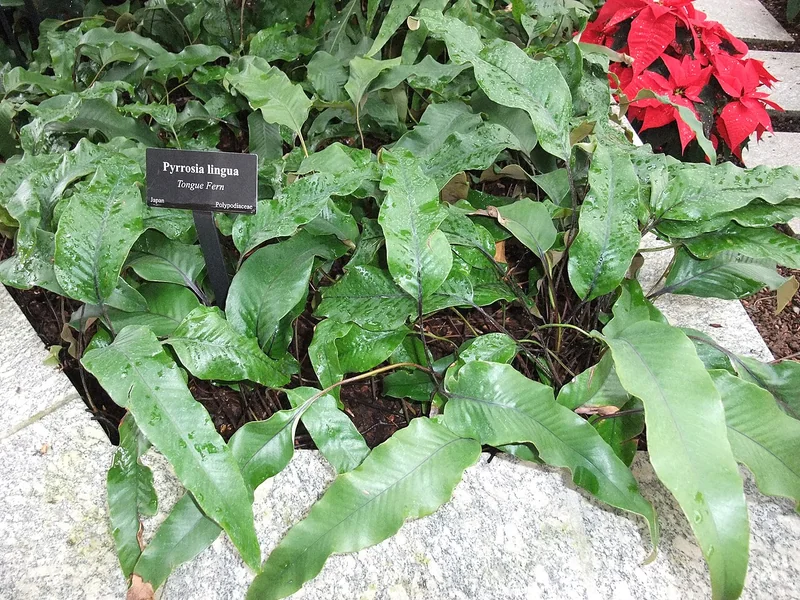 Featured photopyrrosia-lingua.jpg
Pyrrosia lingua, the Tongue Fern or Japanese Felt Fern, is a creeping epiphytic fern from East Asia with simple, undivided, tongue-shaped fronds covered in a soft, felt-like layer of star-shaped hairs (stellate trichomes) that give the undersides a grey-white cast. It creeps on a wiry, surface-running rhizome, making it ideal for mounting on bark, growing in shallow trays, or training along a wall. It tolerates significantly lower humidity and more light than most ferns.
Care facts at a glance
- Light
- Bright indirect
- Water
- Water when the top 2–3 cm of medium dries; approximately every 5 to 7 days. Mounted specimens may need daily misting.
- Humidity
- 40–70 %
- Temperature
- 5–28 °C
- Soil
- Very well-draining, slightly acidic mix; orchid bark or a mix of bark and coco coir works well.
- Origin
- Rocks, tree trunks, and cliff faces of Japan, China, Korea, and Southeast Asia.
- Mature size
- Fronds 10–30 cm long; rhizome creeps to form a mat over time.
Overview
Pyrrosia lingua (Thunb.) Farw. was described in 1931 and belongs to the family Polypodiaceae. It is one of approximately 100 Pyrrosia species, most of which are native to Asia and Africa. The felt-like coating on fronds (more pronounced on the underside) is composed of stellate (star-shaped) hairs that help reduce water loss and protect against intense sun — adaptations to the exposed rock and tree bark habitats the genus naturally occupies. Fronds are either sterile (wider, without sori) or fertile (narrower, with rows of round sori covering the underside).
Care Priorities
- More light than typical ferns: it grows on exposed rocks and cliff faces and tolerates some direct morning sun.
- Mounting on a slab of cork bark or tree fern fibre shows off the creeping rhizome habit most naturally.
- Allow some drying between waterings — overwatering causes rhizome rot more readily than drought.
- Cool to moderate temperatures year-round; avoid sustained heat above 28 °C.
Common Problems
Fronds turning brown from the base of the rhizome outward indicate rhizome rot from excess moisture; reduce watering and improve drainage. The grey-white felt on the frond underside is sometimes mistaken for pests — it is normal and should not be cleaned off. Scale insects appear as waxy, immobile bumps on frond undersides; treat with horticultural oil or diluted isopropyl alcohol. Fronds that become pale green in very high light need to be moved back slightly from the direct sun source.
Sources & further reading (2)
- botanical-garden — accessed 2026-05-27
- encyclopedia — accessed 2026-05-27
Frequently asked questions
How do I mount it on cork bark?
Place the rhizome against the bark surface and secure it with non-metallic fishing line or natural twine. Tuck a small amount of sphagnum moss under the rhizome to retain some moisture. Mist the mount daily and the aerial roots will attach to the bark within a few weeks, after which the ties can be removed.
What are the round dots on the frond underside?
These are sori — clusters of sporangia (spore-producing structures). They appear on fertile fronds and are a normal feature indicating a healthy, mature plant. They are covered in the same felt-like hairs as the rest of the frond underside.
Is it related to Platycerium (staghorn fern)?
Yes — both belong to the family Polypodiaceae. They share epiphytic habits and the presence of stellate hairs on the frond surface, but Platycerium produces large, antler-like fertile fronds, while Pyrrosia fronds are simple and tongue-shaped.