Phalaenopsis amabilis
Phalaenopsis amabilis Care Guide
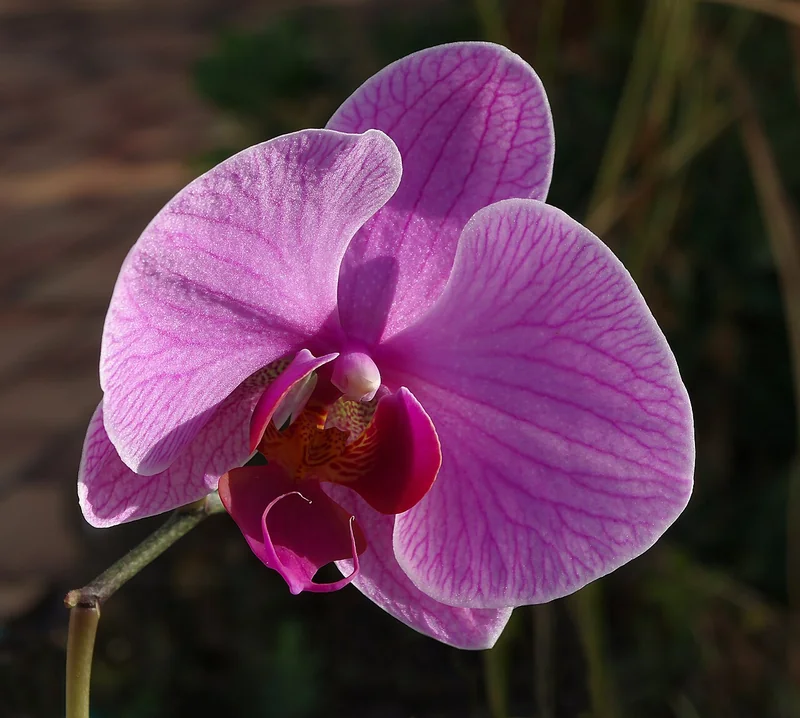 Featured photophalaenopsis-amabilis.jpg
Phalaenopsis amabilis is the type species of the genus and the primary wild ancestor of the billions of hybrid moth orchids sold globally each year. Native to lowland tropical forests from the Philippines and Moluccas to Papua New Guinea and Australia, it produces arching sprays of pure white, flat, broad-petalled flowers up to 10 cm across, with a delicate fragrance. It grows as an epiphyte with broad, leathery leaves and thick aerial roots. Its contribution to modern orchid breeding makes it arguably the most economically important orchid species in existence.
Care facts at a glance
- Light
- Bright indirect
- Water
- Water thoroughly once a week in summer; every 10 to 14 days in winter.
- Humidity
- 50–75 %
- Temperature
- 18–30 °C
- Soil
- Coarse bark chips or a bark-based orchid mix; never standard potting compost.
- Origin
- Lowland tropical forests of the Philippines, Moluccas, Papua New Guinea, and Queensland, Australia.
- Mature size
- Rosette to 40 to 60 cm across; flower spikes to 60 to 90 cm long.
Overview
Phalaenopsis amabilis was first described by Blume in 1825 and is the type species of the entire Phalaenopsis genus. The species name means 'loveable' in Latin, reflecting the flower's immediate appeal. In its native range it grows as an epiphyte on tree branches in the lowland monsoon forests of the Indo-Pacific region, attaching itself with thick, velamen-coated aerial roots that absorb rainfall and humidity. The flowers are pure white with a yellow-tinged lip patterned in red, and each spike can carry 10 to 15 flowers that last several weeks. Hybrid moth orchids are almost exclusively derived from this species crossed with P. schilleriana and others.
Care Priorities
- Bright, indirect light is essential for flowering; direct sun rapidly sunburns the fleshy leaves, but too little light prevents blooming.
- Water quality matters — cold water shocks the tropical roots; use room-temperature water and pour it through the bark, allowing it to drain completely.
- Never allow water to collect in the crown between the leaves; bacterial crown rot is the most common cause of rapid plant death.
- After flowering, cut the spike above a visible node to encourage a secondary spike before the main spike dies back.
Common Problems
Crown rot as a spreading brown mushy lesion at the centre of the leaf rosette is the most serious emergency; it develops when water sits in the crown. Remove all soft tissue with a sterile blade and dust with cinnamon or sulphur powder to halt progression. Root rot from overwatering shows as limp, yellowed leaves and mushy dark roots; remove affected roots, dry the remaining healthy roots, and repot in fresh bark. Failure to rebloom after the first spike usually indicates insufficient light; move to a brighter position near an east- or west-facing window.
Sources & further reading (2)
- botanical-garden — accessed 2026-05-08
- encyclopedia — accessed 2026-05-08
Frequently asked questions
Why won't my Phalaenopsis rebloom?
The most common cause is insufficient light or the absence of a cool-night temperature differential. A drop of 5 to 8 °C between day and night temperatures for 4 to 6 weeks in autumn typically triggers spike initiation.
Can I grow it without bark — in water or sphagnum?
Semi-hydroponic and sphagnum methods work well for experienced growers. Bark mimics the epiphytic natural habitat most closely. Avoid standard potting compost, which retains too much moisture around the roots.
How long do the flowers last?
Individual flowers on P. amabilis typically last 4 to 8 weeks; the full spike, which opens sequentially from base to tip, can be in bloom for 3 to 5 months under good conditions.