Parodia magnifica
Parodia magnifica Care Guide
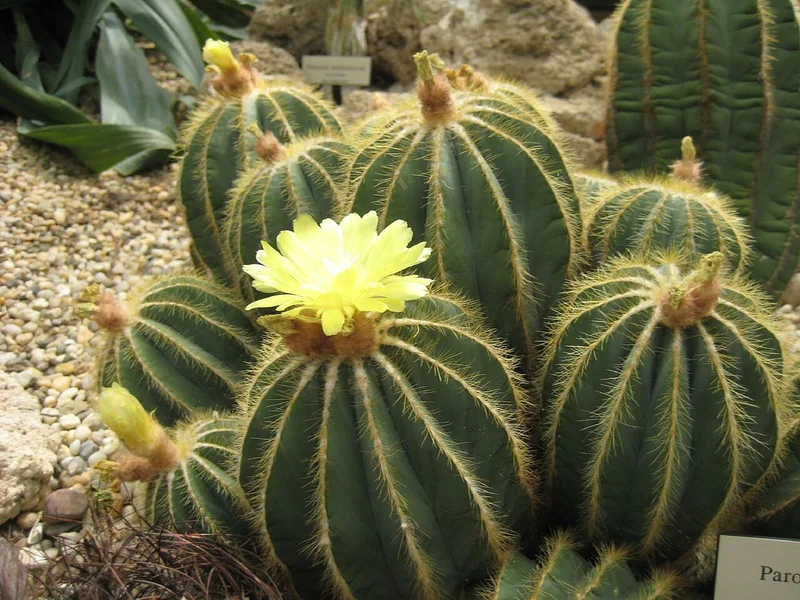 Featured photoparodia-magnifica.jpg
Parodia magnifica is a small globose cactus from the highlands of southern Brazil with an extraordinary blue-green to grey-green waxy surface, prominent ribs, and golden-yellow spines. Unlike many cacti it is a relatively reliable and free-flowering windowsill plant, producing large, bright-yellow flowers on quite young specimens. Its compact size and attractive colouration make it one of the most popular barrel cacti for indoor cultivation, and it is notably more cold-tolerant than many cacti from tropical regions.
Care facts at a glance
- Light
- Bright indirect
- Water
- Water every 14 to 21 days in summer; once every 4 to 6 weeks in winter.
- Humidity
- 20–50 %
- Temperature
- 2–35 °C
- Soil
- Very free-draining cactus mix: 50% coarse grit or perlite, 50% cactus compost.
- Origin
- Rocky grasslands (campos) of Rio Grande do Sul state, southern Brazil and adjacent Uruguay.
- Mature size
- Globose to short-cylindrical; 15–30 cm tall and 10–20 cm across.
Overview
Parodia magnifica (F.Ritter) F.H.Brandt was described in its current combination in 1982, having previously been placed in Notocactus. It is native to the high-altitude rocky grassland of southern Brazil's Rio Grande do Sul, where it grows in large colonies in full exposure to intense sunlight, summer heat, winter frost, and seasonal drought. The blue-green (glaucous) colouration results from a thick wax bloom on the cactus skin that reflects UV radiation and reduces water loss. The golden spines add to the attractive colour contrast. Parodia species are known for flowering more readily and at younger ages than many other globose cacti.
Care Priorities
- Direct or very bright indirect light is essential for maintaining the compact, globose shape and blue colouration; in shade the plant elongates and turns green.
- Excellent drainage is non-negotiable; use a terracotta pot for best moisture regulation.
- A dry winter rest (reduce watering, allow cooler temperatures: 5–12 °C) is not mandatory but encourages reliable spring flowering.
- Repot every 2–3 years into fresh cactus mix; the roots benefit from fresh medium even if the pot size doesn't change.
- The waxy surface should not be touched excessively as fingerprints can damage the wax bloom — use cotton gloves for handling.
Common Problems
Elongation and loss of blue-green colour are the most common problems, both caused by insufficient light; once elongated, the shape is permanent on existing tissue. Root rot from overwatering is the other common failure; in winter, a single overwatering in cold conditions can cause rapid root loss. Mealybugs deep in the areoles and at the root-soil junction are the most troublesome pest; treat with a systemic insecticide drench for root-zone mealybugs. If the cactus develops reddish or brown patches on one side, it has received direct sun burn after a sudden increase in light intensity — acclimate gradually when moving to brighter conditions.
Sources & further reading (2)
- botanical-garden — accessed 2026-05-27
- encyclopedia — accessed 2026-05-27
Frequently asked questions
Is it cold-hardy?
Relatively — its southern Brazilian origin means it tolerates mild frosts (down to 2 °C briefly) when completely dry. It is among the more cold-tolerant Parodia species. However, wet cold is fatal; never expose to temperatures below 5 °C if the medium is moist.
When does it flower?
Typically late spring to early summer (May–July in the northern hemisphere). Flowers are bright yellow, 5–6 cm across, and produced from the woolly apex of even relatively young specimens (3–4 years from seed). A brief cool winter rest reliably triggers flowering in the following season.
How many offsets does it produce?
Established older specimens may develop clusters of small offsets around the base, but offset production is slower than in Echinopsis or Mammillaria. Offsets can be detached when 3–4 cm in diameter and dried for a week before potting in dry cactus mix.