Platycerium wandae
Platycerium wandae Care Guide
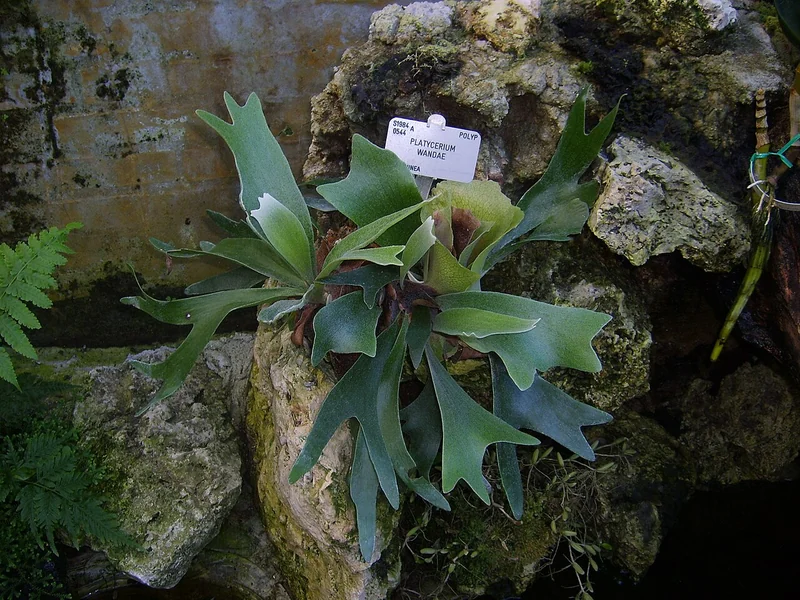 Featured photoplatycerium-wandae.jpg
Platycerium wandae, the queen staghorn fern, is considered by many to be the most impressive staghorn in cultivation. Native to the montane forests of Papua New Guinea, it produces enormous, chalky-white shield fronds that can reach over 1.5 metres across and dramatic, deeply bifurcated fertile fronds hanging up to 2 metres. It requires cooler temperatures than most tropical platycerium, needing night-time temperatures below 20 °C to remain vigorous — making it well-suited to cooler subtropical or temperate greenhouses.
Care facts at a glance
- Light
- Bright indirect
- Water
- Soak the mount thoroughly once every 10 to 14 days; allow to nearly dry before resoaking.
- Humidity
- 60–80 %
- Temperature
- 10–26 °C
- Soil
- Mounted on hardwood, cork bark, or tree fern fibre with sphagnum moss at the root zone.
- Origin
- Montane and cloud forests of Papua New Guinea.
- Mature size
- Shield fronds to 150 cm wide; fertile fronds to 200 cm long.
Overview
Platycerium wandae was described by Racib. It is named for Wanda Burnett. Its striking white shield fronds distinguish it from nearly all other platyceriums — the pale colouration is caused by a dense covering of stellate (star-shaped) hairs on the frond surface. Unlike the solitary P. superbum, P. wandae produces pups and can be propagated vegetatively. Its montane origin means it prefers cooler nights than most tropical staghorns.
Care Priorities
- Provide regular cool nights below 20 °C — this is essential for vigour; this species struggles in consistently warm, stuffy conditions.
- Mount high on a wall with good airflow to prevent shield rot.
- Bright, indirect light; some morning direct sun is tolerated.
- Avoid wetting the white shield fronds; they discolour easily and take months to recover.
Common Problems
Brown patches on the white shield fronds are caused by water contact or fungal infection; improve airflow and water carefully. Consistently warm nights above 22 °C cause slow decline; move to a cooler position. Scale insects are the most common pest — inspect the underside of fertile fronds and the junction between shield and fertile fronds.
Sources & further reading (2)
- botanical-garden — accessed 2026-05-08
- encyclopedia — accessed 2026-05-08
Frequently asked questions
What makes the shield fronds white?
The white colour comes from a dense covering of tiny stellate (star-shaped) hairs on the surface of the shield fronds. These hairs also help trap moisture and organic matter.
Does it need cooler temperatures?
Yes — it performs best when nights drop to 15 to 18 °C. Unlike tropical staghorns (P. bifurcatum, P. grande), it is adapted to cool montane conditions and declines in constant warmth.
Is it the biggest staghorn?
P. wandae and P. superbum compete for the title of largest staghorn. Wandae can produce wider shield fronds, while superbum's fertile fronds may be slightly longer. Both are exceptional specimens.