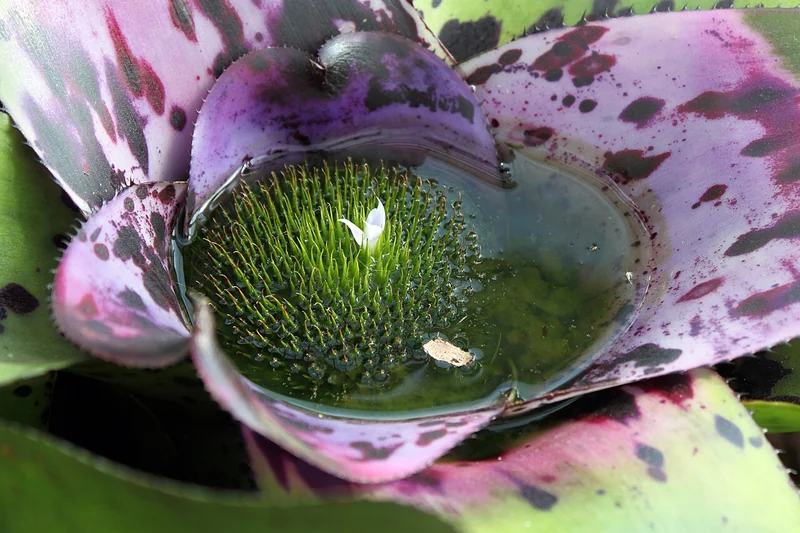
Neoregelia concentrica is a large-growing Brazilian tank bromeliad with broad, strap-shaped leaves edged with stout spines and dramatically patterned in purple spotting and white flecking. At flowering, the entire central portion of the rosette turns deep violet-purple, surrounding a cup of deep indigo water. Its bold markings and striking colouring make it one of the most ornamental Neoregelia species and a favourite for tropical indoor displays.
Care facts at a glance
- Light
- Bright indirect
- Water
- Keep the central cup full of water at all times; flush and refill weekly. Soil should be barely moist.
- Humidity
- 50–75 %
- Temperature
- 15–32 °C
- Soil
- Open, well-draining bromeliad or orchid bark mix.
- Origin
- Humid Atlantic rainforests of southeastern Brazil.
- Mature size
- 25–40 cm tall; rosette 50–70 cm across.
Overview
Neoregelia concentrica (Vell.) L.B.Sm. was described in 1955. It is one of the larger Neoregelia species and is widely used as a parent in hybridisation to produce plants with vivid patterning and bold colouration. The purple spotting and white flecking on the leaf surface are caused by epidermal pigment distribution and trichome patterns respectively — they are fixed characteristics of the individual plant's genetics and do not change with light or nutrition. The deep-blue cup water is a striking feature unique to this species among commonly cultivated bromeliads.
Care Priorities
- Bright, indirect light is needed to maintain the full intensity of the purple patterning and to trigger the central flushing response.
- The spiny leaf margins require care when handling; wear gloves or work carefully around the rosette.
- Keep the cup filled with water year-round and flush monthly; the cup's blue-purple colouration is harmless and part of the appeal.
- Allow offsets to develop to one-third the parent size before separation.
Common Problems
Fading of the purple spotting pattern into plain green indicates insufficient light; move to a brighter, more directly lit position. Stagnant cup water developing an unpleasant odour needs flushing and cleaning — increase the flushing frequency to twice monthly. Brown, crispy spine tips are a normal feature and not a disease sign. Scale insects clustering in the leaf bases near the cup are common; flush the cup, apply horticultural oil to the leaf bases, and rinse thoroughly.
Sources & further reading (2)
- botanical-garden — accessed 2026-05-27
- encyclopedia — accessed 2026-05-27
Frequently asked questions
Why is the water in the cup blue-purple?
The blue-purple colour is caused by anthocyanin pigments leaching from the inner leaf surfaces into the cup water — the same pigments responsible for the purple leaf colouring. This is harmless to the plant and is actually a mark of high pigment production, which correlates with a healthy, well-lit plant.
How big does it get?
N. concentrica is one of the larger Neoregelia species — rosettes can reach 50–70 cm across in ideal conditions. Allow adequate floor or shelf space; it is best displayed alone rather than crowded among other plants.
Does it flower?
The actual flowers are tiny and sit just above the water level in the central cup — they are modest compared to the dramatic leaf display. The visual 'flower' effect of Neoregelia is the central leaf flushing, which lasts several months longer than the actual blooming period.