Aglaomorpha meyeniana
Aglaomorpha meyeniana Care Guide
 Featured photoaglaomorpha-meyeniana.jpg
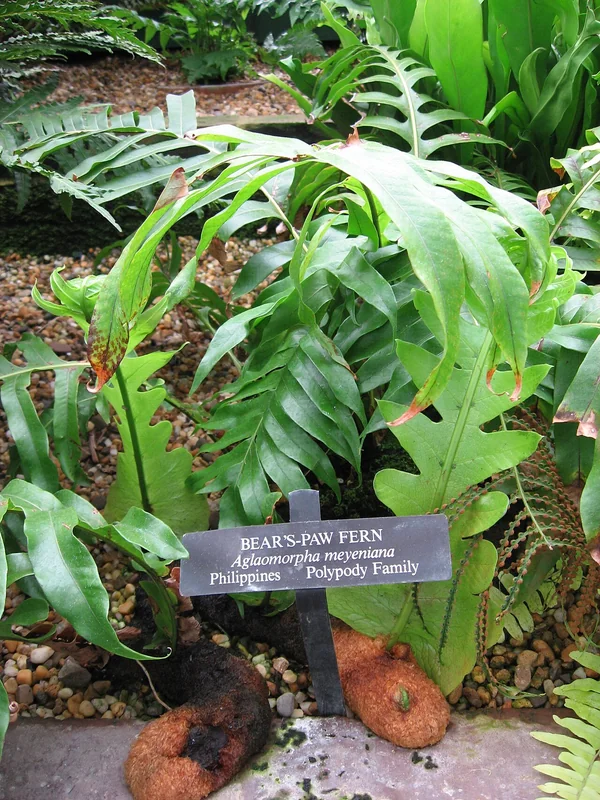
Aglaomorpha meyeniana, the Bear's Paw Fern or Philippine Bear's Paw, is an epiphytic fern from the humid forests of the Philippines, characterised by a thick, creeping, golden-brown hairy rhizome that resembles a bear's paw and large, deeply lobed, pinnate fronds. The base of each frond is reduced to a pair of rounded, sponge-like 'nest pinna' lobes that clasp the support and trap humus. It is a dramatic specimen fern for large containers, wire baskets, or mounted epiphytic displays.
Care facts at a glance
- Light
- Bright indirect
- Water
- Water every 3–5 days, keeping the medium consistently moist. The nest lobes can be misted separately to maintain humidity around the rhizome.
- Humidity
- 60–85 %
- Temperature
- 15–30 °C
- Soil
- Open, well-draining epiphytic mix: orchid bark, perlite, and sphagnum moss in equal parts.
- Origin
- Humid tropical forests of the Philippines.
- Mature size
- Fronds 60–100 cm; rhizome spreads laterally up to 60 cm.
Overview
Aglaomorpha meyeniana Schott was described in 1843, named for the naturalist Franz Julius Ferdinand Meyen who collected the type specimen in the Philippines. The genus Aglaomorpha (from Greek for 'bright beautiful form') includes approximately 40 epiphytic fern species native to tropical Asia. The hairy rhizome coating serves to insulate the rhizome from temperature extremes and retain moisture in its exposed epiphytic position. The nest lobes at the frond base are an analogue of the nest fronds in Drynaria, functioning as a humus trap in the wild.
Care Priorities
- Grow in a hanging basket or wide, open container that allows the rhizome to creep and extend beyond the pot rim.
- Do not bury the rhizome — it must remain on the surface with good airflow around it.
- Bright, indirect light is important; deep shade causes weak, sparse fronds.
- Maintain humidity above 60% for healthy frond development; below this, frond edges progressively brown.
Common Problems
Rhizome rot is caused by the rhizome sitting in waterlogged medium; ensure excellent drainage and never bury the rhizome in soil. Fronds that emerge small and weak indicate insufficient light; move to a brighter position. Scale insects colonise both the rhizome and frond undersides; treat with horticultural oil. The golden-brown hair on the rhizome should not be confused with scale — the hair is uniform and attached firmly, while scale insects have irregular, waxy bumps.
Sources & further reading (2)
- botanical-garden — accessed 2026-05-27
- encyclopedia — accessed 2026-05-27
Frequently asked questions
What are the rounded lobes at the base of each frond?
These are 'nest pinnae' — specialised, reduced, sponge-like lobes at the frond base that clasp the support and trap falling organic matter. They function similarly to the nest fronds of Drynaria, creating a nutrient reservoir for the plant in its epiphytic habitat.
Can I grow it in a hanging basket?
Yes — a hanging wire basket lined with coco coir or sphagnum is an excellent container. The rhizome can creep through and around the basket sides, and the long fronds arch attractively downward. Soak the basket thoroughly when watering.
Why does my rhizome look 'furry'?
The thick coating of golden-brown scales on the rhizome is entirely normal and is actually a defining feature of the species. The scales trap moisture and protect the rhizome from desiccation. They should not be cleaned off or disturbed.