Ananas comosus
Ananas comosus Care Guide
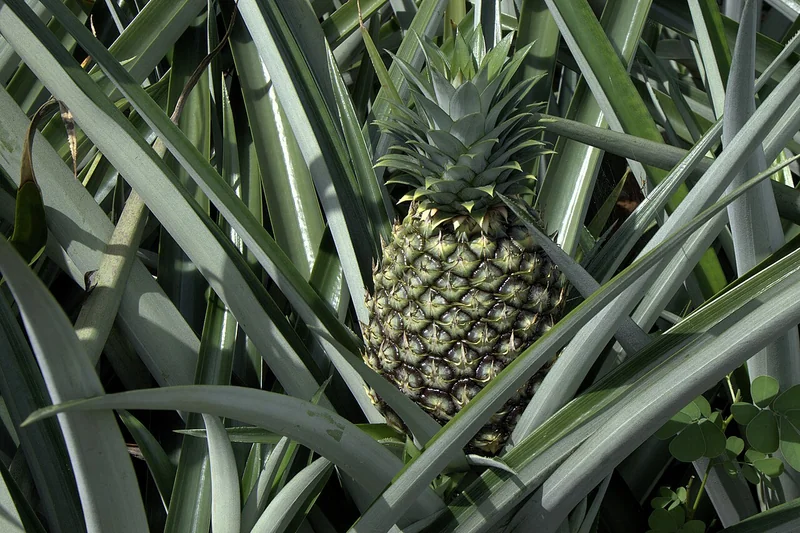 Featured photoananas-comosus.jpg
Ananas comosus, the Pineapple Plant, is the bromeliad species cultivated globally for its fruit, but it is also a striking ornamental houseplant when grown from the crown of a purchased pineapple or as a compact variety. It produces stiff, spiky, blue-green strap leaves in a dramatic, architectural rosette, and with patience can be induced to produce a small ornamental fruit. A remarkably accessible and conversation-worthy houseplant that grows from kitchen scraps.
Care facts at a glance
- Light
- Bright indirect
- Water
- Water every 7–10 days in summer, allowing the top 3–4 cm to dry between waterings. Monthly in winter.
- Humidity
- 40–70 %
- Temperature
- 15–35 °C
- Soil
- Well-draining, sandy potting mix with perlite; good drainage is essential.
- Origin
- Tropical South America (probably Brazil/Paraguay); cultivated pantropically for millennia.
- Mature size
- 60–90 cm tall; rosette 60–100 cm across.
Overview
Ananas comosus (L.) Merr. was described in 1917, though the pineapple has been cultivated in tropical America for over 6,000 years. Belonging to the bromeliad family, it is the only member of the family widely grown for its fruit. The fruit is technically a syncarp — a fusion of many individual fruitlets developing from the individual flowers on the inflorescence. The leafy crown on top of the fruit is a separate shoot that can be rooted and grown into a new plant — the simplest and most accessible propagation method.
Care Priorities
- Maximum light, ideally including several hours of direct sun per day, is needed for the best growth and any chance of fruiting.
- Grow in a heavy, wide pot (35–40 cm diameter) to stabilise the plant and accommodate the root system.
- To encourage fruiting indoors, place a ripe apple in the centre of the rosette and cover loosely with plastic for 2–3 days — the ethylene gas released by the apple triggers flowering.
- The leaf margins are sharp-spined; handle with care.
Common Problems
Brown, wilting leaves with a yellow base indicate root rot from overwatering — improve drainage immediately. Leaves that are pale and yellowish overall indicate nitrogen deficiency or insufficient light; resume feeding and move to a brighter position. Mealybugs are the most common pest, particularly at the leaf bases and around the fruit cup; treat with isopropyl alcohol on a cotton bud or insecticidal soap. Growing from a supermarket crown: allow the cut end to callus for 2–3 days before planting in dry, gritty compost.
Sources & further reading (2)
- botanical-garden — accessed 2026-05-27
- encyclopedia — accessed 2026-05-27
Frequently asked questions
How do I grow one from a supermarket pineapple?
Twist or cut the crown from the top of a fresh pineapple, remove the lower leaves to expose 2–3 cm of stem, and allow to callus for 2–3 days in a dry place. Plant the stem in dry, gritty compost and keep in a warm (above 20 °C), bright position. Do not water for the first week. Roots will develop within 3–6 weeks.
Can I get it to fruit indoors?
Yes, but it takes patience — typically 2–3 years from crown to fruit. Mature plants (18+ months) can be induced to flower by the ethylene gas technique: place a ripe apple in the rosette, cover with plastic for 2–3 days, then remove. Flowering should begin within 2–3 months.
Are there ornamental varieties?
Yes — 'Variegatus' has cream-and-green striped leaves; 'Champaca' is a compact variety suited to containers; 'Nanus' stays under 50 cm. All require the same basic care as the standard species.