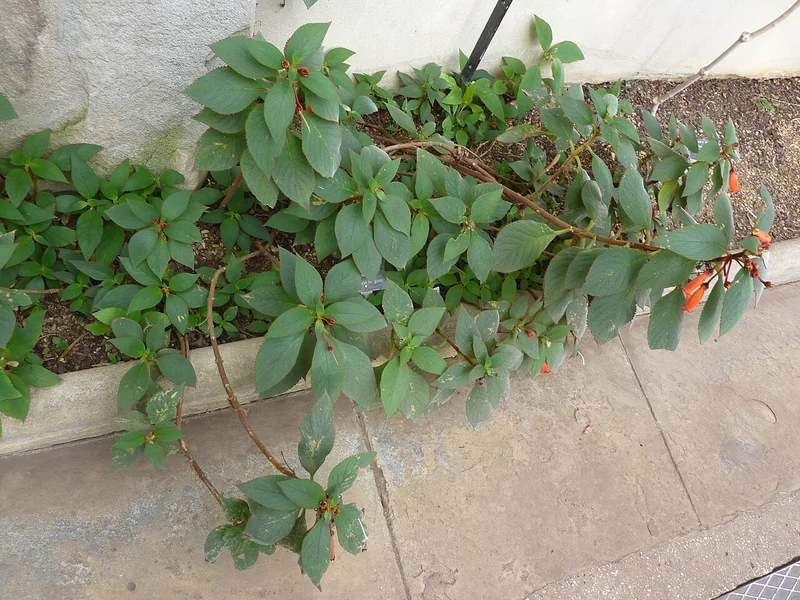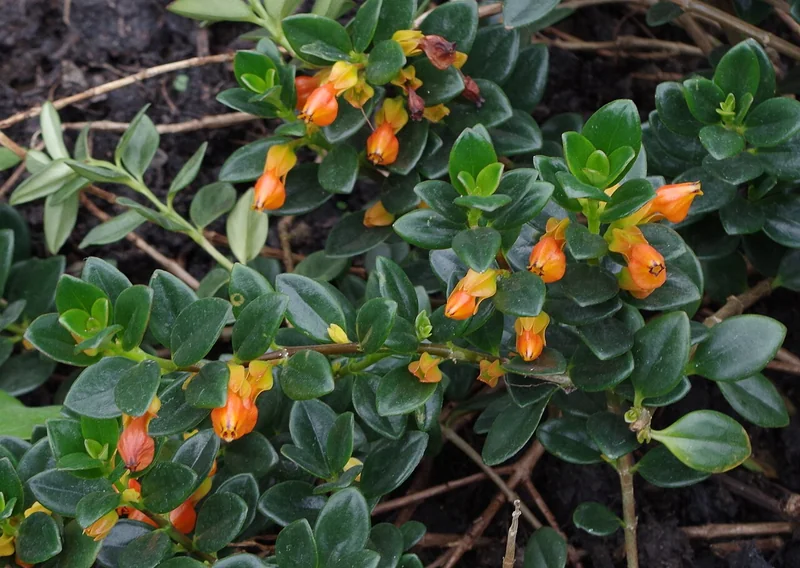
Nematanthus gregarius is a trailing Brazilian gesneriad beloved for its pouch-shaped, bright-orange flowers with a small circular opening at the front — unmistakably resembling leaping goldfish, hence the common name. The glossy, dark-green, oval leaves on pendant stems are attractive year-round, and the flowering season can extend for many months in warm, bright conditions. It is one of the easiest gesneriads to grow as a houseplant, tolerating lower humidity than many family members and rewarding regular fertilisation with a prolific and colourful flower display.
Care facts at a glance
- Light
- Bright indirect
- Water
- Water every 7 to 10 days; allow the top 2–3 cm of medium to dry between waterings.
- Humidity
- 45–70 %
- Temperature
- 15–28 °C
- Soil
- Free-draining, slightly acidic mix: peat-free potting compost with 20% perlite.
- Origin
- Atlantic Forest of Brazil.
- Mature size
- Trailing stems to 60–90 cm in a hanging basket.
Overview
Nematanthus gregarius D.L.Denham was described in the current combination in 1978, having been previously classified as Hypocyrta radicans and then H. gregaria. It belongs to the Gesneriaceae family and is native to the humid Atlantic Forest of Brazil, where it grows as an epiphytic or scrambling shrub on tree branches and rocky outcrops. The pouch-shaped flowers (technically tubular corollas with a very narrow opening) are an adaptation to pollination by hummingbirds — the long bill enters the restricted opening. The shape and orange-red colouration are classic hummingbird flower adaptations.
Care Priorities
- Regular high-phosphorus feeding is the most important factor for sustained heavy flowering; potassium also contributes. Feed every 2 weeks during the growing season.
- Bright indirect light with some morning direct sun maximises flowering; in shade the plant grows but flowers sparsely.
- Pinch stem tips after flowering to promote branching and a denser, more floriferous plant.
- Hanging basket culture shows the trailing stems and pendant flowers to best advantage.
- A mild winter rest (reduce feeding and watering slightly) resets the flowering cycle for spring.
Common Problems
Leaves dropping in autumn is normal if the plant is allowed a slight rest period; reduce watering and temperature slightly and new growth will emerge in spring. Aphids on new growth and flower buds are common in spring; treat with insecticidal soap or a strong water spray. Root rot develops in wet, poorly draining medium; use a free-draining mix and ensure water runs freely from the drainage holes. Failure to flower in a plant with vigorous leaf growth usually indicates too much nitrogen in the fertiliser; switch to a high-phosphorus formula.
Sources & further reading (2)
- botanical-garden — accessed 2026-05-27
- encyclopedia — accessed 2026-05-27
Frequently asked questions
How long does it flower?
Under ideal conditions (bright indirect light, consistent feeding, warm temperatures) N. gregarius can flower almost continuously from spring through autumn, with a brief rest in winter. Each individual flower lasts 2–4 weeks. A well-grown plant in a hanging basket can carry dozens of flowers simultaneously.
Does it need high humidity?
No — it is one of the more humidity-tolerant gesneriads. Unlike Columnea or Aeschynanthus, it grows well at typical household humidity (45–60%) without supplemental misting. This makes it the most accessible of the 'goldfish' type flowering gesneriads for standard indoor environments.
How do I propagate it?
Stem cuttings root easily in water or moist perlite at 18–22 °C within 2–3 weeks. Take cuttings of 8–12 cm with at least 2 leaf nodes, remove lower leaves, and root in a warm, bright position. Multiple cuttings planted together in a hanging basket create a full, bushy display faster than a single cutting.