Delosperma cooperi
Delosperma cooperi Care Guide
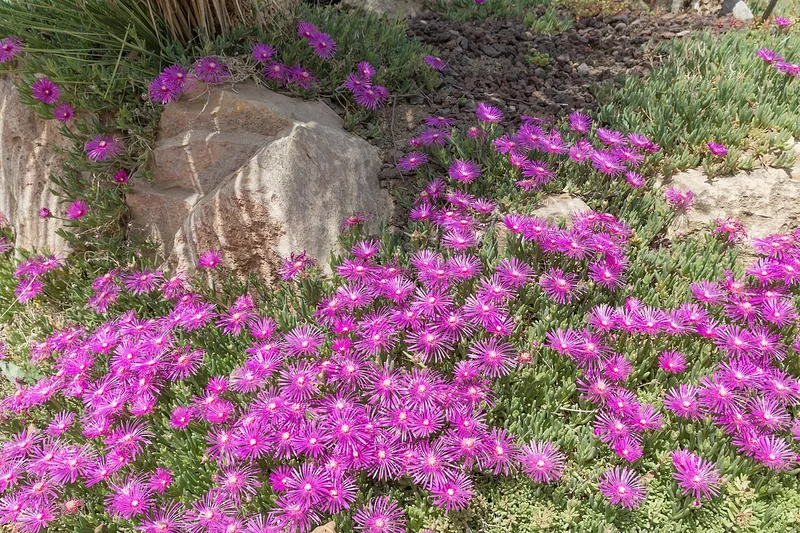 Featured photodelosperma-cooperi.jpg
Delosperma cooperi, the Trailing Ice Plant, is a low-growing succulent from South Africa's mountainous grasslands that produces a near-continuous display of brilliant, iridescent magenta-pink daisy-like flowers from late spring through autumn. The succulent cylindrical leaves have a crystalline texture that sparkles in sunlight. It is one of the most floriferous succulents available, equally effective in pots, window boxes, and hanging baskets.
Care facts at a glance
- Light
- Bright indirect
- Water
- Water every 2–3 weeks in summer when the soil has dried completely; once a month or less in winter.
- Humidity
- 10–50 %
- Temperature
- -10–35 °C
- Soil
- Very gritty, fast-draining mix; standard cactus compost with 40% added perlite or coarse sand.
- Origin
- High-altitude grasslands and rocky slopes of Lesotho and the eastern Cape, South Africa.
- Mature size
- 10–15 cm tall; trailing spread of 30–60 cm.
Overview
Delosperma cooperi (Hook.f.) L.Bolus was described in 1874 and named for Daniel Cooper, curator of the Glasgow Botanic Garden. One of the few genuinely frost-hardy succulents (tolerating temperatures to -10 °C), it has become widely used in temperate garden borders as well as container plantings. The name 'Delosperma' means 'visible seed' and 'ice plant' refers to the glistening papillae on the leaf surface that scatter light like ice crystals. Indoors it requires maximum light to bloom.
Care Priorities
- Maximum light is non-negotiable for flowering — a south-facing window with direct sun for at least 4 hours per day produces the most prolific bloom.
- Excellent drainage is critical: the plant will tolerate drought but not wet feet, particularly in winter.
- Deadhead spent flowers to prolong the blooming season; flowering can continue from May to October with regular deadheading.
- In winter, keep cool and dry — temperatures between 2 and 10 °C with minimal water extend plant life.
Common Problems
Failure to flower is almost always a light issue — insufficient direct sun prevents bud formation. Leggy, spreading stems with few flowers indicate the same. Root rot in winter is fatal; ensure pots drain completely and water only very sparingly or not at all in cold months. Botrytis (grey mould) can develop in damp, cool conditions; improve airflow and remove affected stems. Aphids colonise new flower buds in spring; treat with insecticidal soap.
Sources & further reading (2)
- botanical-garden — accessed 2026-05-27
- encyclopedia — accessed 2026-05-27
Frequently asked questions
Can it survive outdoors in winter?
Yes — D. cooperi is frost-hardy to approximately -10 °C in free-draining conditions. The key is dry soil in winter: wet roots in frost are lethal. In a pot, bring indoors or move to a sheltered, cold spot if the pot cannot drain freely in wet weather.
How do I maximise flowering?
Full sun, good drainage, and deadheading spent blooms are the three essentials. A low-nitrogen, phosphorus-rich fertilizer in spring promotes flower bud development over leafy growth. Remove the entire spent flower stem back to the nearest leaf.
What is the crystalline texture on the leaves?
The leaves are covered with papillae — minute, bladder-like cells that are often water-filled, creating a glistening, crystal-like surface when light strikes them. This feature is the origin of the 'ice plant' common name and is also seen in related mesemb genera.