Haworthia limifolia
Haworthia limifolia Care Guide
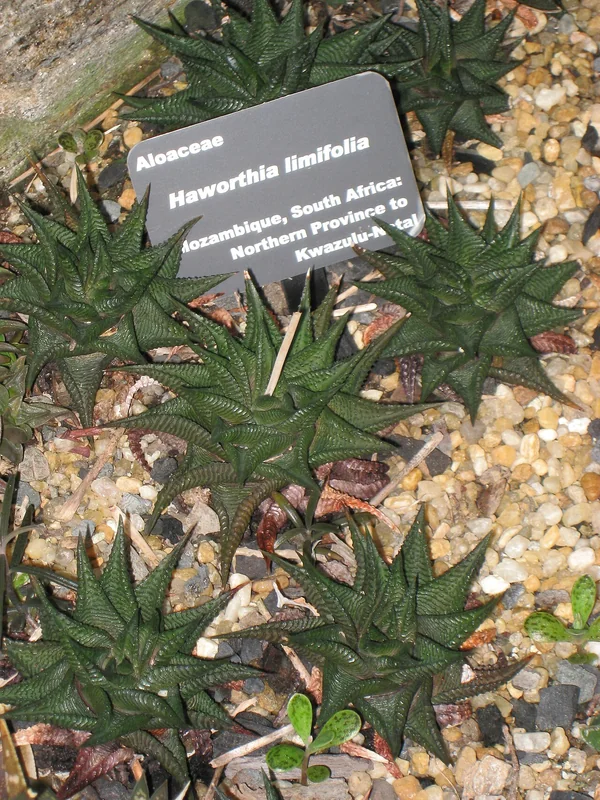 Featured photohaworthia-limifolia.jpg
Haworthia limifolia is a southern African succulent named for its distinctive leaf surface — covered in horizontal ridges and tubercles that resemble the teeth of a file (lime, from the Latin for file). It forms neat, compact rosettes of dark-green leaves and is one of the more ornamentally textured haworthias in cultivation. It is robust and adaptable compared to window-leaved species, tolerating a wider range of light conditions and modest neglect.
Care facts at a glance
- Light
- Bright indirect
- Water
- Water when the soil has dried completely — every 2 to 3 weeks in summer, monthly in winter.
- Humidity
- 30–60 %
- Temperature
- 10–35 °C
- Soil
- Standard succulent mix with added perlite for sharp drainage.
- Origin
- Rocky outcrops and grasslands of South Africa, Mozambique, and Swaziland.
- Mature size
- 8 to 15 cm tall; rosette 8 to 12 cm across.
Overview
Haworthia limifolia was described by Marloth in 1910. It is variable across its range, with some authorities recognising several varieties including var. arcana, var. limifolia, and var. ubomboensis, each differing slightly in tubercle arrangement and leaf colour. In cultivation it is one of the easier haworthias, adapting well to indoor conditions and producing offsets reliably.
Care Priorities
- Provide bright indirect light; unlike some haworthias, limifolia tolerates slightly more direct morning sun.
- Allow soil to dry completely between waterings — this is the most important rule.
- Water the soil directly rather than the rosette to prevent fungal issues in the ridged leaves.
- Remove offsets when the cluster becomes very crowded to maintain airflow.
Common Problems
Leaves stretching, leaning, or the rosette becoming elongated (etiolation) indicates insufficient light — move to a brighter position. Soft, discoloured leaves at the rosette centre signal fungal crown rot, often from trapped moisture; remove damaged tissue and allow to dry. Mealybugs settle between the tightly packed leaves; use a fine brush dipped in isopropyl alcohol to remove them.
Sources & further reading (2)
- botanical-garden — accessed 2026-05-08
- encyclopedia — accessed 2026-05-08
Frequently asked questions
Why are the leaves ridged like a file?
The horizontal ridges (tubercles) are a characteristic surface texture of H. limifolia. Their precise ecological function is debated, but they may deter herbivory or help scatter intense sunlight across the leaf surface.
Is it suitable for low-light conditions?
It tolerates moderate indirect light better than many succulents but will etiolate in true low light. A bright windowsill without direct afternoon sun is the practical minimum.
Can I divide the clump?
Yes — use a clean blade to separate offsets from the mother rosette, ensuring each division has a few roots. Allow cut surfaces to callous for a day before potting in dry succulent mix.