Echeveria shaviana
Echeveria shaviana Care Guide
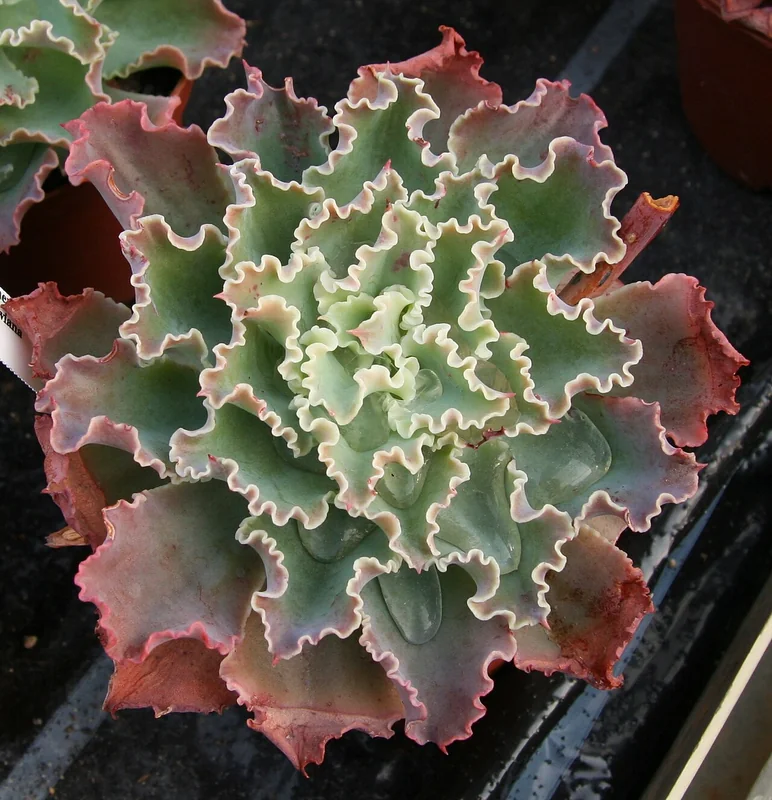 Featured photoecheveria-shaviana.jpg
Echeveria shaviana is one of the most distinctive echeveria species, producing large, flat rosettes of thin, deeply ruffled or crinkled leaf edges in a beautiful pink-grey to lavender-grey colour. Native to the mountains of Nuevo León in Mexico, the unusual crinkled margins are thought to increase surface area for light capture. It is a spectacular specimen plant for bright windowsills but requires slightly more care than thicker-leaved echeverias.
Care facts at a glance
- Light
- Bright indirect
- Water
- Water when the soil has dried, roughly every 2 to 3 weeks in summer; every 4 weeks or less in winter.
- Humidity
- 30–50 %
- Temperature
- 5–30 °C
- Soil
- Well-draining succulent mix with extra perlite; slightly less gritty than for desert cacti.
- Origin
- Rocky slopes of Nuevo León, Mexico.
- Mature size
- 8 to 15 cm tall; rosette 15 to 25 cm across.
Overview
Echeveria shaviana was described by Walther in 1959 and named in honour of E.A. Shaw. Its large, flat rosette and dramatically frilled edges make it instantly recognisable. The leaves are thinner than most echeverias and their pink-grey colour intensifies with bright light and moderate stress. Under very bright conditions the edges may deepen to a vivid pink. It tends to grow as a monocarpic species, dying after flowering but producing offsets.
Care Priorities
- Very bright, indirect light or morning sun brings out the best pink-grey colouration.
- Never water over the rosette — the ruffled margins trap moisture easily; always water at soil level.
- Avoid high humidity, which encourages fungal growth on the thin, densely packed leaves.
- Provide good airflow around the rosette to prevent crown rot.
Common Problems
Crown rot in the ruffled leaf centre is the biggest challenge — caused by trapped water or poor airflow. Remove affected leaves and spray with a dilute fungicide. Stretching and loss of the pink colouration mean insufficient light. Aphids may cluster inside the dense frills; a targeted spray of water or insecticidal soap resolves minor infestations.
Sources & further reading (2)
- botanical-garden — accessed 2026-05-08
- encyclopedia — accessed 2026-05-08
Frequently asked questions
Why are the frilled edges unusual for an echeveria?
Most echeverias have flat or slightly wavy leaf margins. E. shaviana's deeply ruffled edges are an extreme example of marginal crenulation and are produced by uneven growth along the leaf edge.
Does it keep its pink colour all year?
The intensity of the pink-grey colour varies with light levels. Bright light (especially morning sun) and slight drought stress deepen the colour; low light and lush growth make it more grey-green.
How do I propagate it?
Leaf cuttings work but are less reliable than with thicker-leaved echeverias because the thin leaves dry out quickly. Offsets removed with roots are the more reliable method.