Fenestraria rhopalophylla
Fenestraria rhopalophylla Care Guide
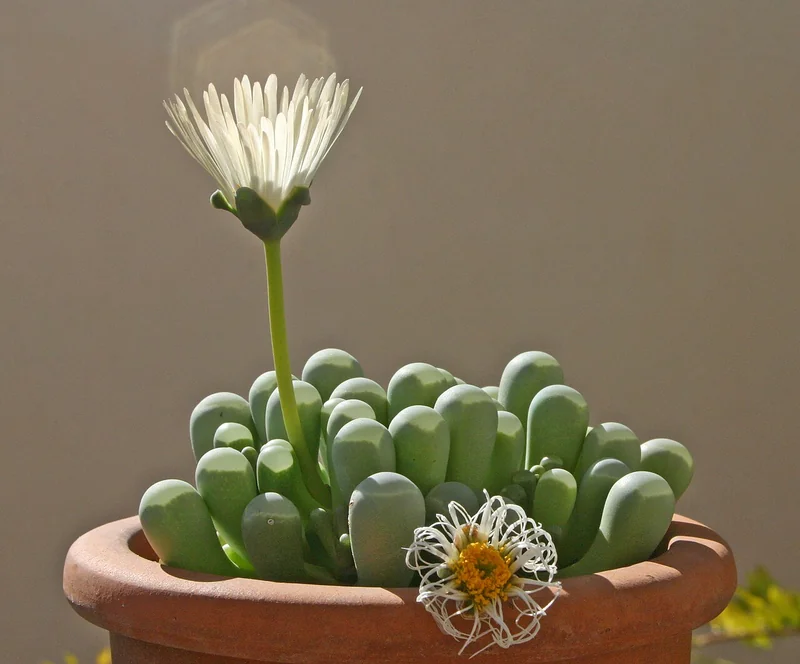 Featured photofenestraria-rhopalophylla.jpg
Fenestraria rhopalophylla, the Baby Toes plant, is a remarkable succulent from the Namib Desert that grows with only the translucent, flat-topped tip of each leaf exposed above the sand. The clear 'window' at the tip acts as a lens, channelling light to the photosynthetic tissue below — an evolutionary adaptation to extreme sun and heat. As a houseplant, it requires very bright light, minimal water, and exceptional drainage to thrive.
Care facts at a glance
- Light
- Bright indirect
- Water
- Water sparingly every 3–4 weeks in summer; almost no water in winter. Allow complete drying between waterings.
- Humidity
- 10–40 %
- Temperature
- 5–38 °C
- Soil
- Very gritty, fast-draining cactus and succulent mix: 50% mineral grit, 50% standard cactus compost.
- Origin
- Coastal fog desert of Namaqualand and the Namib Desert (South Africa and Namibia).
- Mature size
- 3–6 cm tall; clumping spread of 10–20 cm.
Overview
Fenestraria rhopalophylla (N.E.Br.) N.E.Br. is one of a small group of succulent plants that have evolved translucent leaf tips as a response to growing in fine, bright-white coastal sand. In its native habitat, the entire plant is buried by windblown sand with only the transparent tip exposed. The window filters UV radiation while allowing photosynthetically useful wavelengths to penetrate to the buried leaf tissue below. In cultivation the plant grows above ground, but still requires exposure to very bright light to maintain compact, healthy growth.
Care Priorities
- Maximum light is essential: a south-facing windowsill with direct morning sun is ideal. Low light causes elongated, etiolated leaves that lose the compact window-tipped form.
- Water only in the growing season (spring and late summer/autumn); during midsummer dormancy and winter, keep completely dry.
- Plant in a very shallow, wide pot with a deep grit layer at the base — the club-shaped leaves extend downward and need room.
- Never allow water to sit in the leaf clusters, which triggers rot at the base.
Common Problems
Long, stretched-out leaves that lose the characteristic club shape are a sign of insufficient light. Move to the brightest available windowsill immediately. Mushy, translucent leaf bases indicate rot from overwatering — remove affected leaves, dust with fungicide, and repot into completely dry, very gritty mix. Flower production (white to yellow daisy-like flowers) typically occurs in late spring; the plant will not bloom in low light or if it has been overwatered.
Sources & further reading (2)
- botanical-garden — accessed 2026-05-27
- encyclopedia — accessed 2026-05-27
Frequently asked questions
Why does it have transparent tips?
The flat, translucent tip of each leaf is a 'window' — a zone of clear tissue almost devoid of chlorophyll that acts as a light guide, transmitting wavelengths suitable for photosynthesis to the buried chlorophyll-rich tissue below. It is an adaptation to the high-sand, high-UV environment of the Namib Desert.
How much water does it need?
Very little. A typical adult plant needs water only 3–4 times during the growing season and essentially none in winter. When in doubt, do not water — Fenestraria recovers from drought far more easily than from overwatering.
Does it like direct sun indoors?
Yes, more than almost any other houseplant. A south-facing window with unfiltered direct morning sun is ideal. Without very bright light, the characteristic compact, window-tipped growth cannot be maintained.