Mammillaria hahniana
Mammillaria hahniana Care Guide
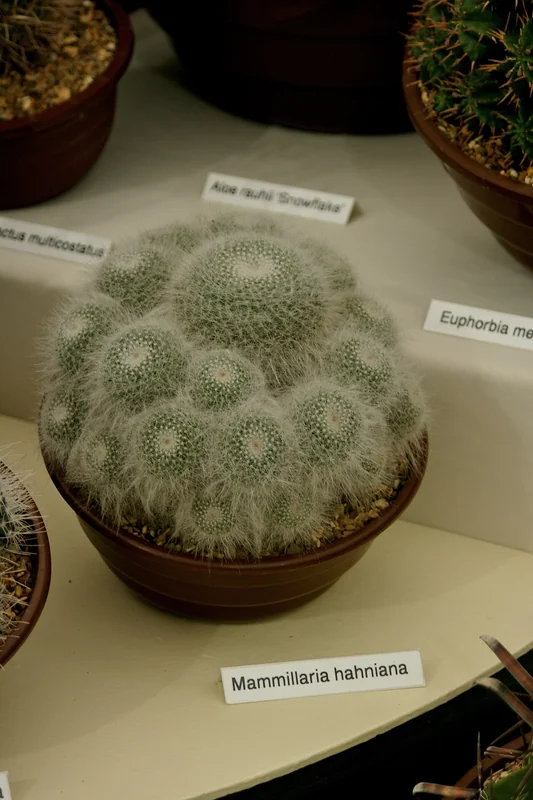 Featured photomammillaria-hahniana.jpg
Mammillaria hahniana is one of the most beloved Mexican cacti in cultivation, covered in a dense mat of fine white hairs and bristles that entirely obscure the plant body and produce a remarkably soft, cotton-wool appearance. In spring it produces a striking halo of small, bright carmine-pink to purple flowers around the growing apex. Easy to grow, long-lived, and producing offsets freely over time, it is an ideal cactus for beginners and windowsill collectors who want reliable annual flowering with minimal care.
Care facts at a glance
- Light
- Bright indirect
- Water
- Water thoroughly when the substrate is completely dry; every 14 to 21 days in summer, once every 4 to 6 weeks in winter.
- Humidity
- 20–50 %
- Temperature
- 5–35 °C
- Soil
- Cactus and succulent compost mixed with 50 percent coarse sand or fine grit for maximum drainage.
- Origin
- Semi-arid hillsides and rocky limestone outcrops of central Mexico (Querétaro, Guanajuato).
- Mature size
- Globe to 10 to 20 cm diameter; forms clumps over time.
Overview
Mammillaria hahniana was described by Werdermann in 1929 and is named for German cactus enthusiast Friedrich Hahn. It is native to the semi-arid Chihuahuan Desert transition zone of central Mexico, growing on limestone hillsides and in rocky soils where rainfall is seasonal and drainage is fast. The dense white hairs are modified spines that serve both as insulation against extreme temperatures and as a light-reflecting surface reducing heat absorption. The annual crown of carmine-pink flowers is produced from the previous year's flower positions, forming a characteristic halo or ring pattern typical of the Mammillaria genus.
Care Priorities
- Maximum light is essential for a compact, densely spined growth habit; insufficient light produces a stretched, pale plant that flowers poorly.
- Water at the soil level only — the fine white hairs trap water and can cause rotting of the plant body if the wool becomes consistently wet.
- A cool, dry winter rest — temperatures of 5 to 10 °C with minimal watering — is the primary driver of reliable spring flowering.
- Use very free-draining substrate; root rot is the main cause of plant death and is entirely preventable with proper soil and watering.
Common Problems
Root rot from overwatering is the most common cause of death; the hairy exterior can obscure early signs of base rot until the plant topples. Check the base annually for softness or discolouration. Mealybugs are particularly problematic as they hide within the white wool; use a fine-tipped artist's brush dipped in isopropyl alcohol to reach them, or apply systemic insecticide. Etiolation — a stretched, pale, thin-spined plant — results from insufficient light; a south-facing windowsill or supplemental grow light prevents this. Red spider mites in hot, dry conditions cause yellowing and webbing on the plant body.
Sources & further reading (2)
- botanical-garden — accessed 2026-05-08
- encyclopedia — accessed 2026-05-08
Frequently asked questions
Is the white hair actually hair or spines?
The white filaments are radial spines — modified leaf structures like all cactus spines. They are soft and fine compared to the central spines and give the classic 'old lady' appearance.
When does it flower?
Typically in spring — late March to May in the Northern Hemisphere. The ring of carmine-pink flowers appears around the growing apex and is most prolific after a cool, dry winter rest.
How do I encourage offsets?
Offsets appear naturally at the base of mature plants. Once they develop their own root primordia (visible as tiny white bumps at the base), they can be carefully detached and potted in dry cactus mix.