Echinocactus grusonii
Echinocactus grusonii Care Guide
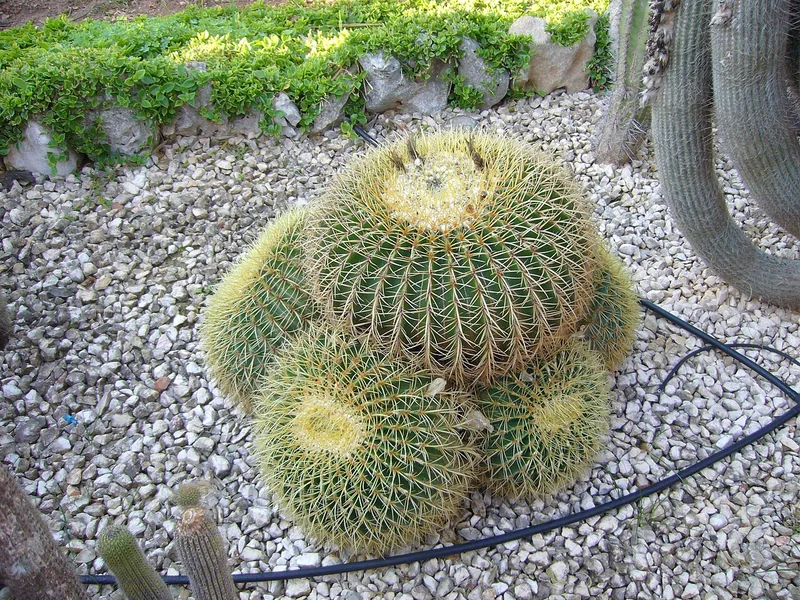 Featured photoechinocactus-grusonii.jpg
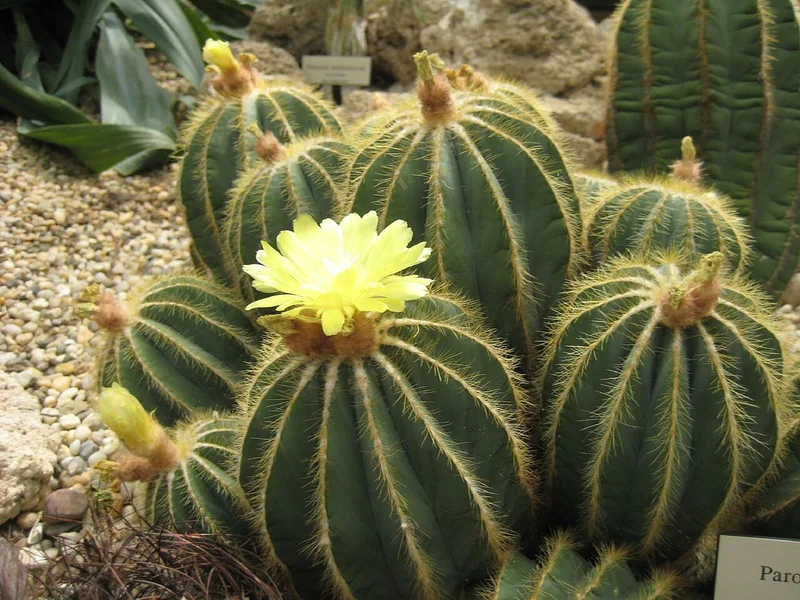
Echinocactus grusonii is one of the most recognised cacti in the world — the Golden Barrel Cactus, a perfectly globose to short-cylindrical Mexican cactus armoured with prominent ribs lined with clusters of brilliant golden-yellow spines. Slow-growing and long-lived, it develops from a small globe into a substantial barrel over decades. It is critically endangered in its wild habitat but widely cultivated worldwide. Cheerful yellow flowers crown the apex of mature specimens in summer. It requires full sun and very free drainage, rewarding minimal-care approaches with decades of architectura...
Care facts at a glance
- Light
- Bright indirect
- Water
- Water every 14 to 21 days in summer; once a month or not at all in winter.
- Humidity
- 20–50 %
- Temperature
- 5–40 °C
- Soil
- Very free-draining cactus mix: 50% coarse grit or perlite, 50% cactus potting compost. Excellent drainage is the single most critical requirement.
- Origin
- Querétaro and Hidalgo states of central Mexico; CRITICALLY ENDANGERED in the wild due to habitat loss.
- Mature size
- Globe to short cylinder; to 90 cm tall and 60 cm diameter over decades. Most indoor specimens stay 15–40 cm.
Overview
Echinocactus grusonii Hildm. was described in 1891 by Heinrich Hildmann. It is named for Hermann Gruson, a German engineer and cactus collector. The species is native to a small area in the states of Querétaro and Hidalgo in central Mexico and is classified as Critically Endangered by the IUCN — its wild population has declined by over 90% due to reservoir construction at Zimapán that flooded much of its native habitat. Conservation populations are maintained in botanic gardens worldwide. The spines are modified leaves and serve multiple functions: physical defence, shade (reducing the apex temperature by reflecting light), and moisture collection (fog and dew drip down the spines to the roots).
Care Priorities
- Maximum available direct sunlight is essential; without direct sun the plant slowly etiolates, losing its perfect globe shape and golden spine colour.
- A full winter drought (no watering October–March) is not optional; watering in cool winter conditions almost always causes root rot.
- Grow in a terracotta pot rather than plastic; the porous walls allow faster moisture loss from the medium.
- The apex (top) of the cactus has a distinctive woolly crown — do not allow water to pool in this area.
- Handle with thick gloves or folded newspaper; the stout golden spines are sharp and cause splinters difficult to remove.
Common Problems
Etiolation (elongating, losing spherical shape) is caused by insufficient light; once distorted, the shape cannot be restored on existing tissue, though new growth in better conditions will be properly formed. Root rot from winter watering shows as sudden softening of the base of the barrel; cut away all soft tissue with a sterile knife, dust with fungicide, and allow to callous before replanting in fresh, dry medium. Mealybugs in the woolly areoles are difficult to spot and treat; use a systemic insecticide drench into the medium. Scale insects on the ribs can be treated with horticultural oil.
Sources & further reading (2)
- botanical-garden — accessed 2026-05-27
- encyclopedia — accessed 2026-05-27
Frequently asked questions
Does it ever flower indoors?
Rarely — flowers are produced by large, mature specimens (20+ years old, 30+ cm diameter) in full direct sun. Indoor specimens in less-than-full-sun conditions typically do not flower. The yellow flowers crown the woolly apex in summer; botanic garden specimens produce them reliably. For most indoor growers, the perfect golden form of the plant is the primary attraction.
How fast does it grow?
Very slowly — a 5 cm seedling takes approximately 10 years to reach 15 cm diameter, and a 30 cm specimen may be 25–30 years old. This slow growth is part of its appeal as a long-lived, low-maintenance specimen. Growth is fastest in full direct sun with appropriate summer watering.
Is it dangerous?
The spines are stout and sharp but not hooked, so they do not embed as deeply as some cacti. They cause significant puncture wounds and can cause splinter-like pain if broken under the skin. Use thick gloves or folded newspaper for all handling. Do not place where children or pets could fall onto the plant.