Dendrobium nobile
Dendrobium nobile Care Guide
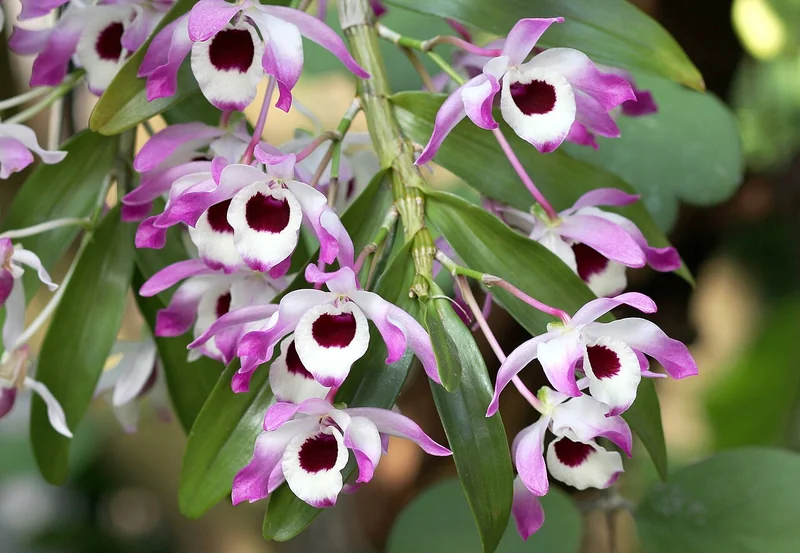 Featured photodendrobium-nobile.jpg
Dendrobium nobile is a cool-growing, deciduous cane orchid from the Himalayan foothills to South China, producing clusters of large, fragrant, white to rosy-pink flowers with a dark purple throat directly from the nodes along each mature cane in late winter to spring. It is one of the most widely grown orchid species, having spawned an enormous hybrid industry of 'nobile-type' dendrobiums bred for florist and houseplant use. With the right cool winter rest period, it flowers reliably and spectacularly, transforming bare winter canes into flower-laden columns.
Care facts at a glance
- Light
- Bright indirect
- Water
- Water thoroughly once a week in summer; reduce to once every 3 to 4 weeks in winter rest.
- Humidity
- 50–70 %
- Temperature
- 10–30 °C
- Soil
- Coarse bark mix in a small pot; prefers being slightly root-bound rather than overpotted.
- Origin
- Himalayan foothills through Southeast Asia to South China and Taiwan; epiphytic in mountain forests.
- Mature size
- Canes 30 to 60 cm long; flowers 5 to 8 cm across.
Overview
Dendrobium nobile was described by Lindley in 1830 and is the type species for section Dendrobium within the genus. It is epiphytic to lithophytic across its wide natural range, growing on tree branches and rocky cliff faces in the subtropical to warm temperate mountain forests of the Himalayas, southern China, and mainland Southeast Asia. It experiences a pronounced monsoon climate — a wet, warm growing season from spring through summer and a dry, cool resting season from October through February. This seasonal cycle drives its flowering: new canes grow in summer, and the cool dry winter triggers flower bud initiation at every node along the mature cane.
Care Priorities
- A cool, dry winter rest period — temperatures of 10 to 15 °C and near-dry conditions — is the single most important care requirement for reliable annual flowering.
- In summer, grow warm and water freely with weekly dilute fertilizer; new canes should be plump and firm by autumn.
- Do not remove old canes even after they have flowered; they may produce keiki plantlets in subsequent years.
- After flowering ends in spring, resume regular watering and feeding as new growth begins from the base.
Common Problems
Failure to flower is almost always caused by insufficient cool-dry rest in winter — if the plant is kept warm and regularly watered year-round it will grow vegetatively but not flower. Keiki (plantlets) forming on cane nodes instead of flowers indicate too much nitrogen fertilizer in late summer or insufficient cold; reduce feeding and ensure a distinct dry cool period. Shrivelled canes despite regular watering indicate root loss; check for root rot and repot if needed. Scale insects on canes are often overlooked — inspect the undersides of cane nodes regularly.
Sources & further reading (2)
- botanical-garden — accessed 2026-05-08
- encyclopedia — accessed 2026-05-08
Frequently asked questions
How cold can D. nobile tolerate?
It tolerates down to about 8 to 10 °C in the winter rest period — cooler than most houseplant orchids. A cool spare room, unheated greenhouse, or cool conservatory provides the ideal winter environment.
What is the difference between the species and hybrid 'nobile-type' dendrobiums?
Hybrid nobile-type dendrobiums are bred for compact size, specific colours, and greater ease of cultivation without an extreme winter rest. The species D. nobile is larger, more strongly fragrant, and requires a more disciplined seasonal cycle.
Can I water and fertilise in winter?
Only minimally — water at most once per month to prevent cane shrivelling, and do not fertilise at all. Continued feeding and regular watering in winter suppresses flowering.