Opuntia microdasys
Opuntia microdasys Care Guide
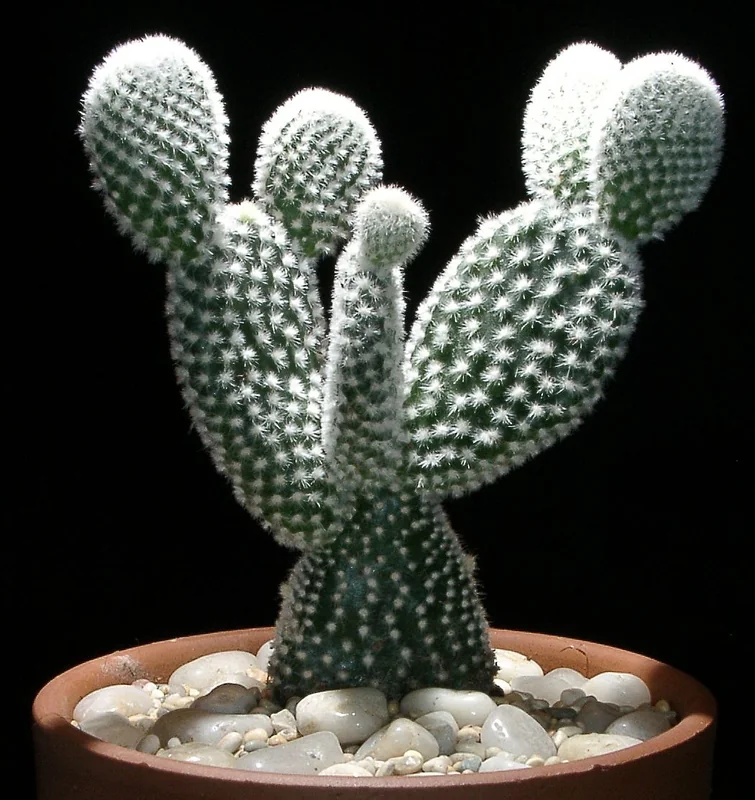 Featured photoopuntia-microdasys.jpg
Opuntia microdasys, the bunny ears cactus, is one of the most recognisable and widely grown cacti in the world — a flat-padded opuntia with oval, paired segments clustered with neat golden-yellow glochid tufts in a polka-dot pattern, giving it an endearingly harmless appearance that belies the minute, barbed glochids that embed painfully in skin on contact. Native to the Chihuahuan Desert of Mexico, it is easy to grow, fast-growing relative to other cacti, and produces bright yellow flowers on mature plants. It is ideal for sunny windowsills and bright indoor spaces.
Care facts at a glance
- Light
- Bright indirect
- Water
- Water when the substrate dries completely; every 10 to 14 days in summer, once a month in winter.
- Humidity
- 15–50 %
- Temperature
- 7–38 °C
- Soil
- Very free-draining cactus mix: cactus compost with 40 to 50 percent coarse sand or perlite.
- Origin
- Chihuahuan Desert, central and northern Mexico; naturalised in many warm regions worldwide.
- Mature size
- 60 to 90 cm tall indoors; individual pads 8 to 15 cm long.
Overview
Opuntia microdasys was described by Lehmann in 1827. Unlike most cacti, it lacks true spines in the typical varieties and instead bears glochids — tiny, barbed, hair-like spines produced from specialised areoles — in tight clusters called glochid tufts. Glochids break off on contact and are extremely difficult to remove from skin due to their microscopic backward-pointing barbs; always handle the plant with thick gloves or folded newspaper. The species name microdasys means 'short-haired' in Greek. Golden, white, and rufida (reddish) colour forms are common in cultivation. The flat pads are modified stems (cladodes) that carry out photosynthesis.
Care Priorities
- Maximum light including several hours of direct sun produces compact, well-coloured pads and is necessary for flowering; inadequate light causes thin, pale, disfigured pads.
- Handle only with thick gloves or folded newspaper; the glochids are effectively invisible and embed on the lightest contact.
- A cool, dry winter rest is essential for healthy seasonal growth cycles and eventual flowering; the plant is cold-tolerant when dry.
- The flat pads are susceptible to bacterial soft rot if physical damage allows entry; handle carefully during repotting.
Common Problems
Glochids embedded in skin are best removed with fine-tipped tweezers under a magnifying glass, or by applying PVA glue, letting it dry, and peeling it off. Scale insects on the pad surfaces can look similar to the glochid tufts and are easily missed; inspect closely and treat with systemic insecticide. Wrinkled, deflating pads indicate either severe underwatering or root loss; check roots before resuming watering. Bacterial soft rot as black, water-soaked lesions expands rapidly and requires immediate removal of affected pads with a sterile blade; dust the cut surface with sulphur fungicide.
Sources & further reading (2)
- botanical-garden — accessed 2026-05-08
- encyclopedia — accessed 2026-05-08
Frequently asked questions
Are the white dots actually harmless?
No — each white or golden dot is a cluster of hundreds of glochids that embed in skin, clothing, and mucous membranes on contact. The plant requires careful handling at all times despite its appealing appearance.
How do I propagate it?
Individual pads can be detached with tongs, allowed to callous for 1 to 2 weeks, and placed upright in dry cactus mix. They root readily in 4 to 8 weeks without watering.
When will it flower?
It requires several years of growth and full sun to flower — typically 3 to 5 years from a rooted pad to first bloom. The bright yellow flowers appear at the tips of pads in summer.