Ceropegia ampliata
Ceropegia ampliata Care Guide
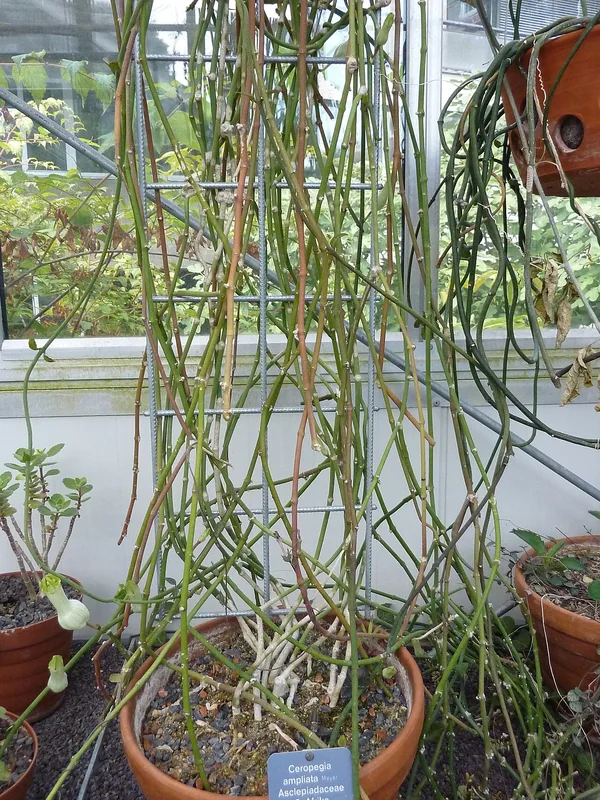 Featured photoceropegia-ampliata.jpg
Ceropegia ampliata is a slender-stemmed climbing succulent from South Africa, producing some of the most architecturally interesting flowers in the genus — inflated, lantern-shaped blooms of white with green stripes, the petal tips fusing at the apex into a hairy cage-like structure. The flowers function as temporary insect traps: visiting flies are detained briefly inside the corolla tube by downward-pointing hairs, dusted with pollen, then released when the hairs wither. The tuber-forming root system provides drought tolerance, making this an interesting and forgiving collector's plant.
Care facts at a glance
- Light
- Bright indirect
- Water
- Water when the medium has fully dried; every 14 to 21 days in summer. Very sparse in winter.
- Humidity
- 40–65 %
- Temperature
- 10–35 °C
- Soil
- Very fast-draining mix: 50% coarse sand or perlite, 50% potting mix. No added moisture-retentive material.
- Origin
- Arid and semi-arid regions of South Africa, particularly the Eastern Cape.
- Mature size
- Slender climbing or trailing stems to 1.5 m; leaves reduced and deciduous.
Overview
Ceropegia ampliata E.Mey. was described in 1838. It is a member of the large Ceropegia genus (subfamily Asclepiadoideae), which includes over 200 species distributed across Africa, the Canary Islands, Asia, and Australia. The genus name comes from Greek for 'wax fountain', referring to the shape of the flower bud. C. ampliata is notable for its elegant, inflated white flowers with green stripes and fused petal tips — the structural elaboration is an insect-trap pollination mechanism. The reduced, quickly deciduous leaves reflect an adaptation to arid conditions; photosynthesis occurs largely in the green stems.
Care Priorities
- Keep the tuber barely covered at the soil surface to ensure good drainage at the crown, which is the most rot-prone zone.
- Provide a thin support or allow it to trail — the slender stems are fragile if unsupported when climbing.
- A winter rest with almost no water (once a month or less) is standard; the deciduous nature of the leaves signals this natural dormancy.
- Bright light with some direct sun is required for good flowering; the flowers are the main attraction and won't appear without adequate light.
- Flowers last only a few days but appear in succession over weeks; do not remove the old flower stems.
Common Problems
Stem rot at the soil surface usually results from a wet crown — ensure the tuber sits just at or slightly above the soil line in a very free-draining medium. Sudden stem collapse when the plant appears otherwise healthy may indicate mealybugs on the tuber below the soil surface; unpot and inspect the root system. Failure to flower despite vigorous stem growth indicates insufficient light — move to a sunnier windowsill with some morning direct sun. If stems die back completely in winter, check the tuber is intact and firm; it will reshoot from the tuber when growth resumes in spring.
Sources & further reading (2)
- botanical-garden — accessed 2026-05-27
- encyclopedia — accessed 2026-05-27
Frequently asked questions
How does the insect-trap flower work?
The inflated, hairy corolla tube temporarily traps small flies attracted by the flower's odour and appearance. Downward-pointing hairs prevent the fly from escaping while it is dusted with pollen. After pollination the hairs wither, the fly escapes, and it carries the pollen to the next flower. The fly is not harmed — this is a temporary deception trap, not a carnivorous mechanism.
Does it need a lot of space?
No — the slender, wiry stems are easy to manage in a small pot with a trellis or thin support. The plant's greatest space need is vertical rather than horizontal. A 1 m tall narrow trellis in a 15 cm pot works well for an established specimen.
Can it be grown from seed?
Yes — Ceropegia seeds germinate reliably and seedlings grow relatively quickly to flowering size in 1–2 years. Seeds are available from specialist succulent seed suppliers. They should be sown fresh on a gritty medium, covered lightly, and kept at 22–25 °C.