Cryptanthus bivittatus
Cryptanthus bivittatus Care Guide
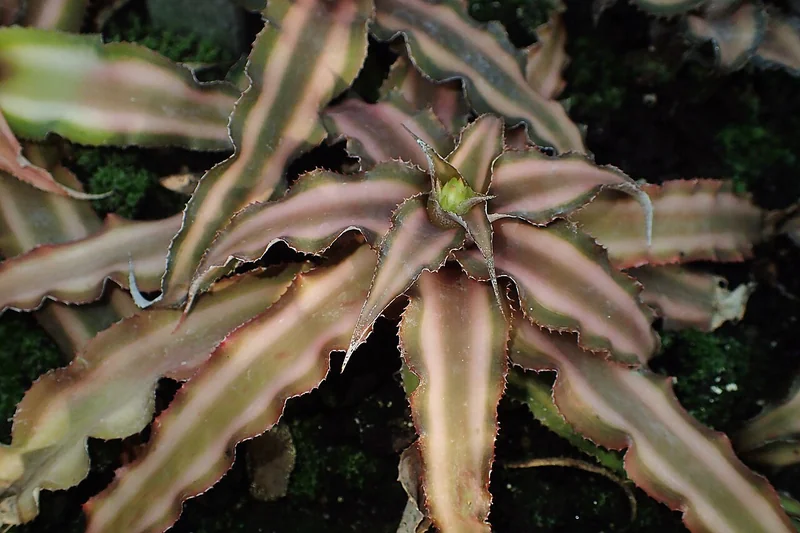 Featured photocryptanthus-bivittatus.jpg
Cryptanthus bivittatus, the Two-banded Earth Star, is a compact, terrestrial bromeliad from Brazil with flat, starfish-shaped rosettes of wavy-edged leaves striped in alternating bands of olive-green and cream that flush rose-pink to deep burgundy in good light. Unlike most bromeliads, it grows in the soil rather than as an epiphyte, and does not rely on a water-holding cup. Its compact size, dramatic patterning, and adaptability to average indoor humidity make it an easy and rewarding specimen.
Care facts at a glance
- Light
- Bright indirect
- Water
- Water the soil when the top 2–3 cm dries; approximately every 7 to 10 days. Mist the rosette lightly in dry conditions.
- Humidity
- 50–75 %
- Temperature
- 15–30 °C
- Soil
- Well-draining, slightly acidic potting mix; bromeliad or orchid bark mix with perlite.
- Origin
- Humid forests and rocky outcrops of southeastern Brazil.
- Mature size
- 10–20 cm tall; rosette 20–30 cm across.
Overview
Cryptanthus bivittatus (Hook.) Regel was described in 1868. The genus name means 'hidden flower', referring to the flowers that are nestled at the centre of the rosette at soil level rather than being elevated on a stalk. The rose-pink to burgundy colouration that develops in bright light is a sun-stress response mediated by anthocyanin production — the bands remain visible but the background turns from olive-green to rose. The wavy, undulate leaf margins are also characteristic and are more pronounced in good growing conditions.
Care Priorities
- Bright, indirect light is needed for the best pink and burgundy colouration; in low light the leaves revert to plain olive-green.
- As a terrestrial bromeliad, it is watered through the soil like a normal plant rather than via a cup.
- The flat, low-growing habit makes it excellent for terrariums, dish gardens, and mixed tropical planters.
- Offset production is the primary propagation method; allow pups to develop until they are at least 5 cm across before separation.
Common Problems
Plain green colouration with loss of the cream stripes indicates insufficient light; move to a brighter position. Central rosette rot can occur if water pools at the leaf bases in cool, damp conditions; improve airflow and water at the soil margin rather than the centre. Scale insects are the most common pest; they often match the striped leaf pattern and are easy to miss — inspect closely with a magnifying glass if growth is slow without explanation. The parent rosette dies slowly after flowering; pups continue the plant.
Sources & further reading (2)
- botanical-garden — accessed 2026-05-27
- encyclopedia — accessed 2026-05-27
Frequently asked questions
Why does it change colour?
The rose-pink to burgundy colouration is an anthocyanin sun-stress response — a protective pigment that develops when the plant receives high levels of bright light. The same mechanism that makes autumn leaves turn red operates here. The cream striping remains constant as it is genetic patterning in the leaf tissue.
Can it grow in a terrarium?
Yes — Cryptanthus bivittatus is an excellent terrarium plant. It stays compact, tolerates the higher humidity of a partly closed terrarium, and its flat, rosette form works well as a ground-level specimen. The one requirement is some bright light reaching the terrarium to maintain the pink colouration.
How is it different from Neoregelia?
The key differences: Cryptanthus is terrestrial (soil-growing) with no water-holding cup; Neoregelia is epiphytic with a central cup. Cryptanthus stays very flat and compact; Neoregelia has a wider, more open rosette. Both are tank-free bromeliads with colourful foliage but they require slightly different watering approaches.