Cotyledon orbiculata
Cotyledon orbiculata Care Guide
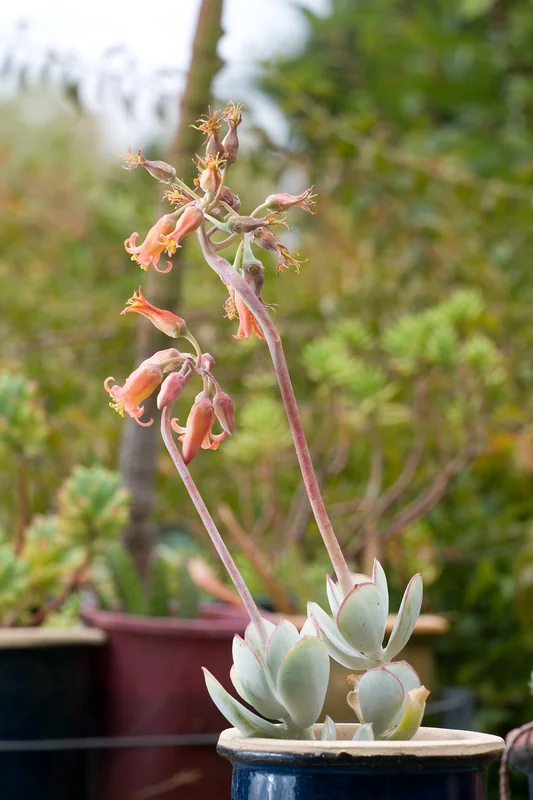 Featured photocotyledon-orbiculata.jpg
Cotyledon orbiculata, commonly known as the Pig's Ear, is a variable, sub-shrubby succulent native to South Africa and Namibia, producing thick, round to oval, grey-white waxy leaves with a distinctive red margin. In summer it sends up long, arching stems bearing pendant clusters of orange-red, tubular, bell-shaped flowers. It is one of the most adaptable and long-lived succulents for windowsill cultivation, tolerating neglect and varying light conditions with admirable resilience.
Care facts at a glance
- Light
- Bright indirect
- Water
- Water when the top half of the soil has dried, approximately every 2–3 weeks in summer. Water once a month or less in winter.
- Humidity
- 10–50 %
- Temperature
- 7–35 °C
- Soil
- Gritty, fast-draining cactus or succulent mix with added perlite or coarse sand.
- Origin
- Rocky hillsides, dry scrubland, and cliff faces of South Africa, Namibia, and Angola.
- Mature size
- 30–80 cm tall; loosely branching shrub.
Overview
Cotyledon orbiculata L. is one of the most variable succulent species in southern Africa, with numerous named varieties and forms spanning a wide range of leaf shapes, sizes, and colouring — from nearly cylindrical to broadly spoon-shaped, and from deep green to almost pure white with farina. The white or grey waxy coating (farina) on the leaves reflects intense sunlight and reduces water loss. The pendant orange flowers, held on tall, branching stalks in summer, are adapted for pollination by sunbirds in its native habitat.
Care Priorities
- Bright light, ideally with some direct morning sun, maintains compact growth and the best leaf colouration.
- Water at the soil level, not overhead — the white farina is hydrophobic and water droplets can cause permanent spotting.
- Good airflow is important — the plant is susceptible to powdery mildew in stagnant, humid conditions.
- Repot every 2–3 years in spring, using fresh gritty compost.
Common Problems
Loss of the red leaf margin usually indicates insufficient light — move to a brighter position with some direct sun. Mealybugs are the most common pest, appearing as white cottony deposits in leaf axils; treat with 70% isopropyl alcohol on a cotton bud or insecticidal soap spray. Leaf bases that turn yellow and mushy indicate root rot; improve drainage immediately. The plant is long-lived and can persist for decades with minimal care, developing an attractive woody stem base over time.
Sources & further reading (2)
- botanical-garden — accessed 2026-05-27
- encyclopedia — accessed 2026-05-27
Frequently asked questions
Why is there a white powder on the leaves?
The white powder is called farina — a waxy bloom produced by the plant's surface cells. It acts as a sunscreen, reflecting intense radiation, and also reduces water loss by forming a barrier against vapour exchange. It is a feature, not a problem, and should not be cleaned off.
How do I encourage it to flower?
Cotyledon orbiculata blooms most reliably when given maximum light and a cool, dry rest period in winter. Reduce watering from autumn through early spring, and the plant should produce flower stalks in early to midsummer.
What are the different varieties?
The species is highly variable. 'Oophylla' has nearly cylindrical, pencil-like leaves; 'Undulata' has wavy leaf margins; 'Silver Waves' has very white, undulate leaves. All varieties have essentially the same care requirements.