Coelogyne cristata
Coelogyne cristata Care Guide
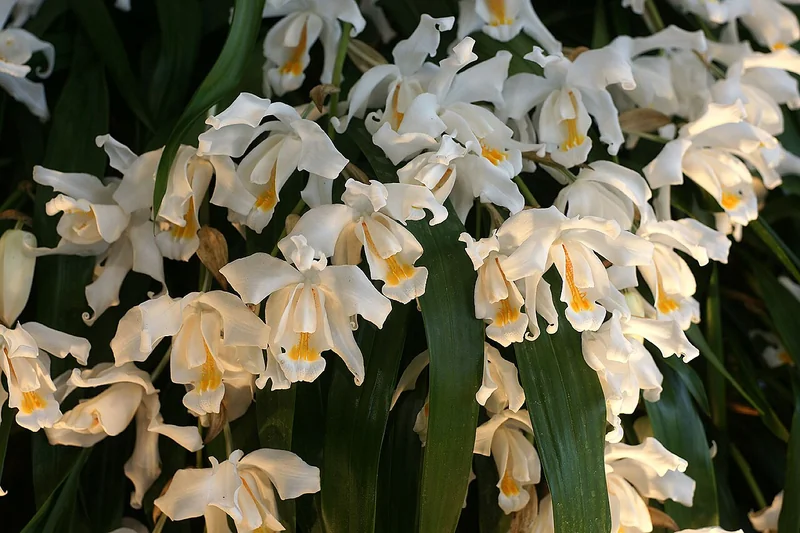 Featured photocoelogyne-cristata.jpg
Coelogyne cristata is a spectacular cool-growing orchid from the Himalayan foothills of Nepal and northern India, producing long, cascading racemes of 5–10 large, pure-white flowers with a distinctive bright orange-yellow crested ridge on the lip. It blooms in winter to early spring — January to March in the northern hemisphere — when its crystal-white flowers are a breathtaking contrast to the grey season. It requires a cool winter rest to initiate bloom but is otherwise robust and long-lived, making it an ideal choice for cool conservatories and unheated rooms.
Care facts at a glance
- Light
- Bright indirect
- Water
- Water every 7 days in spring and summer. Reduce to once every 3 weeks in autumn and winter rest.
- Humidity
- 55–80 %
- Temperature
- 2–25 °C
- Soil
- Well-draining orchid bark mix (medium grade) in a wooden slatted basket or shallow pan. Roots need excellent airflow.
- Origin
- Himalayan foothills of Nepal, northern India (Sikkim, Assam), and Bhutan at 1,200–2,500 m elevation.
- Mature size
- Cascading pseudobulbs to 8 cm; flower racemes to 25–35 cm with 5–10 flowers per spike.
Overview
Coelogyne cristata Lindl. was described in 1824, shortly after specimens were brought back from Nepal to Britain. It quickly became one of the most popular greenhouse orchids of the Victorian era. The species name cristata means 'crested' — referring to the three prominent orange-yellow ridges (crests) on the lip, which serve as nectar guides for pollinators. Growing at elevations of 1,200–2,500 m in the Himalayan foothills, it experiences cool winters (sometimes near freezing), dry spells, and strong monsoon summer rains — all of which must be replicated in cultivation for reliable flowering.
Care Priorities
- A cool, dry winter rest (2–10 °C) from October to January is mandatory for flower bud initiation; without this the plant grows vegetatively but rarely flowers.
- In the northern hemisphere this orchid blooms January–March; the cooling is therefore timed to autumn and early winter.
- Grow in a slatted basket or shallow pan to allow cascading growth and root airflow; roots die in closed pots with poor drainage.
- Strong bright light (not direct midday sun) is important in summer to build the pseudobulbs that will carry the winter flower spikes.
- After blooming, fertilise and water regularly through summer to build robust pseudobulbs for the following winter.
Common Problems
Non-flowering is almost always caused by insufficient winter cool; temperatures must drop below 12 °C at night for several weeks to initiate buds. Pseudobulb wrinkling during the winter rest is normal and expected; the pseudobulbs should firm up after flowering and resumption of watering. Root rot beneath the bark surface is difficult to detect; unpot periodically to check root health and repot into fresh bark every 2–3 years. Scale insects on the pseudobulbs are the most common pest; treat with horticultural oil and remove individually with a cotton bud dipped in isopropyl alcohol.
Sources & further reading (2)
- botanical-garden — accessed 2026-05-27
- encyclopedia — accessed 2026-05-27
Frequently asked questions
How cold can it go?
C. cristata is remarkably cold-tolerant — it can survive brief periods to 2 °C and grows naturally in habitats that experience near-frost in winter. A cool conservatory, unheated greenhouse, or cold spare bedroom (5–10 °C winter nights) is ideal. It is one of the most cold-hardy commonly cultivated orchids.
Can I grow it on a windowsill?
Yes — a cool, north- or east-facing windowsill in winter (near single-glazed glass where temperatures are cooler) combined with a south or west-facing position in summer provides the seasonal variation it needs. Move the plant or use a separate summer spot if the winter windowsill gets too warm.
How large do the flowers get?
Individual flowers are 6–8 cm across — substantial for the genus. On an established plant with multiple pseudobulbs, several flower spikes can appear simultaneously, creating a cascade of dozens of white flowers. The flowers last 3–4 weeks in cool conditions and have a light, pleasant fragrance.