Cattleya walkeriana
Cattleya walkeriana Care Guide
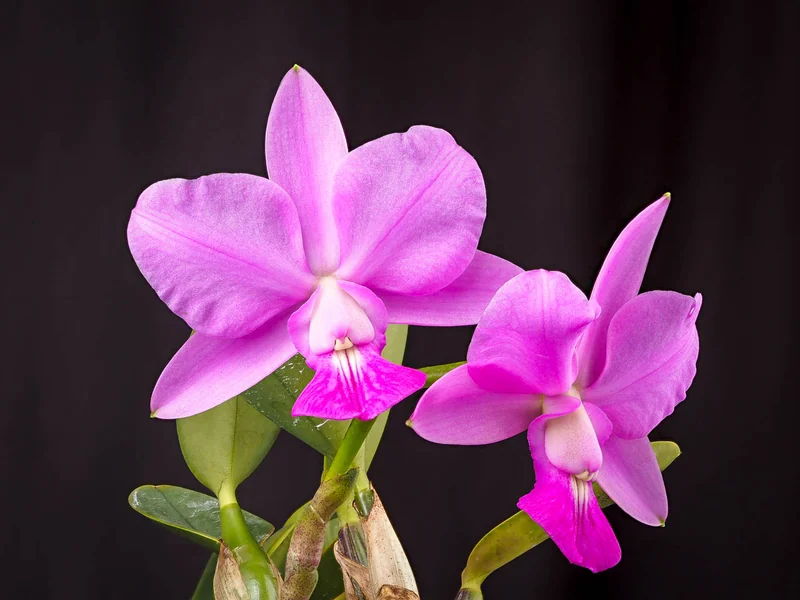 Featured photocattleya-walkeriana.jpg
Cattleya walkeriana is a compact, rupestral (rock-growing) Brazilian cattleya revered in the orchid world for its exceptionally powerful vanilla-cinnamon fragrance and rich rosy-purple to magenta flowers held at the end of a separate, leafless spike. Named for J. Walker, a British consul who collected in Brazil, it grows naturally on rocky outcrops and in gallery forests of the Brazilian cerrado and is threatened in its native habitat. Its compact size, spectacular fragrance, and beautiful flowers make it one of the most prized Cattleya species among collectors.
Care facts at a glance
- Light
- Bright indirect
- Water
- Water thoroughly when the bark mix has dried completely; every 10 to 14 days in summer, less in winter.
- Humidity
- 50–70 %
- Temperature
- 15–32 °C
- Soil
- Very coarse bark or mounted on cork bark or tree fern; exceptional drainage is critical.
- Origin
- Rocky cerrado outcrops and gallery forests of Minas Gerais and São Paulo, Brazil.
- Mature size
- 20 to 35 cm tall; flowers 8 to 12 cm across.
Overview
Cattleya walkeriana was described by Gardner in 1839 and has a unique growth habit: the flower spike emerges from the base of the pseudobulb, separate from the leaves, and produces one or two flowers that face outward on a short stem. This unusual inflorescence habit, along with the extraordinary fragrance — described variously as vanilla, cinnamon, or clove — makes it immediately distinctive among the Cattleya genus. In nature it is a rupestral species, growing on quartzite rock faces and exposed cliff ledges where it experiences strong light, excellent drainage, and distinct wet and dry seasons.
Care Priorities
- Strong, indirect to filtered direct light is needed; it tolerates more light than forest-dwelling Cattleya species due to its rock-face habitat.
- A pronounced dry rest period in winter — reducing watering to once per month or less — is essential to trigger flowering in spring.
- Mounting on cork bark or tree fern panel replicates the rocky, free-draining habitat and promotes the best root and pseudobulb development.
- The fragrance is most intense in morning; position the plant where the morning air allows it to diffuse into the room.
Common Problems
Failure to bloom is most commonly caused by insufficient light or the absence of a winter dry rest period; both are critical for this cerrado-adapted species. Overwatering during the rest period, when growth has slowed or stopped, causes rapid root rot in the coarse bark; reduce watering to near-zero in winter. Scale insects on the compact pseudobulbs and underside of the single leaf are a persistent problem; inspect monthly and treat with neem oil. Thrips damage shows as silvery streaking on the petals and buds; treat with insecticidal soap at the bud stage before flowers open.
Sources & further reading (2)
- botanical-garden — accessed 2026-05-08
- encyclopedia — accessed 2026-05-08
Frequently asked questions
Why is the flower spike separate from the leaves?
This is a consistent botanical feature of C. walkeriana — the inflorescence emerges from the base of the pseudobulb (a rhizome node) rather than from the apex, which is the opposite of most Cattleya species. It is the most immediately distinctive feature of the species.
How strong is the fragrance?
It is among the most powerful fragrances in the orchid world — a single flower can scent a room. The vanilla-cinnamon scent is most intense in morning sunlight and has made it one of the most sought-after species in the genus.
Is it difficult to flower consistently each year?
It requires discipline in the winter rest period — a prolonged dry period with cooler nights triggers the floral initiation. Once the correct winter rest regime is established, it flowers reliably each spring.