Aloe variegata
Aloe variegata Care Guide
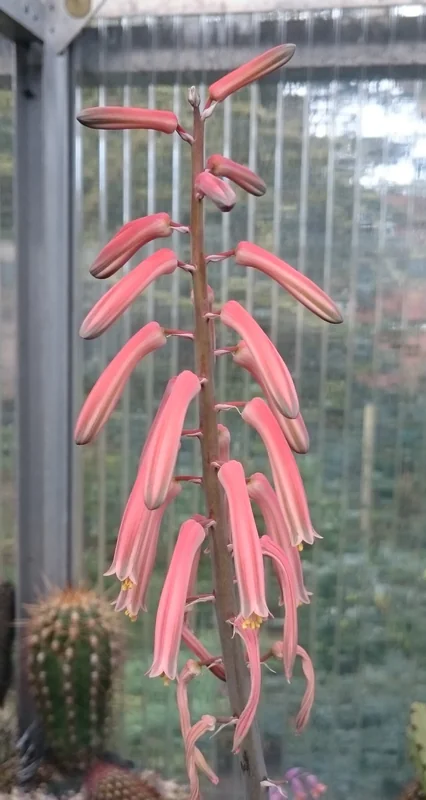 Featured photoaloe-variegata.jpg
Aloe variegata, the Partridge Breast Aloe or Tiger Aloe, is one of the most recognisable dwarf aloes, producing stiff, triangular, dark-green leaves strongly marked with irregular white horizontal bands arranged in a neat, three-ranked spiral. Native to dry scrubland in South Africa and Namibia, it is compact, slow-growing, and offsets to form small clumps. It produces attractive salmon-red tubular flowers in spring and is well-adapted to bright, dry windowsill conditions.
Care facts at a glance
- Light
- Bright indirect
- Water
- Water every 2–3 weeks in summer when completely dry; once a month or less in winter.
- Humidity
- 10–40 %
- Temperature
- 5–38 °C
- Soil
- Very gritty, fast-draining cactus mix; excellent drainage at the rosette level is critical.
- Origin
- Dry scrubland and rocky slopes of South Africa and southern Namibia.
- Mature size
- 20–30 cm tall; tight, stemless or short-stemmed rosette.
Overview
Aloe variegata L. was described by Linnaeus in 1753 and has been cultivated as a houseplant in Europe for over 300 years. The three-ranked arrangement of leaves (distichous to tristichous phyllotaxy) is unusual in aloes and creates the distinctive fan-like appearance. The white cross-banding functions as camouflage in its native habitat of broken light under shrubs. 'Kanniedood' in Afrikaans translates as 'cannot die', referencing its remarkable drought tolerance. The species name 'variegata' refers directly to the banded markings.
Care Priorities
- Provide maximum bright light with some direct morning sun; the banding contrast is maintained best under bright conditions.
- Water at the soil level, never into the rosette — the tightly stacked leaves trap moisture and can develop rot at the centre.
- After watering, tip the pot slightly to ensure no water pools at the base of the central leaves.
- Top-dress with mineral grit around the plant to keep moisture away from the leaf bases.
Common Problems
Central rosette rot is the most common problem, caused by water collecting between the tightly packed leaves. Symptoms are a brown, mushy centre that spreads outward. Remove affected tissue immediately, allow to dry completely, and avoid any overhead watering in future. Mealybugs shelter deep in the leaf axils; apply diluted isopropyl alcohol directly with a cotton bud. Fading of the white bands indicates insufficient light; improve light levels gradually to restore the pattern in new growth.
Sources & further reading (2)
- botanical-garden — accessed 2026-05-27
- encyclopedia — accessed 2026-05-27
Frequently asked questions
How do I water without getting the rosette wet?
Water gently at the soil level at the edge of the pot, never overhead or into the centre of the rosette. Alternatively, use the bottom-watering method: place the pot in 2–3 cm of water for 20 minutes to allow the roots to absorb moisture from below, then remove and allow to drain.
When does it flower?
Typically from late winter to early spring. Mature plants produce an unbranched spike 30–40 cm tall bearing pendant tubular flowers in salmon-red to orange-red. A cool, slightly drier winter rest promotes reliable flowering.
How is it different from A. haworthioides?
A. variegata is larger (to 30 cm), with a clearly three-ranked leaf arrangement and bold white horizontal banding. A. haworthioides is smaller and has a more typical aloe rosette. The white markings in A. variegata are horizontal bands, not tubercles.