Canis lupus familiaris
South Russian Ovcharka
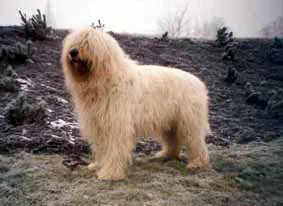 Featured photosouth-russian-ovcharka.jpg
The South Russian Ovcharka is a large, white or pale-coloured livestock guardian dog of Ukraine and the southern Russian steppe, believed to have developed from the crossing of indigenous steppe dogs with Spanish Merino flock-guarding dogs brought to the Kherson region in the late 18th century. The breed was refined on the famous Askania-Nova estate in Ukraine. The FCI registers it as No. 326 under Ukraine's patronage. Males stand 62–66 cm.
Quick facts
- AKC group
- Working
- Origin country
- Ukraine
- Origin period
- Late 18th century
- Coat type
- Long
- Coat colors
- White, White with Yellow Tinge, Pale Grey
- Average lifespan
- 9-11 years
- Recognition
- FCI 1983 · Group 1 — Sheepdogs and Cattledogs (Section 1: Sheepdogs)
Origin
The origins of the South Russian Ovcharka lie in the late 18th century, when the Russian Empire under Catherine the Great invited German colonists and Spanish settlers to the southern Ukrainian steppes to develop the wool industry. The Spanish settlers brought Merino sheep along with their traditional flock-guarding dogs — likely from the Spanish Mastiff and related Iberian livestock-guardian tradition. These Spanish dogs crossed with the robust steppe dogs of Ukraine to produce a hardy, weather-resistant livestock guardian. The Askania-Nova estate in the Kherson province — developed from 1828 by German count Friedrich von Falz-Fein — became the most important breeding centre.
Recognition
Soviet cynologists standardised the breed in the mid-20th century as the 'Yuzhnorusskaya Ovcharka' (South Russian Shepherd Dog). The FCI recognised the breed under standard No. 326 in 1983, initially with the USSR as patron country; after the Soviet Union's dissolution, Ukraine assumed patronage. The FCI assigns the breed to Group 1 — Sheepdogs and Cattledogs (Section 1: Sheepdogs). The breed is not currently recognised by the AKC or UKC.
Standard
The FCI standard describes a large, well-boned, muscular dog with a slightly longer-than-tall rectangular build, a moderately long head, and a thick, profuse, harsh-textured coat that grows over the eyes and hangs down the face — a distinguishing feature. The coat is white or white with a pale yellow tinge; pale grey is also accepted. The tail is long and reaches at least to the hock. Males stand 62–66 cm; females 58–64 cm. The abundant coat provides excellent protection against the extreme temperatures of the Ukrainian and Russian steppe.
Sources & further reading (3)
- fci-standard — accessed 2026-05-27
- encyclopedia — accessed 2026-05-27
- kennel-club-registry — accessed 2026-05-27
Frequently asked questions
How did Spanish dogs end up in Ukraine?
Catherine the Great invited Spanish and German colonists to the southern Ukrainian steppes (Kherson and Zaporizhzhia regions) in the 1760s–1780s to develop the wool industry and settle the newly acquired Black Sea territories. Spanish colonists brought Merino sheep from Spain along with their traditional flock-guarding dogs, probably descendants of the Spanish Mastiff and related Iberian guardian breeds. These Spanish dogs then crossed with local steppe dogs over several generations to produce the South Russian Ovcharka type.
Is the South Russian Ovcharka AKC recognised?
The South Russian Ovcharka is not currently recognised by the AKC or UKC. The FCI has recognised the breed since 1983 under standard No. 326, with Ukraine as patron country (originally the USSR). The breed is maintained primarily in Ukraine, Russia, and several Eastern European countries.
What role did Askania-Nova play in the breed's development?
Askania-Nova, a nature reserve and estate in the Kherson province of Ukraine, was the most important breeding centre for the South Russian Ovcharka from its founding in 1828. The estate's founder, German count Friedrich von Falz-Fein, and later his son Friedrich II, maintained large Merino sheep flocks and the guardian dogs that protected them, selectively breeding for the best working specimens. The Askania-Nova population established the foundational breed type that Soviet cynologists later standardised.