Canis lupus familiaris
Alaskan Malamute
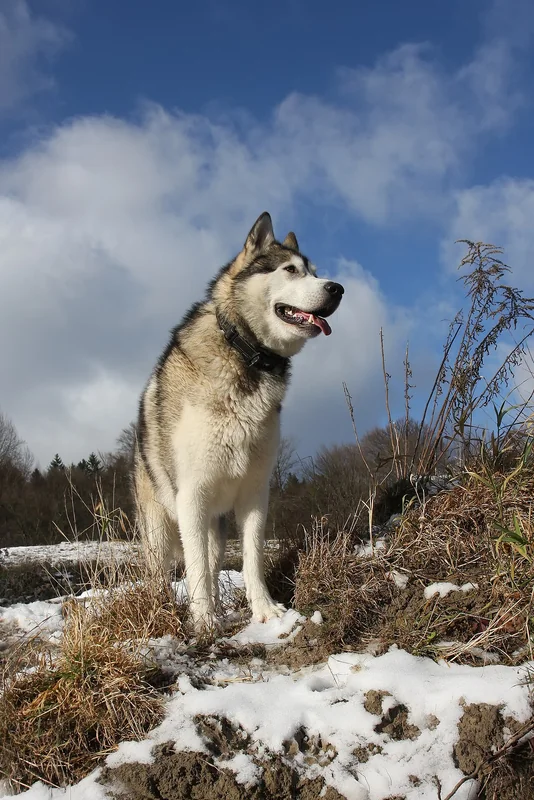 Featured photoalaskan-malamute.jpg
The Alaskan Malamute is a largest Arctic sled-dog — the heavy-freight dog of the Mahlemiut people of Norton Sound. The Alaskan Malamute is the largest of the Arctic sled-dog breeds and was developed by the Mahlemiut (now spelled Mahlemut) people of the Norton Sound region of Alaska as a heavy-haul sled dog capable of sustained hauling of large loads at moderate speeds — distinct from the lighter, faster Siberian Husky and Samoyed.
Quick facts
- AKC group
- Working
- Origin country
- United States (Alaska)
- Origin period
- Pre-contact (Mahlemiut people of Norton Sound)
- Coat type
- Double
- Coat colors
- Light Grey through Black, Sable, Red — with the breed's characteristic facial markings, all over a white underside
- Average lifespan
- 10-14 years
- Recognition
- AKC 1935 · FCI 1965 · UKC 1947 · Group 5 — Spitz and Primitive Types (Section 1: Nordic Sledge Dogs)
Origin
The Alaskan Malamute was developed by the Mahlemiut (now spelled Mahlemut) people of the Norton Sound region of Alaska as a heavy-haul sled dog capable of sustained hauling of large loads at moderate speeds, distinct from the lighter, faster Siberian Husky and Samoyed used elsewhere in the Arctic. The breed name comes from the Mahlemiut tribe; the breed and the tribe were given the spelling 'Malamute' by 19th-century traders. The breed was nearly lost during the 1925 Nome serum run and the subsequent gold-rush era cross-breeding. The Alaskan Malamute Club of America was founded in 1935 and the AKC admitted the breed the same year, working from a small foundation of dogs purchased by Eva 'Short' Seeley from the freight-dog kennels of Alaskan adventurer Arthur T. Walden. The breed served extensively in the Second World War as a search-and-rescue and freight-haul dog with the United States Army.
Recognition
The American Kennel Club admitted the breed in 1935, the United Kennel Club followed in 1947, and the Federation Cynologique Internationale published the international standard (FCI No. 243) in 1965. The FCI assigns the breed to Group 5 — Spitz and Primitive Types (Section 1: Nordic Sledge Dogs).
Standard
The AKC and FCI standards describe a powerful, substantially-built dog with a deep chest and strong, well-muscled body — the heavy-built freighting dog of the Arctic. The double coat is thick, with a coarse outer coat and a dense, wooly, oily undercoat from 2.5 to 5 cm thick. Recognized colours are light grey through to black, sable, and red — always with white on the underbody, parts of the legs, feet, and part of the face markings. Males stand 64-71 cm at the withers, females 58-64 cm.
Sources & further reading (3)
- kennel-club-registry — accessed 2026-05-04
- encyclopedia — accessed 2026-05-04
- fci-standard — accessed 2026-05-04
Frequently asked questions
What is the Alaskan Malamute's AKC group?
The American Kennel Club places the Alaskan Malamute in the Working Group. The Working Group gathers breeds developed for jobs other than herding or hunting — guarding, draft, sled work, and water rescue — including the Boxer, Rottweiler, Saint Bernard, and Newfoundland. The breed's foundation working role was as a largest Arctic sled-dog — the heavy-freight dog of the Mahlemiut people of Norton Sound.
When was the Alaskan Malamute officially recognized?
The American Kennel Club admitted the breed in 1935; the United Kennel Club followed in 1947; the Federation Cynologique Internationale published the international standard (FCI No. 243) in 1965.
What is the average lifespan of a Alaskan Malamute?
Kennel-club longevity surveys place the Alaskan Malamute's average lifespan in the 10-14 years range. The figure here represents the spread reported by the major parent-club studies and the Kennel Club (UK) purebred-dog health surveys.