Canis lupus familiaris
Schapendoes
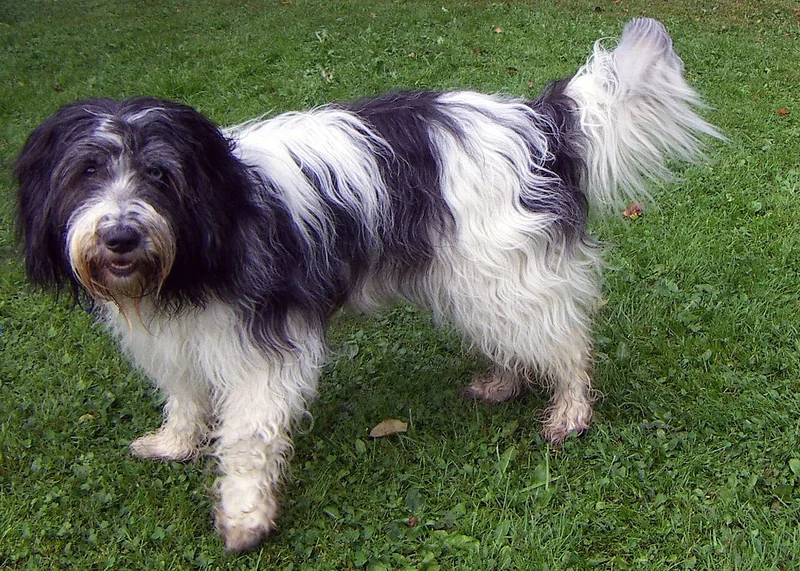 Featured photoschapendoes.jpg
The Schapendoes is a medium-sized, long-coated Dutch herding dog native to the Drenthe province, historically used by sheep farmers as a flock-driving dog. After near-extinction during World War II, the breed was revived by P.M.C. Toepoel beginning in 1954. The FCI registers it as No. 313 under the Netherlands' patronage. Males stand 43–50 cm.
Quick facts
- AKC group
- Herding
- Origin country
- Netherlands
- Origin period
- 19th century (revived 1954)
- Coat type
- Long
- Coat colors
- All colours permissible — blue-grey with black (preferred), brown, black, white
- Average lifespan
- 12-15 years
- Recognition
- FCI 1971 · Group 1 — Sheepdogs and Cattledogs (Section 1: Sheepdogs)
Origin
The Schapendoes (literally 'sheep does' — a Dutch compound meaning 'sheep-dog') was the traditional herding dog of Drenthe's 19th-century sheep farmers, who used it to drive flocks along roads and across the flat peat bogs. Its long, shaggy coat and light-footed gait suggest shared ancestry with the Bearded Collie, Old English Sheepdog, and other long-coated European herding breeds. By 1945 the breed had essentially disappeared as Dutch sheep farming modernised. Toepoel's 1954 reconstruction program was based on the few remaining specimens found in remote Drenthe farms.
Recognition
P.M.C. Toepoel standardised the breed in 1954 and founded the Nederlandse Schapendoes Club. The Raad van Beheer registered the breed, and the FCI granted recognition in 1971 under standard No. 313, assigning it to Group 1, Section 1 (Sheepdogs) with the Netherlands as patron country. The breed is not currently recognised by the AKC or UKC but is recognised by the Kennel Club (UK) and several other European registries.
Standard
The FCI standard describes a medium-sized, lightly built, slightly longer-than-tall dog with a broad, flat skull, a short, blunt muzzle, and large, forward-looking eyes. The coat is long, dense, fine, and wavy to slightly curly, giving the dog a shaggy appearance. All colours are permitted; blue-grey with black is preferred, but brown, black, white, and combinations are all accepted. Males stand 43–50 cm; females 40–47 cm, weighing 12–20 kg. The breed moves with a characteristic 'spring' in its step.
Sources & further reading (3)
- fci-standard — accessed 2026-05-27
- encyclopedia — accessed 2026-05-27
- breed-club — accessed 2026-05-27
Frequently asked questions
What does 'Schapendoes' mean?
The name is a Dutch compound word: 'schapen' means sheep (plural of 'schaap') and 'does' is an old Dutch dialectal word for a dog. Together, 'schapendoes' means 'sheepdog'. The word 'does' for dog survives in several Dutch regional dialects but is otherwise archaic in modern standard Dutch.
Is the Schapendoes AKC recognised?
The Schapendoes is not currently recognised by the AKC or UKC. The FCI has recognised the breed since 1971 under standard No. 313, and the Kennel Club (UK) recognises it as well. The breed remains relatively rare outside the Netherlands and neighbouring countries.
How was the Schapendoes revived after World War II?
P.M.C. Toepoel, a Dutch dog enthusiast and writer, found surviving Schapendoes in rural farms in the Drenthe province of the Netherlands in the late 1940s. He gathered these remaining dogs, photographed and documented them, published a breed standard in 1954, and founded the Nederlandse Schapendoes Club the same year. The reconstruction was successful, and the breed's population has since grown to a secure level in the Netherlands and wider Europe.