Canis lupus familiaris
Dutch Shepherd
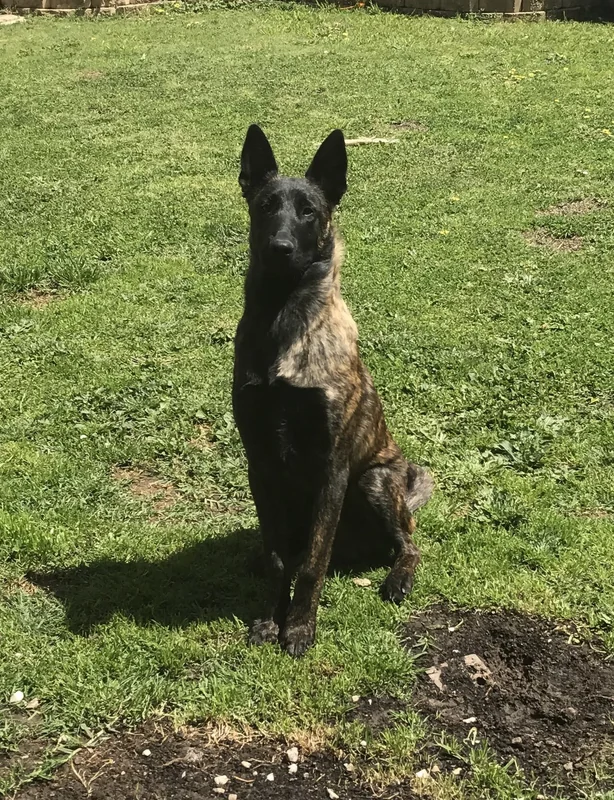 Featured photodutch-shepherd.jpg
The Dutch Shepherd is a medium-to-large Belgian-type herding dog native to the Netherlands, developed from the same Central European herding stock as the Belgian Malinois and Belgian Sheepdog. The breed exists in three coat varieties (short, long, and wire) and is always brindle in colour. It was used on Dutch farms for herding, cart pulling, and guarding from the mid-19th century. The FCI registers it as No. 223 under the Netherlands' patronage. Males stand 57–62 cm.
Quick facts
- AKC group
- Herding
- Origin country
- Netherlands
- Origin period
- Mid-19th century
- Coat type
- Short
- Coat colors
- Gold Brindle, Silver Brindle, Blue-Grey Brindle
- Average lifespan
- 11-14 years
- Recognition
- FCI 1960 · UKC 1995 · Group 1 — Sheepdogs and Cattledogs (Section 1: Sheepdogs)
Origin
The Dutch Shepherd and the Belgian Shepherd varieties share a common ancestry in the medium-sized herding dogs of the Low Countries and northern France. When the Raad van Beheer standardised the Dutch Shepherd in 1898, it required a brindle coat — the diagnostic feature that separates Dutch Shepherds from the Belgian varieties (which are never brindle). Before this standardisation, Dutch and Belgian herding dogs were often interbred. The breed's three coat varieties — short, long, and rough (wire) — reflect the practical diversity maintained by Dutch farmers across different regions.
Recognition
The Raad van Beheer (Dutch Kennel Club) standardised the Dutch Shepherd in 1898. The FCI registered the breed under standard No. 223 in 1960, classifying it in Group 1, Section 1 (Sheepdogs) with the Netherlands as patron country. The three coat varieties compete in separate classes at FCI shows. The UKC recognised the breed in 1995. The AKC has not granted full recognition; the Dutch Shepherd is in the AKC Foundation Stock Service.
Standard
The FCI standard describes a medium-to-large, well-muscled, athletic dog of balanced proportions, slightly longer than tall. The three coat varieties are short (dense, 5 cm), long (flat, 6 cm with feathering), and rough (wire, 6 cm with beard and eyebrows). Brindle is the only permitted colour: gold brindle, silver brindle, or blue-grey brindle. Tan, red, or non-brindle patterns are disqualifying. Males stand 57–62 cm; females 55–60 cm. The breed is maintained in limited numbers but is highly regarded for police and military work.
Sources & further reading (3)
- fci-standard — accessed 2026-05-27
- encyclopedia — accessed 2026-05-27
- kennel-club-registry — accessed 2026-05-27
Frequently asked questions
How does the Dutch Shepherd differ from the Belgian Malinois?
The Dutch Shepherd and Belgian Malinois are closely related herding breeds of the same general body type and size. The most obvious distinguishing feature is colour: Dutch Shepherds are always brindle (gold, silver, or blue-grey brindle), while Belgian Malinois are fawn to mahogany with a black mask. The Dutch standard was deliberately set to require brindle to distinguish the Dutch national breed from the Belgian varieties. Both breeds are widely used in police, military, and sport work.
Is the Dutch Shepherd AKC recognised?
The Dutch Shepherd is not fully recognised by the AKC but is listed in the AKC Foundation Stock Service (FSS). The FCI has recognised the breed since 1960 under standard No. 223, and the UKC since 1995.
What are the three coat varieties of the Dutch Shepherd?
The Dutch Shepherd exists in three coat varieties: short-haired (dense, harsh-textured coat approximately 5 cm long), long-haired (flat, straight, close-lying coat approximately 6 cm with feathering on the ears, backs of the legs, and tail), and rough-haired (wire-coat approximately 6 cm with a beard, eyebrows, and ruff). All three varieties are identical in build, proportions, and brindle colouration; they compete separately in FCI shows.