Canis lupus familiaris
Australian Cattle Dog
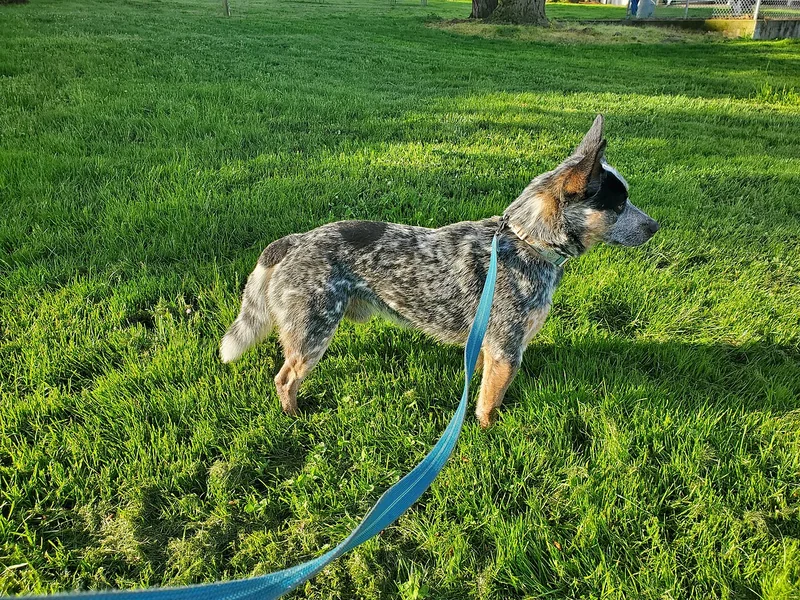 Featured photoaustralian-cattle-dog.jpg
The Australian Cattle Dog is a 19th-century New South Wales heel-nipping cattle-driver — Smithfield collie × Dingo cross. The Australian Cattle Dog was developed in 19th-century New South Wales by cattle-station owners — most importantly Thomas Hall of Muswellbrook from the 1830s onward — who crossed working blue-merle Smithfield collies (the imported British droving dog) with the Australian Dingo to produce a heat-tolerant heel-nipping cattle-driver capable of moving the long-distance droving herds across the Outback.
Quick facts
- AKC group
- Herding
- Origin country
- Australia
- Origin period
- Mid-19th century (formalized 1903)
- Coat type
- Short
- Coat colors
- Blue (with or without black, blue, or tan markings), Red Speckle
- Average lifespan
- 12-16 years
- Recognition
- AKC 1980 · FCI 1972 · UKC 1985 · Group 1 — Sheepdogs and Cattledogs (Section 2: Cattledogs)
Origin
The Australian Cattle Dog was developed in 19th-century New South Wales by cattle-station owners as the British-origin Smithfield collie (the imported droving dog of Australia's first decades) proved poorly adapted to the Australian heat and the long-distance droving conditions of the Outback. The most important foundation breeder was Thomas Simpson Hall of Muswellbrook (Hunter Valley, NSW), who from the 1830s crossed his blue-merle Smithfield collies with the Australian Dingo (the wild dog of the Australian continent, descended from a single canine introduction approximately 4,000 years ago); the resulting dogs were heat-tolerant, silent workers that drove cattle by nipping at the heels rather than by barking. Subsequent crosses with the Bull Terrier (for tenacity) and the Dalmatian (for horse-affinity and the speckled coat pattern) by George Elliott and the Bagust brothers refined the type. The modern breed standard was published by Robert Kaleski in 1903 and the AKC admitted the breed in 1980.
Recognition
The American Kennel Club admitted the breed in 1980, the United Kennel Club followed in 1985, and the Federation Cynologique Internationale published the international standard (FCI No. 287) in 1972. The FCI assigns the breed to Group 1 — Sheepdogs and Cattledogs (Section 2: Cattledogs).
Standard
The AKC and FCI standards describe a sturdy, compact, symmetrically-built working dog with great agility, strength, and endurance — ready to perform well-balanced, hard-driving cattle-droving work. The defining features are the prick ears, the broad, slightly-curved skull, the powerful, well-muscled hindquarters, and the unique speckled or mottled coat — a short, weather-resistant double coat that mottles the ground colour with darker speckles or ticks. Recognized colours are blue (with or without black, blue, or tan markings) and red speckle (with or without darker red markings). Males stand 46-51 cm at the withers, females 43-48 cm.
Sources & further reading (3)
- kennel-club-registry — accessed 2026-04-30
- encyclopedia — accessed 2026-04-30
- fci-standard — accessed 2026-04-30
Frequently asked questions
What is the Australian Cattle Dog's AKC group?
The American Kennel Club places the Australian Cattle Dog in the Herding Group. The Herding Group, carved out of the older Working Group in 1983, gathers breeds developed to control the movement of livestock — Border Collies, Australian Shepherds, Welsh Corgis, and the German Shepherd among them. The breed's foundation working role was as a 19th-century New South Wales heel-nipping cattle-driver — Smithfield collie × Dingo cross.
When was the Australian Cattle Dog officially recognized?
The American Kennel Club admitted the breed in 1980; the United Kennel Club followed in 1985; the Federation Cynologique Internationale published the international standard (FCI No. 287) in 1972.
What is the average lifespan of a Australian Cattle Dog?
Kennel-club longevity surveys place the Australian Cattle Dog's average lifespan in the 12-16 years range. The figure here represents the spread reported by the major parent-club studies and the Kennel Club (UK) purebred-dog health surveys.