Canis lupus familiaris
Appenzeller Sennenhund
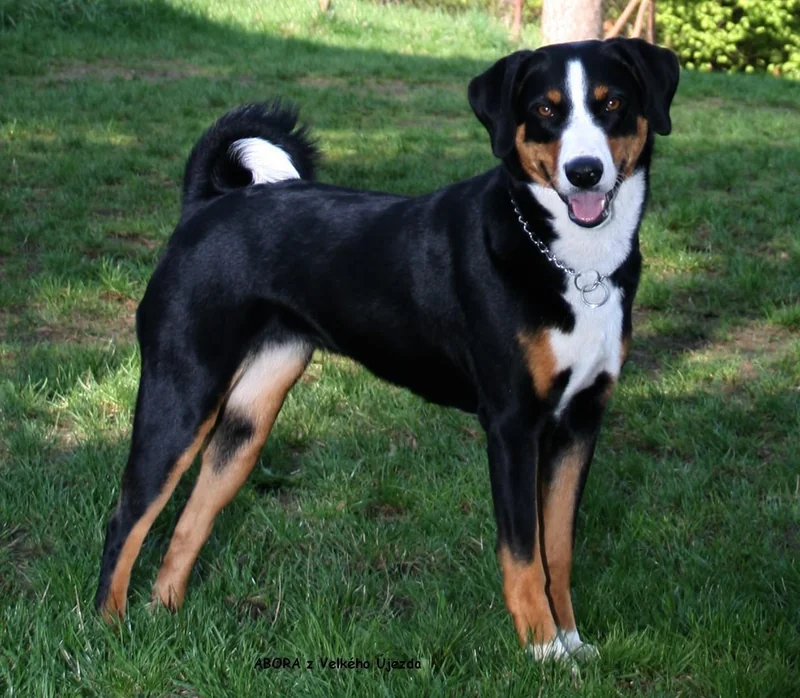 Featured photoappenzeller-sennenhund.jpg
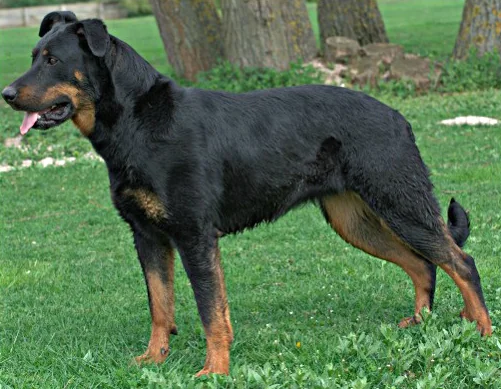
The Appenzeller Sennenhund is a medium-sized tri-colour Swiss mountain dog from the Appenzell canton of northeastern Switzerland, the smallest of the four Sennenhund breeds and the only one used primarily as a cattle drover and all-purpose farm dog rather than as a cart puller. The breed has a short, dense tri-colour coat. The FCI registers it as No. 46. The AKC lists the Appenzeller in the Foundation Stock Service. Males stand 52–56 cm.
Quick facts
- AKC group
- Herding
- Origin country
- Switzerland
- Origin period
- Ancient, standardised 1898
- Coat type
- Short
- Coat colors
- Tri-colour: Black or Havana Brown with Symmetrical Tan and White Markings
- Average lifespan
- 12-14 years
- Recognition
- FCI 1954 · Group 2 — Pinscher and Schnauzer-Molossoid Breeds, Swiss Mountain and Cattle Dogs (Section 3: Swiss Mountain and Cattle Dogs)
Origin
The Appenzeller Sennenhund — 'Sennenhund' translates as 'Alpine herdsman's dog' (from 'Senne', an Alpine dairyman) — is one of four closely related Swiss tri-colour mountain dogs. The four breeds (Grosser Schweizer Sennenhund, Berner Sennenhund, Entlebucher Sennenhund, and Appenzeller Sennenhund) share a common ancestry traced to the large, mastiff-type dogs brought to the Alps by Roman legions and subsequently crossbred with indigenous herding dogs over many centuries. The Appenzeller was specifically developed as a light, quick cattle drover for the Appenzell Alpine pastures, in contrast to the larger cart-pulling and estate-guarding roles of the other Sennenhunds.
Recognition
The naturalist Max Siber described the Appenzeller type in 1853, and it was formally described as a breed in subsequent Swiss cynological literature. The Appenzell Cattle Dog Club was founded in 1906 and codified the breed standard. The Schweizerische Kynologische Gesellschaft (Swiss Kennel Club) registered the breed, and the FCI recognised it under standard No. 46 in 1954, assigning it to Group 2, Section 3 (Swiss Mountain and Cattle Dogs) with Switzerland as patron country. The AKC lists the Appenzeller in the Foundation Stock Service.
Standard
The FCI standard describes a medium-sized, compact, strong, square-built dog with a slightly dome-shaped skull and a moderately long, tapering muzzle. The short, dense, close-lying coat is always tri-colour: jet black or Havana brown (dark liver) as the base colour, with symmetrical tan markings above the eyes, on the cheeks, chest, legs, and under the tail, and white markings on the muzzle, chest, and feet. Males stand 52–56 cm; females 50–54 cm.
Sources & further reading (3)
- fci-standard — accessed 2026-05-27
- encyclopedia — accessed 2026-05-27
- kennel-club-registry — accessed 2026-05-27
Frequently asked questions
What are the four Swiss Sennenhund breeds?
The four Swiss Sennenhund (Alpine cattle dog) breeds are: the Grosser Schweizer Sennenhund (Great Swiss Mountain Dog, FCI No. 58 — the largest), the Berner Sennenhund (Bernese Mountain Dog, FCI No. 45 — the only long-coated variety), the Appenzeller Sennenhund (FCI No. 46 — the most agile cattle drover), and the Entlebucher Sennenhund (FCI No. 47 — the smallest). All four share a tri-colour coat of black (or dark brown), tan, and white.
Is the Appenzeller Sennenhund AKC recognised?
The Appenzeller Sennenhund is not fully recognised by the AKC but is listed in the AKC Foundation Stock Service (FSS). The FCI has recognised the breed since 1954 under standard No. 46, with Switzerland as patron country.
What does 'Sennenhund' mean?
The word 'Sennenhund' combines 'Senne' (the Alpine dairyman or shepherd who moves with cattle between highland summer and lowland winter pastures) and 'Hund' (dog). It therefore means 'the Alpine dairyman's dog'. The four Swiss mountain dog breeds all carry this suffix, reflecting their shared origin as working companions of the transhumant dairy farmers of the Swiss Alps.