Canis lupus familiaris
Puli Dog
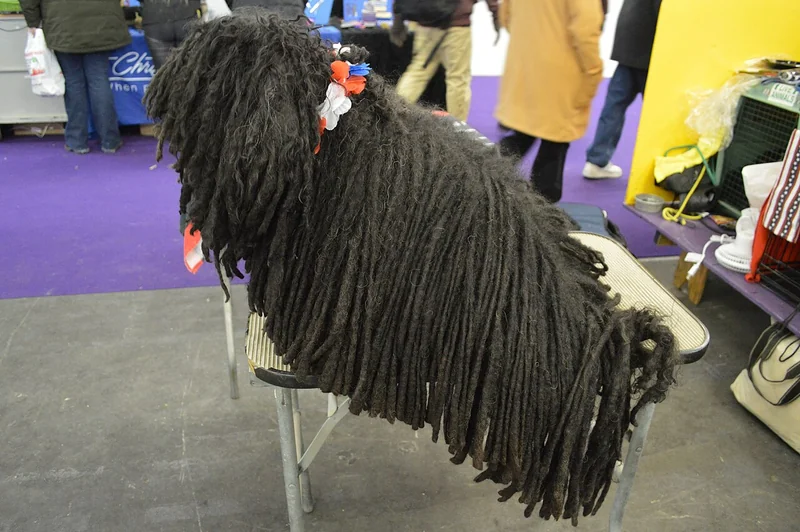 Featured photopuli.jpg
The Puli is a medium-sized Hungarian herding dog of ancient origin, famous for its long, dense, naturally corded coat that develops into rope-like cords covering the entire body. Brought to the Carpathian Basin by Magyar tribes around 895 AD, the breed was the essential sheepdog of Hungarian plains herders for over a millennium. The AKC admitted the Puli in 1936 and places it in the Herding Group. The FCI registers it as No. 55. Males stand 41–45 cm.
Quick facts
- AKC group
- Herding
- Origin country
- Hungary
- Origin period
- Ancient, brought to Hungary c. 895 AD
- Coat type
- Long
- Coat colors
- Black, Rusty Black, White, Grey
- Average lifespan
- 12-16 years
- Recognition
- AKC 1936 · FCI 1954 · UKC 1948 · Group 1 — Sheepdogs and Cattledogs (Section 1: Sheepdogs)
Origin
The Puli's ancestors were brought to the Carpathian Basin by the Magyar tribes from the eastern steppes around 895 AD; the dogs were bred on the Hungarian Great Plain (Puszta) as active, compact sheepdogs suited to driving and managing large flocks across flat terrain. Magyar herdsmen used two different sheepdog types: the large, white, heavy-coated Komondor (which guarded flocks at night) and the smaller, black Puli (which actively drove them during the day). The Puli's corded coat forms naturally from the interweaving of the soft undercoat and harsh outer coat; on working dogs the cords eventually reach the ground.
Recognition
The Magyar Ebtenyésztők Országos Egyesülete (Hungarian Dog Breeders' National Association) formalised the breed standard in the early 20th century. The AKC admitted the Puli in 1936, making it one of the earliest Eastern European herding breeds recognised in America. The FCI registered the Puli under standard No. 55 in 1954, classifying it in Group 1, Section 1 (Sheepdogs) with Hungary as patron country. The UKC followed in 1948.
Standard
The FCI and AKC standards describe a medium-small, compactly built, square dog with a strong, slightly domed skull and a blunt, medium-length muzzle. The defining feature is the coat: a dense, weatherproof double coat that naturally forms rope-like cords covering the entire body including the head and face; cords on adult dogs reach the ground. The coat colour is black (the most traditional), rusty black, white, or grey. Males stand 41–45 cm and weigh 10–15 kg. The Puli is nimble and agile despite its heavy coat.
Sources & further reading (3)
- kennel-club-registry — accessed 2026-05-27
- encyclopedia — accessed 2026-05-27
- fci-standard — accessed 2026-05-27
Frequently asked questions
Do all Puli coats naturally cord?
Yes. The Puli's coat naturally begins to form cords at approximately 6–18 months of age when the dense, wavy undercoat interweaves with the harsh, coarse outer coat and forms ropes. Without human intervention the cords form on their own, though owners typically separate them regularly to prevent them from matting into flat sheets. On a working dog living outdoors, the cords eventually grow to floor length. Show dogs and companions typically have cords maintained at a more uniform length.
When did the AKC recognise the Puli?
The AKC admitted the Puli in 1936 and places it in the Herding Group. The FCI registered the breed under standard No. 55 in 1954 with Hungary as patron country.
What is the difference between the Puli and the Komondor?
Both the Puli and the Komondor are Hungarian breeds with naturally corded coats, but they differ substantially in size, colour, and traditional working function. The Puli is medium-small (41–45 cm), black, and was used to actively drive and herd sheep during the day. The Komondor is large to giant (65–80+ cm), white, and was used to guard flocks at night against wolves and thieves. The two breeds worked together on Hungarian farms — the Puli as an agile drover and the Komondor as a guardian.