Canis lupus familiaris
Perro de Presa Canario
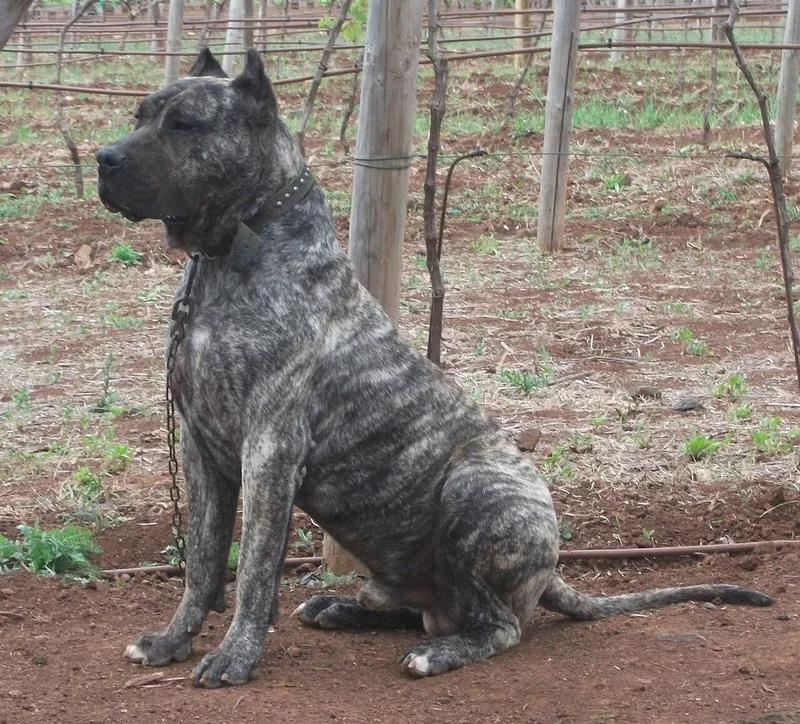 Featured photoperro-de-presa-canario.jpg
The Perro de Presa Canario is a large, powerful molosser breed native to the Canary Islands, historically used for cattle work, livestock guarding, and protection. The breed is believed to descend from ancient Iberian molossers brought by Spanish conquistadors and indigenous Canarian dogs. It nearly disappeared in the mid-20th century but was revived in the 1970s and 1980s. The FCI registers it as No. 346 under Spain's patronage. Males stand 60–66 cm and weigh 50–65 kg.
Quick facts
- AKC group
- Working
- Origin country
- Spain (Canary Islands)
- Origin period
- 16th century (revived 1970s)
- Coat type
- Short
- Coat colors
- Brindle (all shades), Fawn (sand to dark fawn), Black
- Average lifespan
- 9-11 years
- Recognition
- FCI 2001 · UKC 2003 · Group 2 — Pinscher and Schnauzer-Molossoid Breeds, Swiss Mountain and Cattle Dogs (Section 2.1: Molossoid breeds, Mastiff type)
Origin
The Canary Islands were conquered by the Spanish Crown between 1402 and 1496. Spanish settlers brought large molosser-type dogs to the archipelago for cattle work and guarding. Over the following centuries these dogs crossed with the larger indigenous 'perros majoreros' (native Canarian dogs) to produce a type suited to the volcanic terrain and subtropical climate of the islands. The resulting 'Presa' — from the Spanish 'presa' (grip or hold) — became the characteristic working dog of the Canarian agricultural tradition, used to hold cattle during veterinary procedures and to guard estates against intruders.
Recognition
The Club Español del Presa Canario (CEPRC) was founded in 1982 to standardise and revive the breed. The Real Sociedad Canina de España (RSCE) and then the FCI granted recognition in 2001 under standard No. 346, placing the breed in Group 2, Section 2.1 (Molossoid breeds, Mastiff type) with Spain as patron country. The UKC recognised the Presa Canario in 2003. The AKC has not granted full recognition. The breed is also sometimes called 'Dogo Canario' in Spain.
Standard
The FCI standard describes a large, powerful, compact, and well-proportioned mastiff with a broad, slightly convex skull, a marked stop, and a wide, moderately short muzzle. The short, flat coat shows in brindle (all shades from pale to dark), fawn (sand to dark fawn), and black; white markings are permissible on the chest, throat, and feet but not preferred. The tail is thick at the root, tapering to a point, and is not docked. Males stand 60–66 cm and weigh 50–65 kg; females 56–62 cm and 38–55 kg.
Sources & further reading (3)
- fci-standard — accessed 2026-05-27
- encyclopedia — accessed 2026-05-27
- kennel-club-registry — accessed 2026-05-27
Frequently asked questions
What does 'Presa Canario' mean?
The name translates from Spanish as 'Canarian Catch Dog' — 'presa' means grip, hold, or catch (as in the technique of holding cattle by the nose or neck), and 'Canario' refers to the Canary Islands, the breed's place of origin. The full official name is 'Perro de Presa Canario', meaning 'Canarian Catch Dog'.
Is the Presa Canario the same as the Dogo Canario?
The Presa Canario and the Dogo Canario refer to the same breed. 'Dogo Canario' is an informal name used in Spain and the Canary Islands; the official FCI name is 'Perro de Presa Canario'. The breed club in the Canary Islands uses the informal 'Dogo Canario' name in some contexts, while the mainland Spanish club uses the formal FCI name.
When was the Presa Canario recognised by the FCI?
The FCI granted provisional recognition to the Perro de Presa Canario in 2001 under standard No. 346, with Spain as patron country. The Club Español del Presa Canario had been founded in 1982 and the breed had been in revival since the 1970s. The UKC recognised the breed in 2003. The AKC has not granted full recognition.