Canis lupus familiaris
Neapolitan Mastiff
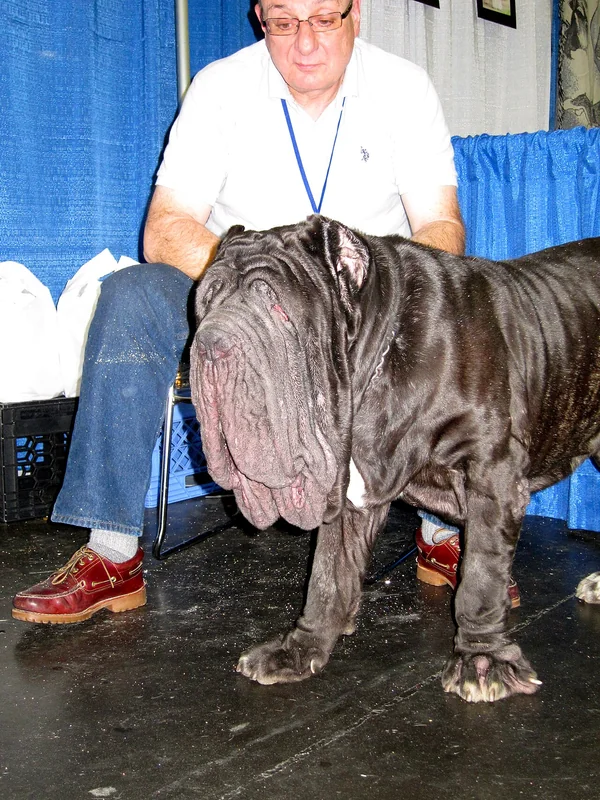 Featured photoneapolitan-mastiff.jpg
The Neapolitan Mastiff is a massive Italian molosser of ancient lineage, descended directly from the Roman war dog and used throughout the Campania region around Naples as an estate guardian for centuries. The breed is characterised by heavy wrinkles and loose skin covering the entire body and head. The AKC admitted the Neapolitan Mastiff in 2004 and places it in the Working Group. The FCI registers it as No. 197. Males stand 65–75 cm and weigh 60–70 kg.
Quick facts
- AKC group
- Working
- Origin country
- Italy
- Origin period
- Ancient, revived and standardised 1949
- Coat type
- Short
- Coat colors
- Grey, Lead Grey, Black, Mahogany, Tawny, Brindle
- Average lifespan
- 8-10 years
- Recognition
- AKC 2004 · FCI 1956 · UKC 1993 · Group 2 — Pinscher and Schnauzer-Molossoid Breeds, Swiss Mountain and Cattle Dogs (Section 2.1: Molossoid breeds, Mastiff type)
Origin
The Neapolitan Mastiff descends from the massive molosser-type war and guard dogs of the ancient world. Alexander the Great brought giant fighting dogs from India after his eastern campaigns, and Roman legions employed similar animals in warfare, in the arena (as gladiatorial beasts against other animals), and as estate guardians. In the 1st century AD, Marcus Terentius Varro's 'Rerum rusticarum' describes the large, loose-skinned guardian dogs of Italian farms. This type survived in Campania through the medieval and early modern periods in a localised, unmanaged way. Piero Scanziani, a journalist and canine enthusiast, found the remnant type at the Naples street market in 1946 and undertook systematic reconstruction.
Recognition
Piero Scanziani exhibited the first modern specimens at the Naples dog show in 1946 under the name 'Mastino Napoletano'. He drafted the breed standard in 1948 and the Ente Nazionale della Cinofilia Italiana (ENCI) granted formal recognition in 1949. The FCI registered the breed under standard No. 197 in 1956, classifying it in Group 2, Section 2.1 (Molossoid breeds, Mastiff type) with Italy as patron country. The UKC recognised the Neapolitan Mastiff in 1993 and the AKC in 2004.
Standard
The FCI and AKC standards describe an enormous, massive dog with a rectangular build slightly longer than tall. The defining characteristic is the abundance of loose skin and heavy wrinkling over the skull, face, cheeks, and neck, forming a pronounced dewlap. The short, dense, fine coat lies flat. Recognised colours include grey, lead grey, black, mahogany, tawny, and brindle; white markings on chest and feet are permissible. Males stand 65–75 cm and weigh 60–70 kg. The breed's gait is a slow, deliberate walk or slow trot.
Sources & further reading (3)
- kennel-club-registry — accessed 2026-05-27
- encyclopedia — accessed 2026-05-27
- fci-standard — accessed 2026-05-27
Frequently asked questions
When did the AKC recognise the Neapolitan Mastiff?
The AKC granted the Neapolitan Mastiff full Working Group recognition in 2004. The UKC had recognised the breed in 1993 and the FCI in 1956 under standard No. 197.
Who revived the Neapolitan Mastiff as a recognised breed?
Piero Scanziani, an Italian journalist and dog enthusiast, is credited with the modern revival. He encountered the surviving type at the Naples street market in 1946, exhibited specimens at the first post-war Naples dog show in 1946, and drafted the breed standard in 1948. The Ente Nazionale della Cinofilia Italiana recognised the breed in 1949 under the name Mastino Napoletano.
How does the Neapolitan Mastiff differ from the Mastiff?
The Neapolitan Mastiff (Mastino Napoletano) is an Italian breed characterised by extreme looseness of skin, heavy wrinkling across the entire head and body, and a more rectangular, lower-slung build than the English Mastiff. The English Mastiff is British, taller and less wrinkled, with a squarer head and a higher tail set. Both descend from ancient molosser-type dogs, but they developed independently for centuries on different traditions — the English as a war and guard dog in Britain, the Neapolitan as a regional estate guardian in southern Italy.