Canis lupus familiaris
Cane Corso
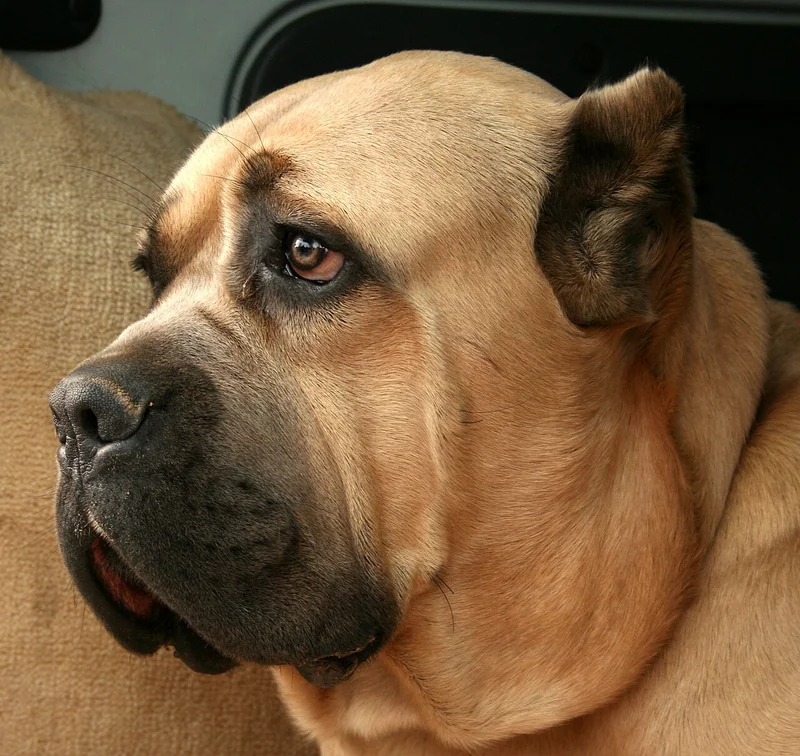 Featured photocane-corso.jpg
The Cane Corso is a Italian Roman-descended mastiff guardian, rebuilt from southern-Italy survivors in 1983. The Cane Corso (from Latin cohors, meaning 'guardian' or 'protector') is an Italian mastiff-type breed descended from the Roman canis pugnax (war dog), used across the Italian peninsula from antiquity through the modern era as a property guard, hunting dog for boar, and farm dog.
Quick facts
- AKC group
- Working
- Origin country
- Italy
- Origin period
- Roman antiquity (modern type formalized 1979)
- Coat type
- Short
- Coat colors
- Black, Grey, Fawn, Red, Brindle — all may show the breed's black or grey mask
- Average lifespan
- 9-12 years
- Recognition
- AKC 2010 · FCI 2007 · UKC 2008 · Group 2 — Pinscher and Schnauzer-Molossoid breeds-Swiss Mountain and Cattle Dogs (Section 2.1: Molossoid breeds, Mastiff type)
Origin
The Cane Corso descends from the Roman canis pugnax — a war and arena dog of the legions — and was used across the Italian peninsula from antiquity through the modern era as a property guard, hunting dog for wild boar, and general-purpose farm dog. The breed name combines the Latin canis ('dog') and cohors ('cohort, guardian, protector'). The breed nearly went extinct after the Second World War with the mechanization of Italian farming and the post-war collapse of the Italian rural economy; only a handful of dogs survived in the rural Apulia and Basilicata regions of southern Italy. Dr Paolo Breber and a group of enthusiasts founded the Società Amatori Cane Corso (SACC) in 1983 to rebuild the breed; the Ente Nazionale della Cinofilia Italiana recognized the breed in 1994 and the FCI followed in 2007.
Recognition
The American Kennel Club admitted the breed in 2010, the United Kennel Club followed in 2008, and the Federation Cynologique Internationale published the international standard (FCI No. 343) in 2007. The FCI assigns the breed to Group 2 — Pinscher and Schnauzer-Molossoid breeds-Swiss Mountain and Cattle Dogs (Section 2.1: Molossoid breeds, Mastiff type).
Standard
The AKC and FCI standards describe a sturdy dog with great athleticism, a robust and powerful but elegant build, with strongly-developed musculature. The defining features are the large, powerful head with a flat skull, a strong, deep, square muzzle, and a slightly undershot bite, and the proudly-carried high tail (traditionally docked, but the FCI now requires the tail to be left natural). The short, dense, lustrous coat lies tight to the body. Males stand 64-70 cm at the withers, females 58-66 cm.
Sources & further reading (3)
- kennel-club-registry — accessed 2026-04-30
- encyclopedia — accessed 2026-04-30
- fci-standard — accessed 2026-04-30
Frequently asked questions
What is the Cane Corso's AKC group?
The American Kennel Club places the Cane Corso in the Working Group. The Working Group gathers breeds developed for jobs other than herding or hunting — guarding, draft, sled work, and water rescue — including the Boxer, Rottweiler, Saint Bernard, and Newfoundland. The breed's foundation working role was as a Italian Roman-descended mastiff guardian, rebuilt from southern-Italy survivors in 1983.
When was the Cane Corso officially recognized?
The American Kennel Club admitted the breed in 2010; the United Kennel Club followed in 2008; the Federation Cynologique Internationale published the international standard (FCI No. 343) in 2007.
What is the average lifespan of a Cane Corso?
Kennel-club longevity surveys place the Cane Corso's average lifespan in the 9-12 years range. The figure here represents the spread reported by the major parent-club studies and the Kennel Club (UK) purebred-dog health surveys.