Canis lupus familiaris
Central Asian Shepherd Dog
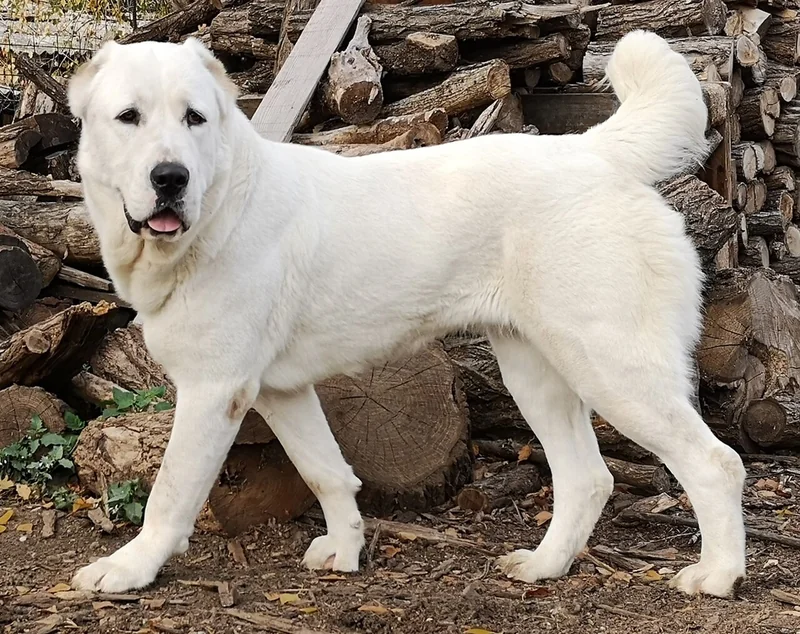 Featured photocentral-asian-shepherd-dog.jpg
The Central Asian Shepherd Dog is one of the world's oldest and most geographically widespread livestock guardian breeds, developed over thousands of years across the vast steppes of Central Asia — from the Caspian Sea through Kazakhstan, Kyrgyzstan, Afghanistan, and into Pakistan. Natural selection over four millennia by nomadic herders produced an exceptionally powerful, self-reliant guardian capable of protecting flocks from wolves and bears in extreme climates. The FCI registers it as No. 335. Males stand 65–78 cm and weigh 40–65 kg.
Quick facts
- AKC group
- Working
- Origin country
- Central Asia (Kazakhstan, Uzbekistan, Afghanistan)
- Origin period
- Ancient, over 4,000 years
- Coat type
- Double
- Coat colors
- White, Black, Grey, Straw, Red-brown, Parti-colour, Brindle
- Average lifespan
- 12-14 years
- Recognition
- FCI 1993 · UKC 2001 · Group 2 — Pinscher and Schnauzer-Molossoid Breeds, Swiss Mountain and Cattle Dogs (Section 2.2: Molossoid breeds, Mountain type)
Origin
Artefacts from the Bactria-Margiana Archaeological Complex (2300–1700 BC) and images from ancient Persian reliefs depict massive, heavy-boned livestock guardian dogs consistent with the Central Asian Shepherd Dog type. The breed was shaped entirely by natural selection and the practical needs of nomadic herders across the Central Asian steppe over at least four millennia — a span during which no formal breed management existed. Dogs that could not protect livestock from wolves, leopards, or bears, and survive extreme heat and cold, were not maintained. The result is a physically robust, psychologically self-reliant animal with remarkable stamina and an extremely strong protective instinct for its flock.
Recognition
Soviet kennel authorities standardised the breed as the 'Sredneaziatskaya Ovcharka' (Central Asian Ovcharka) in the 1970s, drawing on diverse regional specimens from across the Soviet Central Asian republics. The FCI recognised the breed as the Central Asian Shepherd Dog under standard No. 335 in 1993, classifying it in Group 2, Section 2.2 (Molossoid breeds, Mountain type) with the patronage initially shared among former Soviet republics and subsequently assigned to Russia. The UKC recognised the breed in 2001. The AKC has not granted full recognition.
Standard
The FCI standard describes a massive, long, slightly rectangular dog with a broad skull, a strong, blunt muzzle, and a well-developed, powerfully muscled body. Two coat lengths are recognised: short (approximately 3–5 cm) and long (7–10 cm), both with a dense undercoat. The colour range is extremely wide, including white, black, grey, straw, red-brown, brindle, and all parti-colour combinations. Males stand 65–78 cm and weigh 40–65 kg. The ears are traditionally cropped short and the tail docked to various lengths in the countries of origin, though this is prohibited in many European countries.
Sources & further reading (3)
- fci-standard — accessed 2026-05-27
- encyclopedia — accessed 2026-05-27
- kennel-club-registry — accessed 2026-05-27
Frequently asked questions
How old is the Central Asian Shepherd Dog?
The Central Asian Shepherd Dog is considered one of the oldest domesticated dog types still in existence, with zooarchaeological and artistic evidence placing a similar type in the Bactria-Margiana Archaeological Complex as early as 2000–2300 BC. Over at least four millennia the breed was shaped primarily by natural selection under the extreme conditions of the Central Asian steppe rather than by formal breed management.
What is the difference between the Central Asian Shepherd Dog and the Caucasian Shepherd Dog?
The Central Asian Shepherd Dog and the Caucasian Shepherd Dog are distinct FCI-registered breeds. The Caucasian (FCI No. 328) originates from the Caucasus mountain range between the Black and Caspian Seas; it is typically heavier, longer-coated, and more massive than the Central Asian type. The Central Asian (FCI No. 335) originates from the flat steppe and desert regions stretching from the Caspian east to China and south to Afghanistan; it is generally longer-legged and more athletic. Both are ancient livestock guardian breeds.
Is the Central Asian Shepherd Dog the same as the Alabai?
In Turkmenistan, the breed is known as the 'Alabai' (from the Turkic words for 'patchy' or 'varied coloured'), and the Turkmen Alabai is considered a national symbol. 'Alabai' is widely used as an informal name for the breed across Central Asia and Russia, and the breed is sometimes listed under this name in Russian registries. The FCI registers the breed under the name 'Central Asian Shepherd Dog' (standard No. 335).