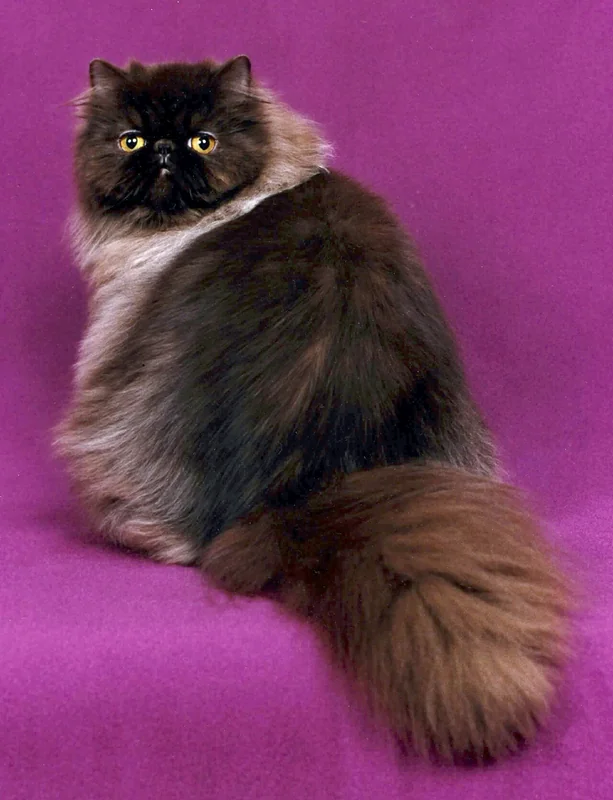
The Persian is a long-haired domestic cat breed historically associated with the region of Greater Iran. The modern show form was standardized in late-19th-century England — Persians appeared at Harrison Weir's foundational 1871 Crystal Palace cat show, and the Governing Council of the Cat Fancy registered the breed from its 1910 founding. The Cat Fanciers' Association recognized the Persian at its 1906 establishment; the FIFe standard followed in 1949. The breed presents a cobby body, brachycephalic head, and long flowing coat in many recognized colour divisions.
Quick facts
- Origin country
- Iran (historically Persia)
- Origin period
- 17th century imports to Europe; modern type formalized late 19th century
- Coat type
- Long
- Coat colors
- Solid Black, Solid White, Solid Blue, Solid Cream, Silver, Smoke, Tabby, Tortoiseshell, Calico, Bicolor, Himalayan (color point)
- Size category
- Medium
- Average lifespan
- 12-17 years
- Recognition
- CFA 1906 · TICA 1979 · GCCF 1910 · FIFe 1949
Origin
The earliest European records of long-haired cats of the Persian type appear in the correspondence of Pietro della Valle, who reports bringing specimens from the Khorasan region of Iran to Italy in 1620, and in the writings of Nicolas-Claude Fabri de Peiresc, whose Anatolian imports reached France around the same decade. The cats circulated through Italian and French aristocratic households for the next two centuries before the breed was systematized in Britain. Harrison Weir's 1871 Crystal Palace cat show — the founding event of the British cat fancy — is the documented anchor for the standardized show form.
Recognition
The Cat Fanciers' Association admitted the Persian among the founding breed group at its 1906 establishment in the United States. The Governing Council of the Cat Fancy registered the breed from its 1910 founding in the United Kingdom. The Fédération Internationale Féline published its standard at the federation's 1949 founding in continental Europe, and The International Cat Association recognized the breed at its 1979 founding in Texas. All four registries continue to maintain a current Persian standard.
Standard
The CFA standard describes a heavy-boned, cobby cat of medium size with a round head, full cheeks, small rounded ears set far apart, and large round eyes. The coat is long, thick, and stands away from the body, with a full ruff continuing into a deep frill between the front legs. Recognized colour divisions span solid (black, white, blue, red, cream, chocolate, lilac), silver and golden, shaded and smoke, tabby, particolour, bicolour, and Himalayan (color point) — the last admitted by CFA in 1984 as a Persian division rather than as a separate breed.
Sources & further reading (3)
- registry-breed-profile — accessed 2026-04-30
- encyclopedia — accessed 2026-04-30
- fife-standard — accessed 2026-04-30
Frequently asked questions
When was the Persian recognized by the major registries?
The Cat Fanciers' Association admitted the Persian among the founding breed group at its 1906 establishment. The Governing Council of the Cat Fancy registered the breed from its 1910 founding in the United Kingdom. The Fédération Internationale Féline published its standard at its 1949 founding, and The International Cat Association recognized the breed at its 1979 founding.
Where does the Persian breed originate?
Long-haired cats of the Persian type are first attested in European records from the 1620s, when Pietro della Valle is reported to have brought specimens from the Khorasan region of Iran to Italy. The modern show form was standardized in late-19th-century Britain at Harrison Weir's 1871 Crystal Palace cat show and through the early Governing Council of the Cat Fancy register.
What is the average lifespan of a Persian?
Breed-club longevity surveys consistently report an average lifespan of 12 to 17 years. The figure aggregates CFA and GCCF parent-club records and the published longevity tables from veterinary insurance datasets that cover the breed.