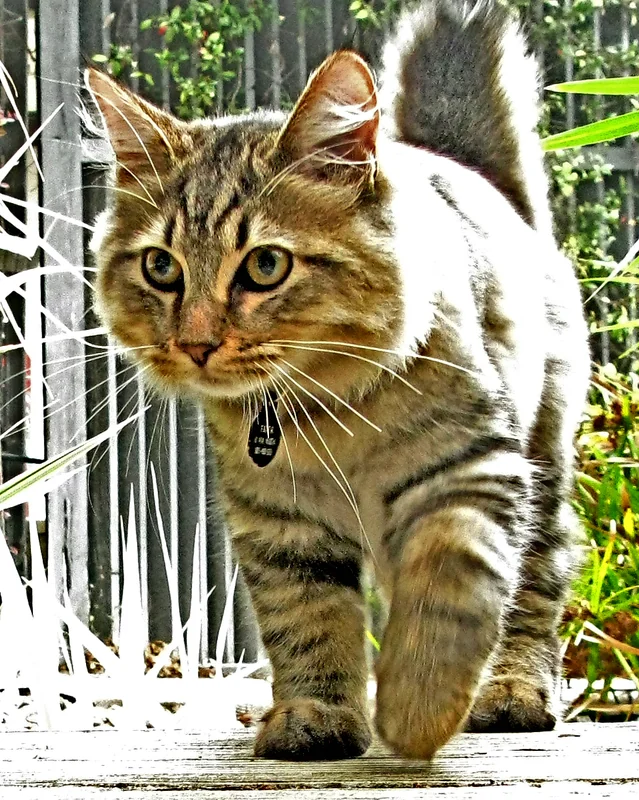
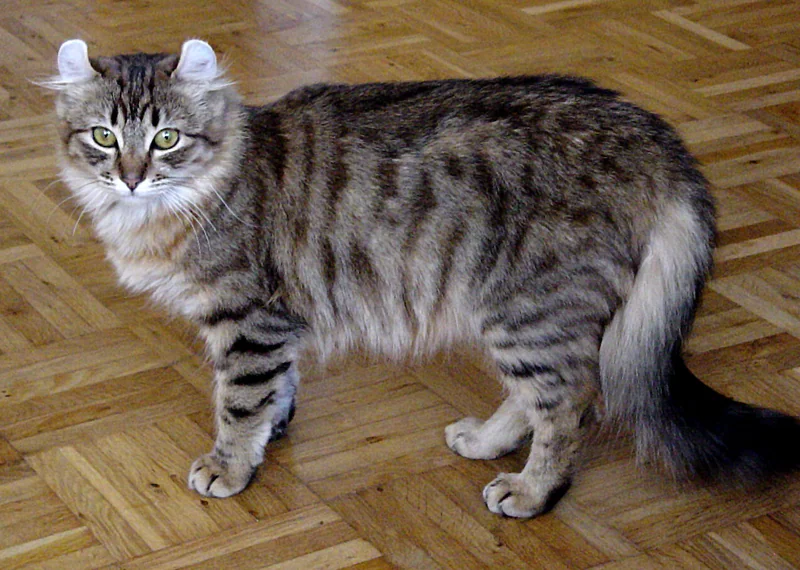
Felis catus
American Ringtail Longhair
The American Ringtail Longhair is the longhaired division of the American Ringtail, a breed developed in the United States from a naturally occurring tail-curl mutation first observed in a California stray kitten named Solomon in 1998. TICA carries the breed in its registration programme. The standard describes a medium-sized, athletic cat whose tail curls over the back or side when at rest.
Quick facts
- Origin country
- United States (California)
- Origin period
- Founding mutation observed in Solomon, a California stray, 1998; TICA registration programme
- Coat type
- Long
- Coat colors
- All colours and patterns
- Size category
- Medium
- Average lifespan
- 12–15 years
- Recognition
- —
Origin
The American Ringtail breed descends from a single naturally occurring mutation discovered in Solomon, a stray male kitten in Vallejo, California, in 1998. Solomon's tail curled over his back in a distinctive arc. Breeder Susan Manley established a selective breeding programme and brought the breed to TICA for registration. Veterinary X-ray studies have confirmed that the tail curl is flexible and involves no vertebral fusion or associated health problems.
Standard
The TICA draft standard describes a medium-sized, athletic, well-proportioned cat. The defining feature is the tail, which is long, flexible, and carried curled over the back or to the side at rest — never rigid or fused. The longhair division has a semi-long to long, silky coat with feathered tail and ear furnishings. All colours and patterns are accepted.
Breed Development History
After Solomon's discovery in 1998, breeder Susan Manley spent over a decade documenting the tail-curl trait in controlled breeding, publishing health and genetic data to support TICA registration. The breed's development followed TICA's new-breed protocol requiring documented generations, veterinary X-ray confirmation of tail health, and a formal breed club. The American Ringtail achieved registration status in the early 2000s.
Sources & further reading (2)
- encyclopedia — accessed 2026-05-27
- registry-breed-profile — accessed 2026-05-27
Frequently asked questions
Is the tail curl of the American Ringtail harmful?
No. Veterinary X-ray studies of the American Ringtail's tail confirm that the vertebrae are normal and the curl is fully flexible. This distinguishes it from conditions like tail kinking caused by vertebral fusion, which can be associated with neurological problems.
Which registries recognize the American Ringtail Longhair?
TICA carries both coat-length divisions in its registration programme. CFA, GCCF, FIFe, and WCF do not currently recognize the breed.
Is the American Ringtail Longhair's tail-curl heritable?
Yes. The tail-curl trait is heritable; crosses between Solomon's descendants and standard domestic cats produce a proportion of offspring with the curled tail. The mode of inheritance has not been fully mapped as of 2026, but the trait is consistently passed to a meaningful proportion of offspring and does not appear to be linked to any health problem.