Felis catus
American Curl Longhair
 Featured photoamerican-curl-longhair.jpg
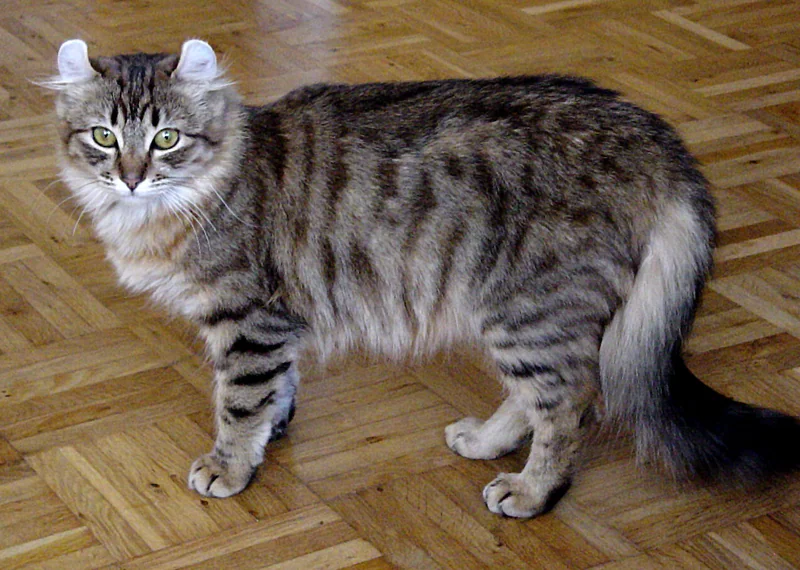
The American Curl Longhair is the semi-long-coated form of the American Curl, sharing the same uniquely backward-curling ears caused by a dominant genetic mutation first observed in California in 1981. CFA, TICA, and other registries recognize both the shorthaired and longhaired American Curl within the same breed standard but in separate show divisions. The founding cat Shulamith, discovered in Lakewood, California in 1981, was a longhaired cat, making the longhaired form the original type.
Quick facts
- Origin country
- United States
- Origin period
- Founded 1981; CFA recognition 1993; TICA recognition 1987
- Coat type
- Long
- Coat colors
- All colors and patterns accepted
- Size category
- Medium
- Average lifespan
- 12-16 years
- Recognition
- CFA 1993 · TICA 1987
Founding and Genetics
The American Curl's breed history begins with Shulamith, a semi-longhaired black cat with unusually backward-curling ears found in Lakewood, California in 1981. Her first litter included two curled-ear kittens, confirming the trait as heritable. Geneticist Roy Robinson studied the breed and determined the ear curl is caused by a dominant autosomal gene (Curl gene) that affects cartilage in the ear, causing it to curl backward rather than folding forward. The gene is not associated with deafness or other health problems. Because the curl gene is dominant, all Curls carry only one copy (heterozygous); homozygous breeding has not been documented as problematic.
Ear Development
Kittens are born with straight ears that begin to curl backward within the first few days of life. The degree of curl increases over the first few months, reaching its final degree by approximately 4 months of age. CFA and TICA standards recognize three curl degrees: first degree (slight curl, pet quality only), second degree (moderate curl, show quality), and third degree (arc of 90-180 degrees, maximum show quality). The ears must remain flexible and not curl forward like a Fold's ears; they should feel firm but mobile. The cartilage that causes the curl is different from the fold mutation in Scottish Folds and is not associated with skeletal problems.
Longhaired Standard
The American Curl Longhair standard describes a semi-long, silky coat with minimal undercoat, providing a flowing, feathered appearance without the dense cottony texture of heavier longhaired breeds. The tail is a full plume. The body is moderate and moderately foreign in type: neither cobby nor tubular, with a rectangular silhouette. All colors and patterns are accepted. The longhaired form is considered the original type as the founding cat Shulamith was semi-longhaired; the shorthaired form emerged from subsequent breedings that uncovered cats carrying the short-hair allele.
Sources & further reading (2)
- registry-breed-profile — accessed 2026-05-07
- encyclopedia — accessed 2026-05-07
Frequently asked questions
Is the American Curl ear curl the same as the Scottish Fold?
No. The Scottish Fold's ear-fold mutation causes cartilage defects throughout the body, leading to osteochondrodysplasia in homozygous cats. The American Curl's ear-curl mutation affects only the cartilage of the outer ear, is not associated with systemic skeletal disease, and has been found safe in both heterozygous and homozygous forms. The two mutations are genetically unrelated.
Which came first, the longhaired or shorthaired American Curl?
The founding cat Shulamith was a semi-longhaired cat, making the longhaired form technically the original type. The shorthaired form emerged when breeding programs introduced cats carrying the short-hair allele. CFA recognized both forms simultaneously in 1993; TICA recognized both simultaneously in 1987.
What degree of ear curl is required for show quality?
CFA and TICA recognize three degrees of curl. Second-degree curls (moderate arc) and third-degree curls (arc of 90-180 degrees) are considered show quality. First-degree curls (slight tilt) are considered pet quality only. The ear must remain mobile and flexible; stiff ears that cannot be gently straightened are a fault.