Felis catus
Moscow Rex
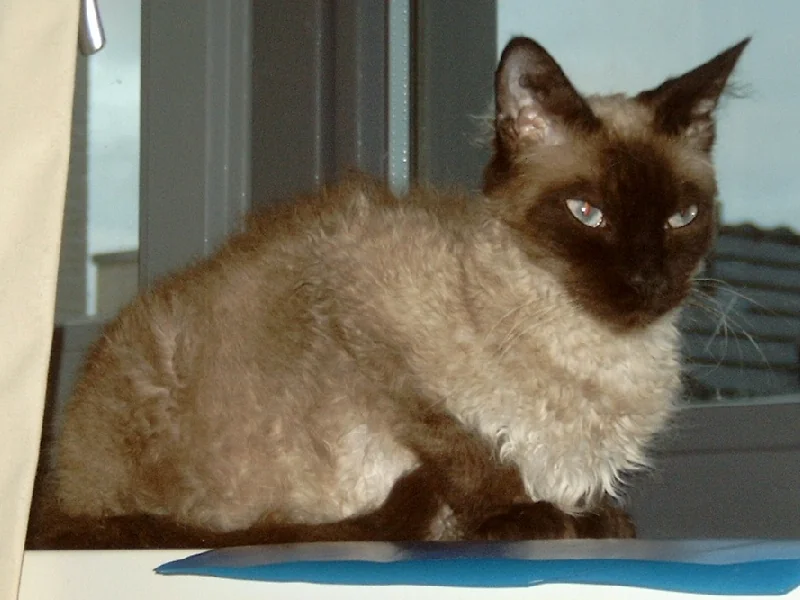
The Moscow Rex is a natural curly-coat mutation documented in the Moscow region of Russia in the 1990s. Like other Rex breeds, the Moscow Rex carries a recessive gene producing a soft, wavy or curly coat. It was registered with the Russian Felinological Federation (SFF) and received World Cat Federation (WCF) recognition. The Moscow Rex has a moderate foreign-type body, medium build, and curly whiskers alongside the characteristic Rex coat. It remains a rare breed confined primarily to Russian cat fancy circles.
Quick facts
- Origin country
- Russia (Moscow)
- Origin period
- 1990s natural curly-coat mutation, Moscow; SFF registration
- Coat type
- Curly
- Coat colors
- All colours and patterns recognized
- Size category
- Medium
- Average lifespan
- 12-15 years
- Recognition
- —
Origin
The Moscow Rex mutation appeared in Moscow-area domestic cats in the 1990s. The recessive gene produces soft, wavy guard hairs and curly whiskers. Genetic testing has confirmed the Moscow Rex mutation is distinct from those of the Cornish Rex, Devon Rex, and Ural Rex, making it one of several independently arising Russian Rex breeds developed from separate mutations.
Standard
The Moscow Rex standard describes a medium-sized, moderately built cat without the extreme elongation of some Oriental-type Rex breeds. The head is a modified wedge; ears are medium-large; eyes are almond-shaped. The defining trait is the curly coat: soft, wavy to curly guard hairs covering a slightly sparse but even coat layer, with curly or wavy whiskers. All colours are permitted.
Rex Mutation Genetics
The Moscow Rex carries a recessive rex mutation distinct from the Cornish Rex (gene r), Devon Rex (gene re), German Rex, and other rex variants. Cross-testing between the Moscow Rex and other rex breeds confirmed the allelic independence of the Moscow mutation. The curly coat results from a modified cortex structure in the guard hairs and awn hairs, producing soft, wavy curls. The SFF and WCF standards describe the coat as short to medium with soft, wavy or rippled curls.
Sources & further reading (1)
- encyclopedia — accessed 2026-05-27
Frequently asked questions
How does the Moscow Rex differ from the Ural Rex?
Both the Moscow Rex and Ural Rex are Russian curly-coat breeds arising from separate natural mutations in different geographic regions of Russia. The Ural Rex originated in the Ural Mountains region and is tighter-curled and slightly smaller in body than the Moscow Rex, which has a more moderate foreign-type build. Genetic testing has confirmed the two mutations are not allelic.
How is the Moscow Rex different from the Cornish Rex?
The Moscow Rex's curly coat results from a different recessive gene than the Cornish Rex (gene r). Cross-testing between the two breeds produces straight-coated offspring, confirming the mutations are not allelic. The Moscow Rex originated in Russia and is recognized by the WCF and Russian registries; the Cornish Rex is recognized by all major international registries including CFA, TICA, GCCF, and FIFe.
Is the Moscow Rex recognized outside Russia?
The Moscow Rex is recognized by the WCF and Russian felinological bodies. CFA, TICA, GCCF, and FIFe do not carry the breed internationally. The WCF recognition allows Moscow Rex cats to be shown at WCF-affiliated shows across Europe and other WCF member countries.