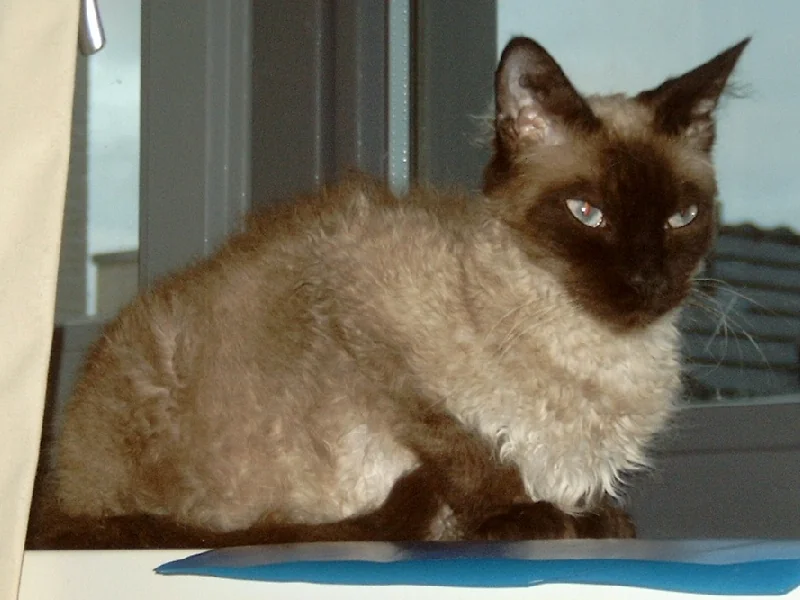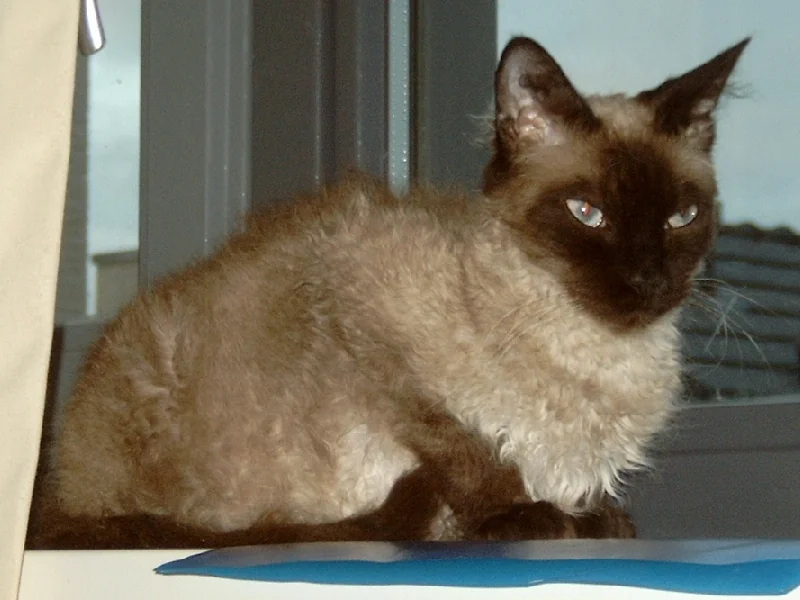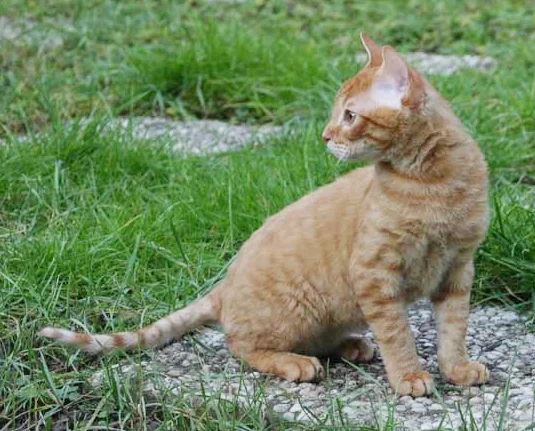
The German Rex is the earliest documented natural curly-coat mutation in domestic cats. The foundation cat, Lammchen, was observed in East Berlin in 1947 by Dr. Rose Scheuer-Karpin. Breeding work was delayed by post-war conditions; formal development began in the 1950s. FIFe recognized the German Rex in 1982. CFA, TICA, and GCCF have not published German Rex standards. The Rex coat gene (gene r — Cornish Rex gene) is allelic with the Cornish Rex mutation, which appeared three years after Lammchen's documentation.
Quick facts
- Origin country
- Germany (East Berlin)
- Origin period
- 1947 first observed (Lammchen, Dr. Rose Scheuer-Karpin); FIFe championship 1982
- Coat type
- Curly
- Coat colors
- All colours and patterns recognized
- Size category
- Medium
- Average lifespan
- 9-14 years
- Recognition
- FIFe 1982
Origin
Dr. Rose Scheuer-Karpin observed a black female cat with a curly coat on the grounds of the Hufeland Hospital in East Berlin in 1947 and named her Lammchen ('little lamb'). Lammchen is the earliest documented naturally occurring curly-coat mutation in domestic cats — predating the Cornish Rex Kallibunker (1950) by three years. Post-war conditions in East Germany delayed any formal breeding programme until 1957, when Lammchen was bred with one of her own descendants and produced curly-coated offspring. Genetic crosses with Cornish Rex stock subsequently confirmed that the German Rex mutation is allelic with the Cornish r gene.
Recognition
The Fédération Internationale Féline recognized the German Rex in 1982. The Cat Fanciers' Association, TICA, and GCCF have not published German Rex standards. The breed is shown primarily through FIFe-affiliated bodies in Germany and Continental Europe. The shared mutation with the Cornish Rex has limited interest in maintaining the German Rex as a separately recognized breed in non-European registries.
Standard
The FIFe standard describes a medium-sized, muscular cat with a moderate-foreign body type — heavier than the Cornish Rex but lighter than the British Shorthair. The head is rounded with full cheeks and a medium-length straight nose. The ears are medium-sized and rounded at the tips. The coat is short, soft, and curly or wavy across the entire body. The whiskers are short, brittle, and curly. All colours and patterns are recognized.
Sources & further reading (3)
- fife-standard — accessed 2026-04-30
- encyclopedia — accessed 2026-04-30
- registry-standard — accessed 2026-04-30
Frequently asked questions
How does the German Rex differ from the Cornish Rex?
The German Rex (1947) and the Cornish Rex (1950) carry the same recessive r gene mutation — they are genetically allelic. The breeds differ in conformation: the German Rex has a more moderate, rounded body and head, while the Cornish Rex has a slender, long-bodied, narrow-headed conformation. FIFe maintains the German Rex as a separately recognized breed reflecting its earlier and independent origin.
When was the German Rex recognized?
FIFe recognized the German Rex in 1982. CFA, TICA, and GCCF have not published German Rex standards. The breed is shown primarily through FIFe-affiliated bodies in Germany and Continental Europe.
Why is the German Rex rare today?
Post-war conditions in East Germany delayed breeding until 1957, and the small foundation population limited early development. The shared mutation with the Cornish Rex (which gained earlier recognition in CFA and TICA) further limited interest in the German Rex as a distinct breed in non-European registries. The breed remains numerically rare, primarily maintained by German breed clubs.